- Fungi Including Lichens
- ›Basidiomycete Fungi
- ›Higher Basidiomycetes
- ›Mushrooms, Bracket Fungi, Puffballs, and Allies
- ›Agaricomycetidae
- ›boletes and allies
- ›boletes
- ›Pseudoboletus
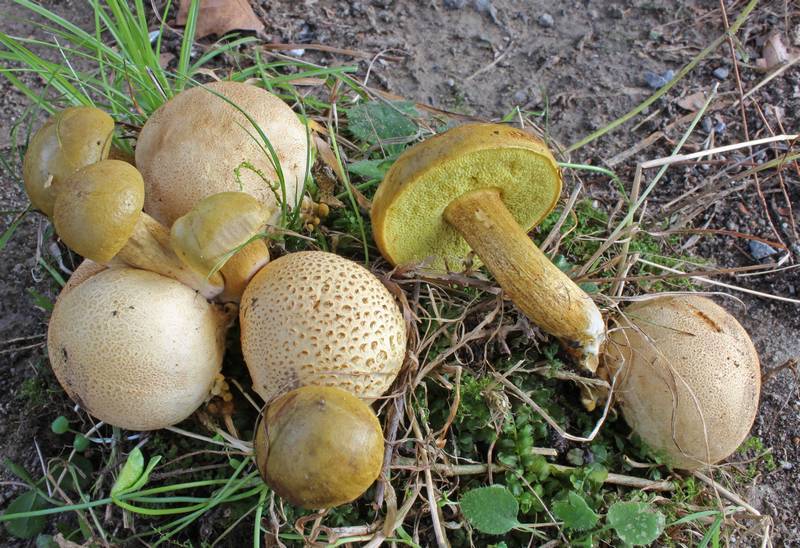
Parasitic Bolete
Pseudoboletus parasiticus
Pseudoboletus parasiticus, previously known as Boletus parasiticus and Xerocomus parasiticus, commonly known as the parasitic bolete is a rare, inedible Boletaceae mushroom found on earthballs (Scleroderma citrinum). Pseudoboletus parasiticus is one of the early most diverging lineages of the Boletaceae, the lineage of Chalciporus spp and Buchwaldoboletus lignicola is the most basal lineage in the Boletaceae.
From the article Pseudoboletus parasiticus on Wikipedia (CC BY-SA), quoted section by section
Description
The cap is hemispherical when young, later flat, yellowish brown or darker and up to 6 centimetres (2+1⁄4 in) wide. The yellow stem is 3–7 cm (1–3 in) tall and 6–15 millimetres (1⁄4–5⁄8 in) thick. The flesh is pale yellow and the spore print is olive brown.
Range & habitat
It can be found growing on Scleroderma citrinum earthballs in eastern North America from July to September.
Wikipedia: “Habitat and distribution”
At the table
While edible, it is not recommended to do so, due to concerns about being poisoned by its host, the common earthball, which is poisonous.
Wikipedia: “Edibility”
Where it lives
Recorded sightings
—
geo-referenced records in GBIF, from museums, herbaria and field observers.
Drag the globe to turn it. Dots are where records exist, not a range map; darker means more records.
In the stacks
Searching the stacks…
Every page naming Pseudoboletus parasiticus in the Biodiversity Heritage Library →
This page is assembled live from iNaturalist, GBIF, Wikipedia, the Source Library and the Internet Archive. It is not yet part of the hand-edited codex. iNaturalist taxon 125724.