- Plants
- ›Vascular Plants
- ›flowering plants
- ›monocots
- ›grasses, sedges, cattails, and allies
- ›grasses
- ›Panicums, Bluestems, Paspalums, and Allies
- ›bristle, rosette, and barnyard grasses, and allies
- ›Panicinae
- ›Panicum
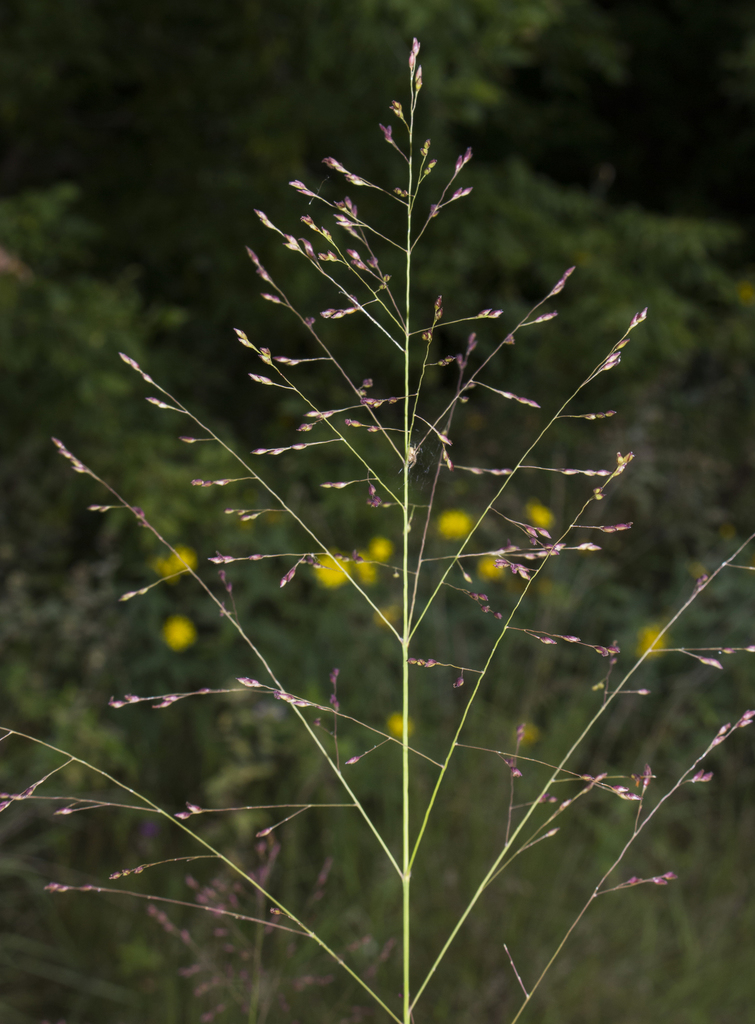
switchgrass
Panicum virgatum
Panicum virgatum, commonly known as switchgrass and panic grass, is a perennial warm season bunchgrass native to North America, where it occurs naturally from 55°N latitude in Canada southwards into the United States and Mexico. Switchgrass is one of the dominant species of the central North American tallgrass prairie and can be found in remnant prairies, in native grass pastures, and naturalized along roadsides. It is used primarily for soil conservation, forage production, game cover, as an ornamental grass, in phytoremediation projects, fiber, electricity, heat production, for biosequestration of atmospheric carbon dioxide, and more recently as a biomass crop for the production of ethanol and butanol.
Other common names for switchgrass include tall panic grass, Wobsqua grass, blackbent, tall prairiegrass, wild redtop, thatchgrass, and Virginia switchgrass.
From the article Panicum virgatum on Wikipedia (CC BY-SA), quoted section by section
Description
Switchgrass is a hardy, deep-rooted, perennial rhizomatous grass that begins growth in late spring. It can grow up to 2.7 m (8 ft 10 in) high, but is typically shorter than big bluestem grass or indiangrass. The leaves are 30–90 cm (12–35 in) long, with a prominent midrib. Switchgrass uses C4 carbon fixation, giving it an advantage in conditions of drought and high temperature. Its flowers have a well-developed panicle, often up to 60 cm (24 in) long, and it bears a good crop of seeds. The seeds are 3–6 mm (1⁄8–1⁄4 in) long and up to 1.5 mm (1⁄16 in) wide, and are developed from a single-flowered spikelet. Both glumes are present and well developed. When ripe, the seeds sometimes take on a pink or dull-purple tinge, and turn golden brown with the foliage of the plant in the fall. Switchgrass is both a perennial and self-seeding crop, which means farmers do not have to plant and reseed after annual harvesting. Once established, a switchgrass stand can survive for ten years or longer. Unlike corn, switchgrass can grow on marginal lands and requires relatively modest levels of chemical fertilizers. Overall, it is considered a resource-efficient, low-input crop for producing bioenergy from farmland.
Range & habitat
Much of North America, especially the prairies of the Midwestern United States, was once prime habitat to vast swaths of native grasses, including switchgrass, indiangrass (Sorghastrum nutans), eastern gamagrass (Tripsacum dactyloides), big bluestem (Andropogon gerardi), little bluestem (Schizachyrium scoparium) and others. As European settlers began spreading west across the continent, the native grasses were plowed under and the land converted to crops such as corn, wheat, and oats. Introduced grasses such as fescue, bluegrass, and orchardgrass also replaced the native grasses for use as hay and pasture for cattle.
Wikipedia: “Habitat”
At the table
Switchgrass can be used as a feedstock for biomass energy production, as ground cover for soil conservation, and to control erosion, for forages and grazing, as game cover, and as feedstock for biodegradable plastics. It can be used by cattle farmers for hay and pasture and as a substitute for wheat straw in many applications, including livestock bedding, straw bale housing, and as a substrate for growing mushrooms. Additionally, switchgrass is grown as a drought-resistant ornamental grass in average to wet soils and in full sun to part shade.
Moth host plant. It is the preferred larval host plant of Dargida rubripennis. It is also a larval host for the Delaware skipper and the Hobomok skipper.
Bioenergy. Switchgrass has been studied as a potential renewable bioenergy crop since the mid-1980s, because it is a native perennial warm season grass with the ability to produce moderate to high yields on marginal farmlands. It is now being considered for use in several bioenergy conversion processes, including cellulosic ethanol production, biogas, and direct combustion for thermal energy applications. …
Wikipedia: “Uses”
Where it lives
Recorded sightings
—
geo-referenced records in GBIF, from museums, herbaria and field observers.
Drag the globe to turn it. Dots are where records exist, not a range map; darker means more records.
In the stacks
Searching the stacks…
Every page naming Panicum virgatum in the Biodiversity Heritage Library →
This page is assembled live from iNaturalist, GBIF, Wikipedia, the Source Library and the Internet Archive. It is not yet part of the hand-edited codex. iNaturalist taxon 125727.