- Fungi Including Lichens
- ›Basidiomycete Fungi
- ›Higher Basidiomycetes
- ›Mushrooms, Bracket Fungi, Puffballs, and Allies
- ›Phallomycetidae
- ›stinkhorns and allies
- ›stinkhorns
- ›Phallus
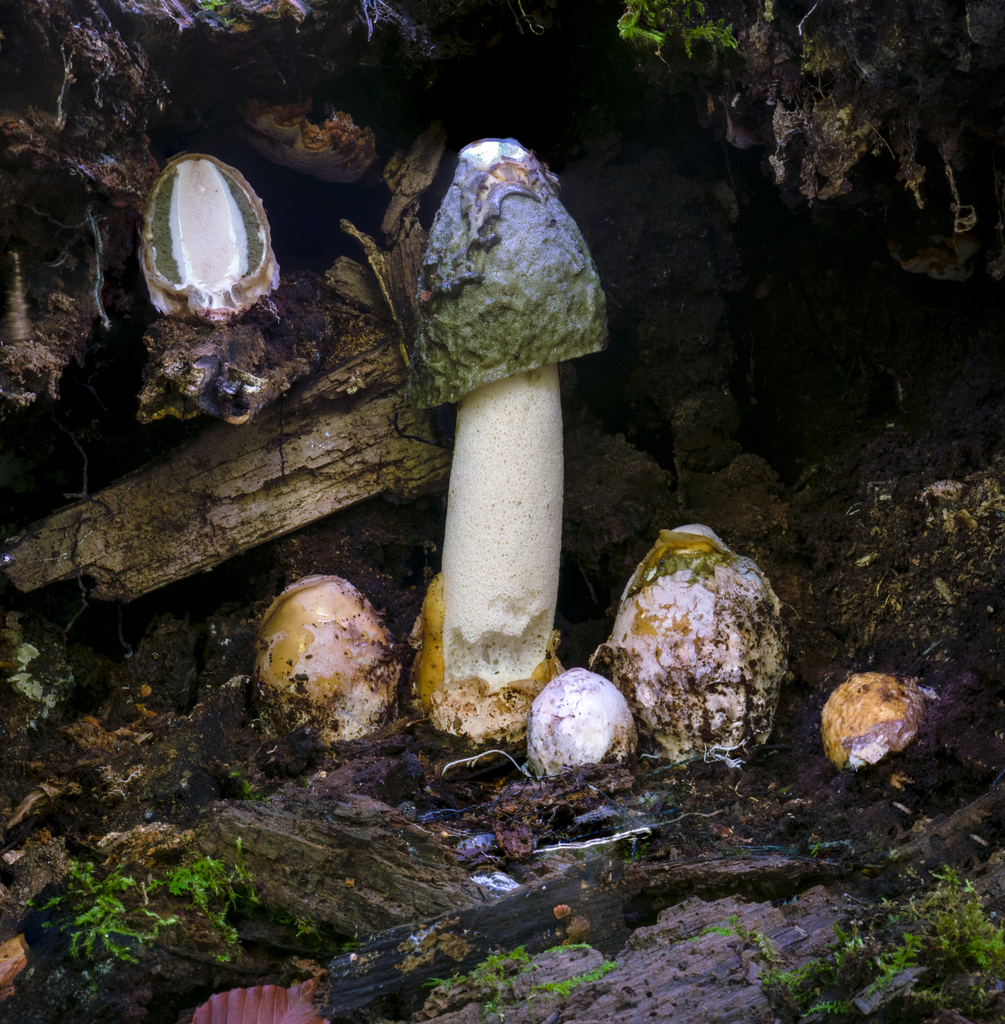
Ravenel's stinkhorn
Phallus ravenelii
Phallus ravenelii, commonly known as Ravenel's stinkhorn, is a fungus in the Phallaceae (stinkhorn) family. It is found in eastern North America. Its mushrooms commonly grow in large clusters and are noted for their foul odor and phallic shape when mature. It is saprobic, and as such it is encountered in a wide variety of habitats rich in wood debris, from forests to mulched gardens or sawdust piles in urban areas. It appears from August to October. The fruit body emerges from a pink or lavender-colored egg to form a tall, cylindrical, hollow and spongy white stalk with a bell-shaped cap. The remains of the egg persist as a white to pink or lilac volva at the base of the stalk. The cap is covered in a foul-smelling olive-green spore slime, which attracts insects that help to spread the spores. Sometimes, the cap has a "veil" attached—a thin membrane that hangs underneath. The lack of a roughly ridged and pitted cap differentiates it from the closely related Phallus impudicus. The fungus is named after Henry William Ravenel, a botanist who first discovered it in 1846, though it remained undescribed until 1873. It is considered to be an edible mushroom while in its egg form.
From the article Phallus ravenelii on Wikipedia (CC BY-SA), quoted section by section
Description
The mushroom begins its development in the form of pink-, lilac-, or purple-tinged "eggs" that resemble a puffball. The egg expands rapidly to form a phallus-shaped structure with a yellowish-white stalk and thimble-like cap. The cap ranges from 1.5 to 4 cm (0.6 to 1.6 in) in width and 3 to 4.5 cm (1.2 to 1.8 in) in height; the entire fruit body can reach heights of 20 cm (7.9 in). The cap texture is finely granular and it is attached to a white open circlet at the top where it meets the stalk. In some specimens, this opening is relatively large with a broad margin, and gives the mushroom a truncated appearance. Microscopically, the cap surfaces comprises minute cells and cavities, with a spongy structure similar to that of the stem, but with smaller perforations than the stem. The lower margin of the cap is free from attachment to the stalk, and there is sometimes a membranous veil suspended like a collar around the stem under the cap; the veil can be of varying lengths. This veil can be seen in dissected eggs where it is present as a distinct, thin membranous tissue between the stalk and the cap before expansion. In this form, the veil is continuous from its attachment with the "primordial tissue" at the base of the stalk and volva below to the tip of the stem at the point where it joins the cap. The veil produced in P. …
Range & habitat
Ravenel's stinkhorn is widespread in eastern North America, from Quebec in the north, south to Florida and west to Iowa and Ohio. West of the Mississippi, the common stinkhorn (Phallus impudicus) becomes more dominant. In the early 1900s, Lloyd called it the most common phalloid in the United States. The fungus is also found in Costa Rica. As a saprobic mushroom, or decomposer of organic material, Ravenel's stinkhorn can be found in almost any habitat that includes decaying wood. They are most often found growing in groups, though occasionally singly, on wood chips, rotten tree stumps or sawdust. They are common in urban flowerbeds, parks and lawns, as well as in meadows, cultivated areas and woods. The foul odor of the gleba attracts insects that walk and feed on the spore-bearing surface, and later disseminate the sticky spores to other locales.
Wikipedia: “Distribution and habitat”
Where it lives
Recorded sightings
—
geo-referenced records in GBIF, from museums, herbaria and field observers.
Drag the globe to turn it. Dots are where records exist, not a range map; darker means more records.
In the stacks
Searching the stacks…
Every page naming Phallus ravenelii in the Biodiversity Heritage Library →
This page is assembled live from iNaturalist, GBIF, Wikipedia, the Source Library and the Internet Archive. It is not yet part of the hand-edited codex. iNaturalist taxon 125743.