- Fungi Including Lichens
- ›Ascomycete Fungi
- ›Sac Fungi and Lichens
- ›Sordariomycetes
- ›Hypocreomycetidae
- ›Hypocreales
- ›Hypocreaceae
- ›Hypomyces
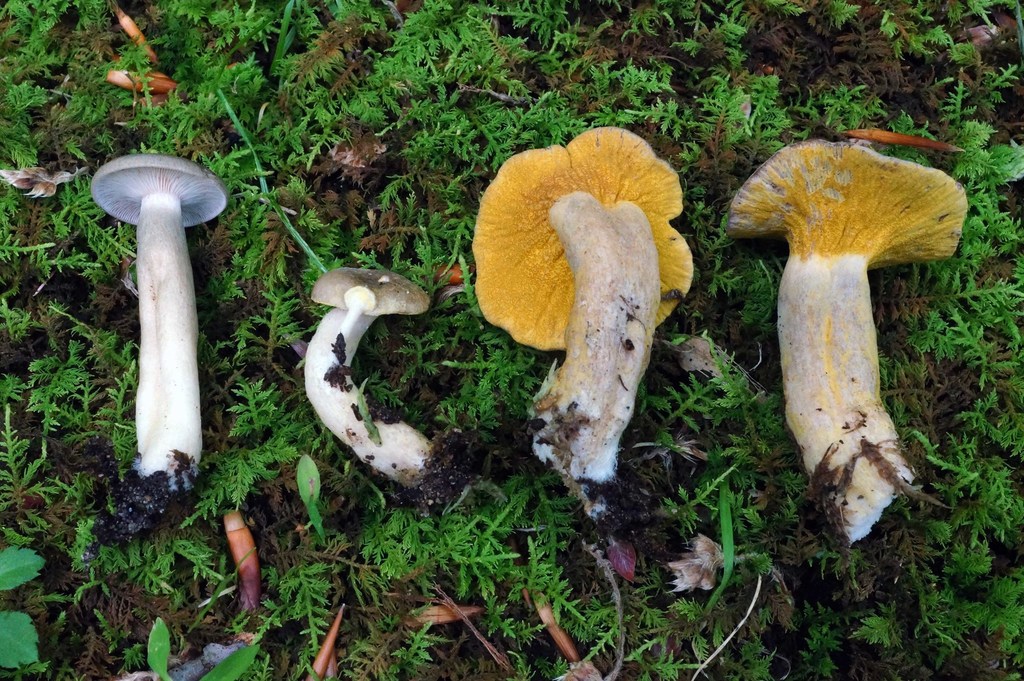
Yellow-green Russula Mold
Hypomyces luteovirens
Hypomyces luteovirens, commonly known as the green langoustine, is a parasitic fungus in the genus Hypomyces. It is a green mold that grows on certain Russula mushrooms. It sometimes grows on Lactarius species. It is not recommended for consumption, because its host species and host edibility are largely unknown.
From the article Hypomyces luteovirens on Wikipedia (CC BY-SA), quoted section by section
Description
The fruiting body of Hypomyces luteovirens is a crusty, bumpy moldlike structure that grows on certain Russula and Lactarius mushrooms. It starts out white or yellow, becoming light green and eventually dark green as it matures. The fungus rarely covers the cap of its host and typically only covers the gills and upper stipe. The fungus makes its host's gills look more shallow, destroying their structure. H. luteovirens produces tiny parathecia in order to release its spores.
Range & habitat
Hypomyces luteovirens is a parasite to Russula mushrooms, especially purple and red ones. It also sometimes grows on Lactarius mushrooms.
== References ==
Wikipedia: “Habitat and ecology”
Where it lives
Recorded sightings
—
geo-referenced records in GBIF, from museums, herbaria and field observers.
Drag the globe to turn it. Dots are where records exist, not a range map; darker means more records.
In the stacks
Searching the stacks…
Every page naming Hypomyces luteovirens in the Biodiversity Heritage Library →
This page is assembled live from iNaturalist, GBIF, Wikipedia, the Source Library and the Internet Archive. It is not yet part of the hand-edited codex. iNaturalist taxon 125774.