- Plants
- ›Vascular Plants
- ›flowering plants
- ›Dicots
- ›Legumes, Milkworts, and Allies
- ›Legumes
- ›Faboideae
- ›Peas, Vetches, and Allies
- ›Lathyrus
- ›Pratenses
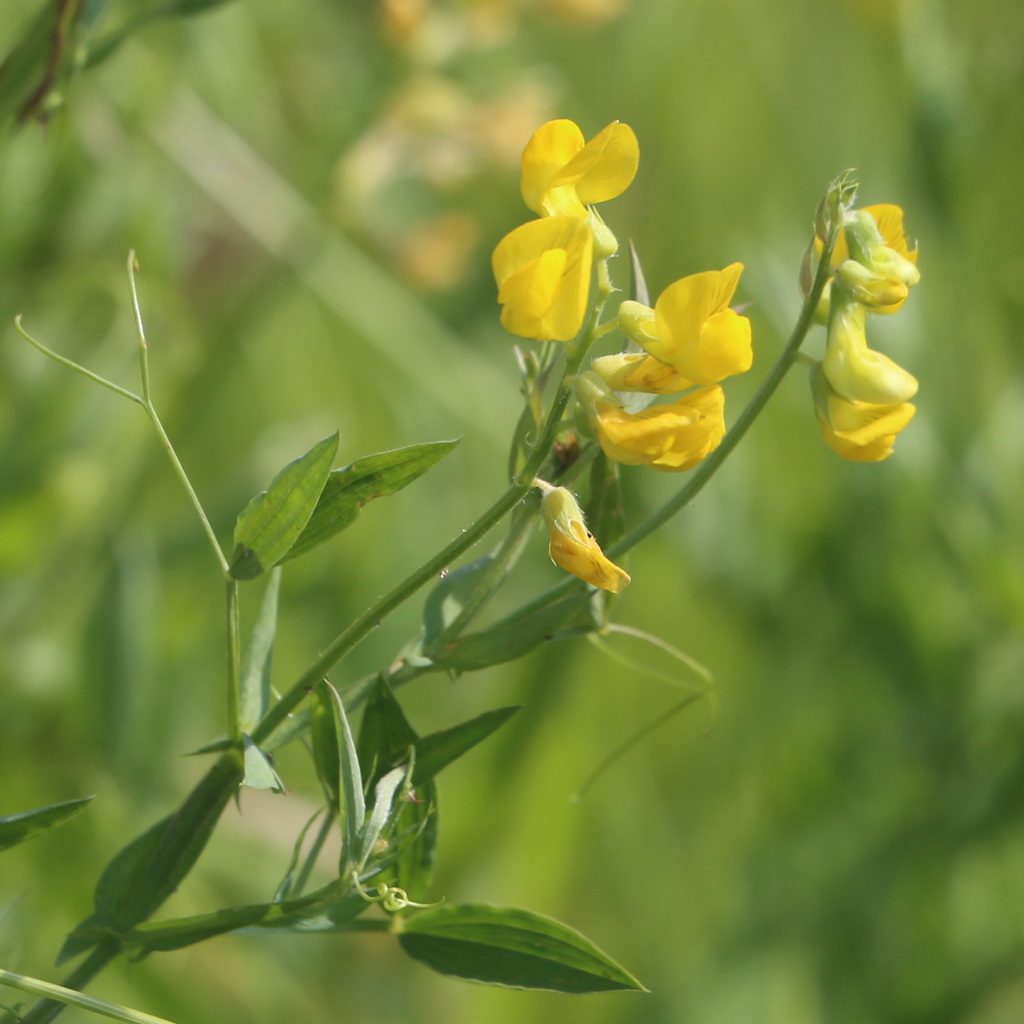
meadow pea
Lathyrus pratensis
Lathyrus pratensis or meadow vetchling, yellow pea, meadow pea and meadow pea-vine, is a perennial legume that grows to 1.2 m in height.
The hermaphrodite flowers are pollinated by bees. As a perennial, this plant reproduces itself over many years, spreading out from the point it was introduced, especially in damp grassy areas. This plant has been propagated in the past as animal fodder.
From the article Lathyrus pratensis on Wikipedia (CC BY-SA), quoted section by section
Description
Meadow vetchling is a perennial plant with a limp, unwinged stem that grows to 25 to 60 cm (10 to 24 in) and is erect and hairy. The leaves are alternate with short stalks and large stipules. The leaf blades are pinnate with a single pair of broad lanceolate leaflets with blunt tips, entire margins and a terminal unbranched tendril. The inflorescence has a long stem and a cluster of five to twelve yellow flowers, each 10 to 16 mm (0.4 to 0.6 in) long. These have five sepals and five petals and are irregular. The uppermost petal is known as the "standard", the lateral two as the "wings" and the lowest two are joined to form the "keel". There are ten stamens and a single carpel. The fruit is a long black pod. This plant flowers from June to August.
Range & habitat
Meadow vetchling is native to Europe and Asia, but has been introduced to other parts of the world. In the United States, this plant is found primarily in the northwestern states of Oregon and Alaska. Its typical habitat is rough grassy places, broad-leaved woodland, forest margins, hedgerows and banks where it uses its tendrils to clamber over other vegetation.
Wikipedia: “Distribution and habitat”
Where it lives
Recorded sightings
—
geo-referenced records in GBIF, from museums, herbaria and field observers.
Drag the globe to turn it. Dots are where records exist, not a range map; darker means more records.
In the old herbals & bestiaries

In the stacks
Searching the stacks…
Every page naming Lathyrus pratensis in the Biodiversity Heritage Library →
This page is assembled live from iNaturalist, GBIF, Wikipedia, the Source Library and the Internet Archive. It is not yet part of the hand-edited codex. iNaturalist taxon 125787.