- Plants
- ›Vascular Plants
- ›flowering plants
- ›Dicots
- ›beeches, oaks, walnuts, and allies
- ›beech family
- ›Quercus
- ›Quercus
- ›Quercus
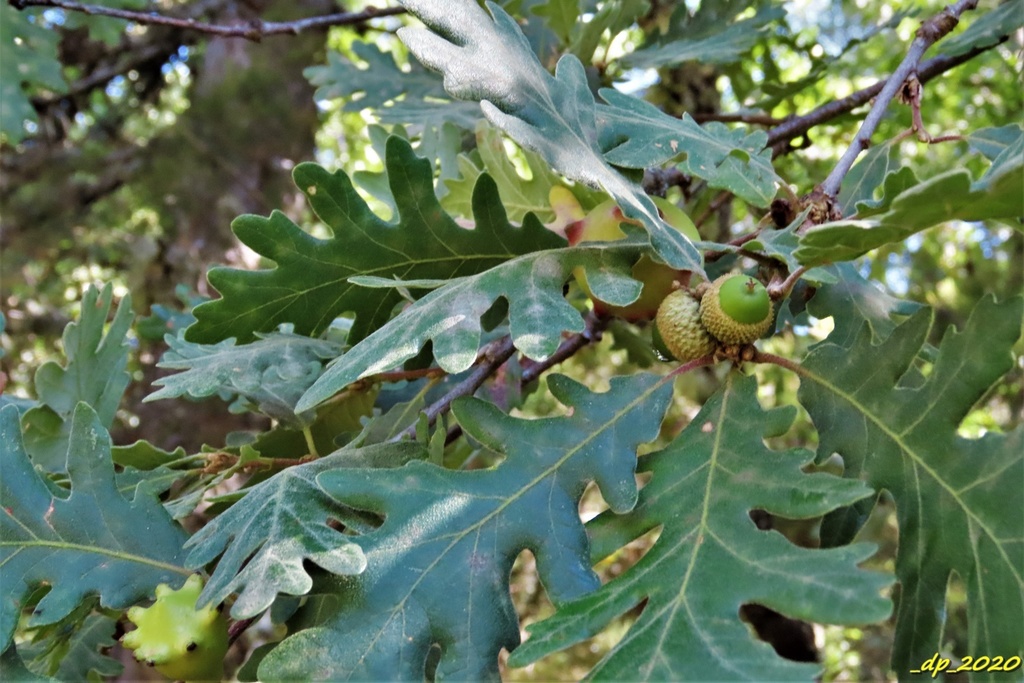
Pyrenean Oak
Quercus pyrenaica
Quercus pyrenaica, also known as Pyrenean oak, or Spanish oak is a tree native to southwestern Europe and northwestern North Africa. Despite its common name, it is rarely found in the Pyrenees Mountains and is more abundant in northern Portugal and north and northwestern Spain.
It is placed in section Quercus.
From the article Quercus pyrenaica on Wikipedia (CC BY-SA), quoted section by section
Description
Quercus pyrenaica is a tall deciduous tree, often marcescent in immature individuals, up to 25 metres (80 feet) tall, though it is sometimes found as a bush or small tree. It has an average lifespan of 300 years. The leaves have short petioles and are deeply and irregularly lobed, with four to eight pairs of lobes per leaf. There are stellate hairs on both sides of the leaf. Roots frequently produce suckers. The species has high resprouting capabilities.
Range & habitat
Quercus pyrenaica is native to the Iberian Peninsula and parts of southwest France and northern Morocco inhabiting mainly subatlantic or continental environments up to 2,100 m (6,900 ft) in elevation. In the Iberian Peninsula, which represents 95% of its population, it occupies mainly the northern portion, south of the Cantabrian Mountains, very common in the west of the Peninsula in the northern half of mountainous Portugal, and rare on the east It is adapted both to sub-humid temperate and Mediterranean semi-arid conditions, from the humid Peneda-Gerês National Park in Portugal, to the semi-arid Spanish central plain. It is also adapted to survive in hot local temperatures. It is thought to have a short growth season to avoid the summer drought. It is often the dominant species in the forests in which it occurs. Its acorns are dispersed by birds and small mammals.
Wikipedia: “Distribution and habitat”
Where it lives
Recorded sightings
—
geo-referenced records in GBIF, from museums, herbaria and field observers.
Drag the globe to turn it. Dots are where records exist, not a range map; darker means more records.
In the stacks
Searching the stacks…
Every page naming Quercus pyrenaica in the Biodiversity Heritage Library →
This page is assembled live from iNaturalist, GBIF, Wikipedia, the Source Library and the Internet Archive. It is not yet part of the hand-edited codex. iNaturalist taxon 125848.