- Animals
- ›Arthropods
- ›Hexapods
- ›Insects
- ›Winged and Once-winged Insects
- ›Beetles
- ›Water, Rove, Scarab, Long-horned, Leaf, and Snout Beetles
- ›Scarabaeiform Beetles
- ›Scarabs, Stag Beetles, and Allies
- ›Scarabs
- ›Dung Beetles
- ›Scarabaeini
- ›Scarabaeus
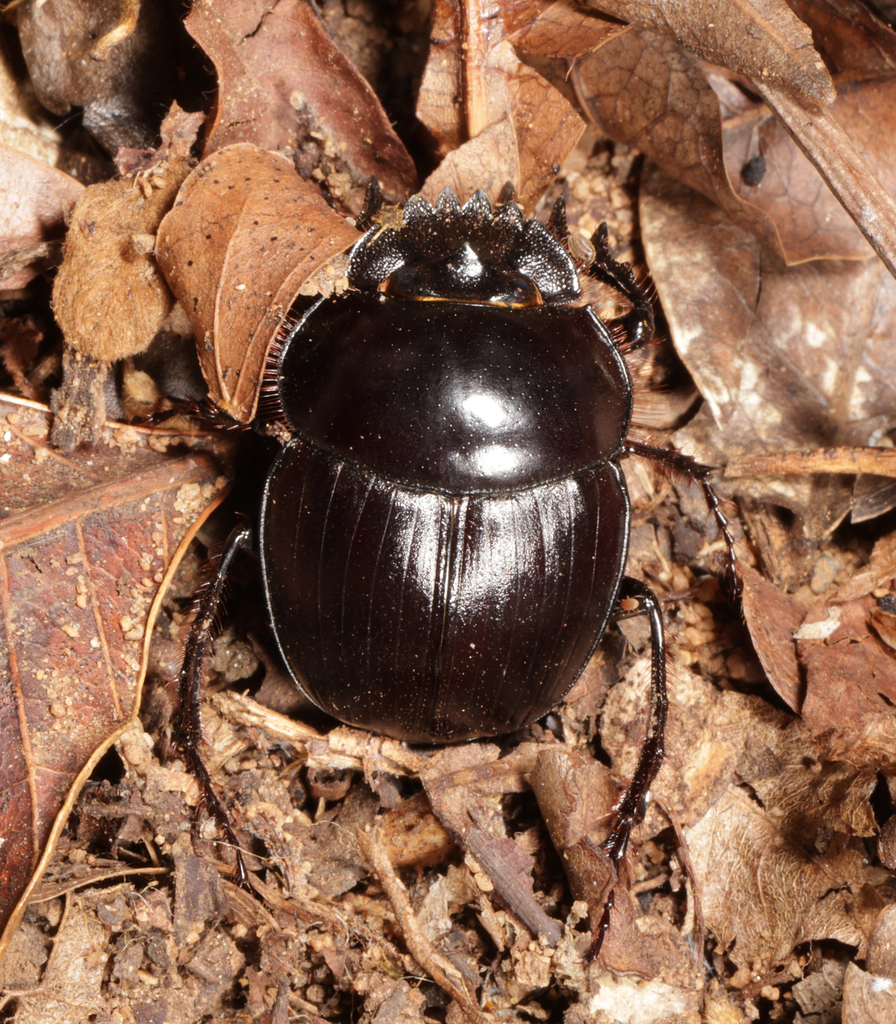
Scarabaeus viettei
Scarabaeus viettei, or Viette's scarab beetle, is a species of dung beetle in the family Scarabaeidae, subfamily Scarabaeinae. It was first described by French entomologist Renaud Paulian in 1953. The species is endemic to Madagascar, with its known range restricted to the dry spiny forests of the island's western region.
From the article Scarabaeus viettei on Wikipedia (CC BY-SA), quoted section by section
Description
Adult S.viettei beetles exhibit a robust, rounded body typical of scarabaeines; individuals measure about 20 to 30 mm (0.8 to 1.2 in) in length. The exoskeleton is black and glossy, with reddish-brown setae distributed along the lateral and ventral surfaces. The antennae of males are composed of nine antennomeres, terminating in a lamellate club used for detecting odors. Sexual dimorphism is present, as males may exhibit more pronounced forelegs and possess horn-like structures on the head or thorax, which are typically used in intraspecific combat and mate competition.
Wikipedia: “Appearance”
What it does
Like other members of its genus, S.viettei plays a crucial role in nutrient cycling and soil aeration. Adults are coprophagous, collecting and burying dung for feeding and reproduction. The species is primarily active during the early morning and late afternoon, avoiding peak daytime heat. Reproductive behavior involves the construction of brood balls, into which eggs are laid and larvae develop.
Wikipedia: “Behavior”
Listen
Looking for field recordings…
Where it lives
Recorded sightings
—
geo-referenced records in GBIF, from museums, herbaria and field observers.
Drag the globe to turn it. Dots are where records exist, not a range map; darker means more records.
In the stacks
Searching the stacks…
Every page naming Scarabaeus viettei in the Biodiversity Heritage Library →
This page is assembled live from iNaturalist, GBIF, Wikipedia, the Source Library and the Internet Archive. It is not yet part of the hand-edited codex. iNaturalist taxon 1259699.