- Animals
- ›Arthropods
- ›Hexapods
- ›Insects
- ›Winged and Once-winged Insects
- ›Ants, Bees, Wasps, and Sawflies
- ›Narrow-waisted Wasps, Ants, and Bees
- ›Ants, Bees, and Stinging Wasps
- ›Vespoid Wasps
- ›Hornets, Paper Wasps, Potter Wasps, and Allies
- ›Hornets and Yellowjackets
- ›Vespula
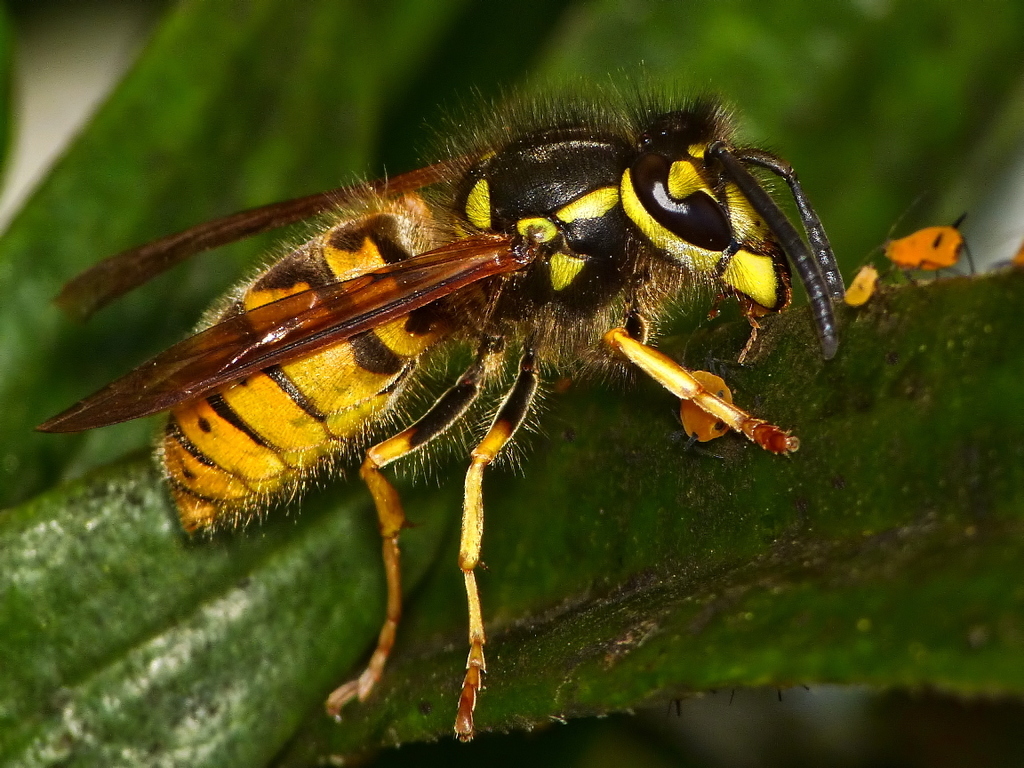
German Yellowjacket
Vespula germanica
Vespula germanica, known colloquially as the European wasp, German wasp, or German yellowjacket, is a species of wasp found in much of the Northern Hemisphere, native to Europe, Northern Africa, and temperate Asia. It has spread and become well-established in many other places, including North America, South America (Argentina and Chile), Australia, South Africa, and New Zealand. German wasps are part of the family Vespidae and are sometimes mistakenly referred to as paper wasps because they build grey paper nests, although strictly speaking, paper wasps are part of the subfamily Polistinae. In North America, they are also known as yellowjackets.
From the article Vespula germanica on Wikipedia (CC BY-SA), quoted section by section
Description
The German wasp is about 13 mm (0.5 in) long, has a mass of 74.1 ± 9.6 mg, and has typical wasp colours of black and yellow. It is very similar to the common wasp (V. vulgaris), but unlike the common wasp, has three tiny black dots on the clypeus. To further complicate the issue this only applies to workers. To help with identification, a good practice to observe is to first categorize the wasp as worker, queen, or male before identifying it as V. vulgaris or V. germanica. Gastral pattern (the black dots or marks on the abdomen) are highly variable and not good characteristics to use in identifying. However, the identification of a wasp as V. vulgaris may be difficult because the normally unbroken black mark on its clypeus can sometimes appear broken (particularly in males) making it look extremely similar to V. germanica.
Wikipedia: “Description and identification”
Range & habitat
V. germanica originated in Europe, Asia, and North Africa and can now be found in sections of every continent but Antarctica. It has established populations in North America, South America, South Africa, New Zealand, and Australia. The species has been described as an invasive species. German yellowjackets are known to be especially successful and destructive invaders of new territories. These wasps are polyphagous predators which feed on native arthropods, and because they are able to outdo many other animals for food, they have caused considerable harm to the indigenous wildlife of areas which they have invaded. For a given year, V. germanica disperses at distances of no more than 1000 m, (1 km) so that their rapid dispersal is likely to be aided by accidental human transport of hibernating queens. This normally leads to a bottleneck effect during the establishment of new populations, which explains the significant genetic differentiation often found among geographically distant populations. The nest is made from chewed plant fibres, mixed with saliva. The majority of nests are found in the soil below ground. A significant portion of nests are found in artificial structures such as attics, and a small portion are found above ground.
Wikipedia: “Distribution and habitat”
What it does
Vespula germanica queens are typically polyandrous. The queens mate with a moderate number of males, usually between one and seven, with no optimal number of mates. In addition, mating events are independent of each other, which discredits the hypothesis that queens terminate mating behavior after mating with a male that possesses an optimal set of attributes. V. germanica workers are unable to mate and so incapable of producing diploid offspring. In some nests, however, the workers produce haploid male offspring from unfertilized eggs. Worker reproduction has been documented in other Vespula wasp colonies, but usually only after the death of the queen. However, workers of V. germanica have been found reproducing in the presence of a queen.
Wikipedia: “Mating behavior”
Listen
Looking for field recordings…
Where it lives
Recorded sightings
—
geo-referenced records in GBIF, from museums, herbaria and field observers.
Drag the globe to turn it. Dots are where records exist, not a range map; darker means more records.
In the stacks
Searching the stacks…
Every page naming Vespula germanica in the Biodiversity Heritage Library →
This page is assembled live from iNaturalist, GBIF, Wikipedia, the Source Library and the Internet Archive. It is not yet part of the hand-edited codex. iNaturalist taxon 126155.