- Fungi Including Lichens
- ›Basidiomycete Fungi
- ›Higher Basidiomycetes
- ›Mushrooms, Bracket Fungi, Puffballs, and Allies
- ›Agaricomycetidae
- ›boletes and allies
- ›boletes
- ›Xerocomoideae
- ›Boletellus
- ›Boletellus
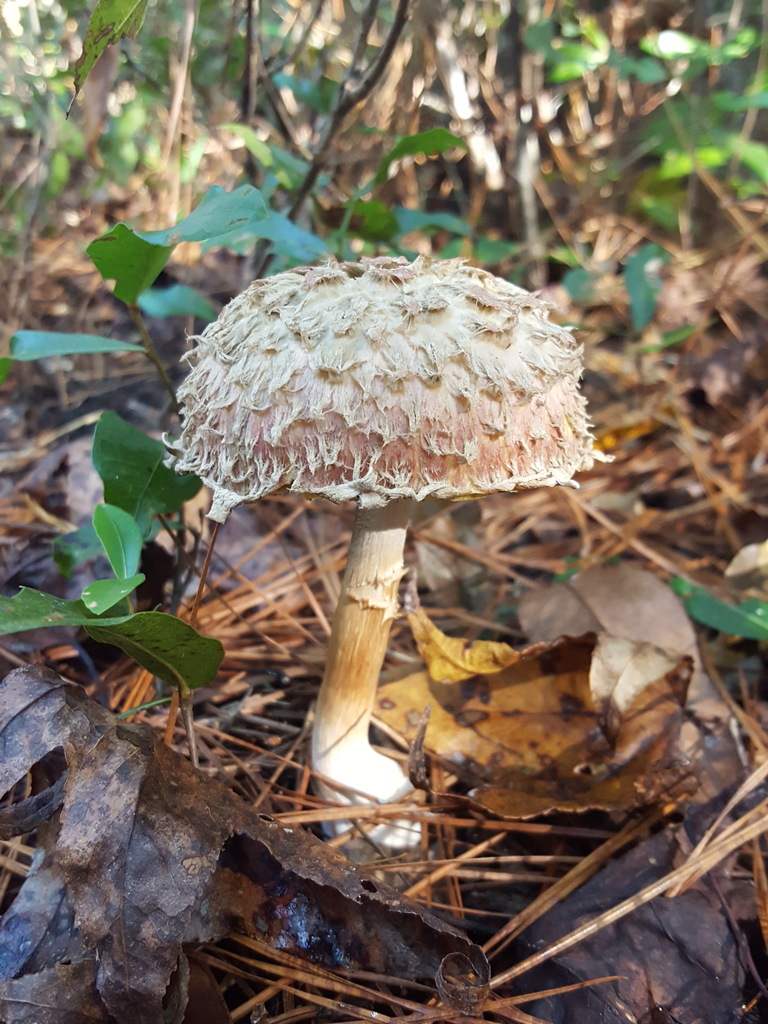
Pineapple Bolete
Boletellus ananas
Boletellus ananas, commonly known as the pineapple bolete, is a mushroom in the family Boletaceae, and the type species of the genus Boletellus. Previously known as Boletus ananas and Boletus coccinea (among other synonyms), the species was given its current name by William Alphonso Murrill in 1909.
The fruit body is characterized by the reddish-pink (or pinkish-tan to yellowish if an older specimen) scales on the cap that are often found hanging from the edge. The pore surface on the underside of the cap is made of irregular or angular pores up to 2 mm wide that bruise a blue color. It is yellow when young but ages to a deep olive-brown color. Microscopically, B. ananas is distinguished by large spores with cross striae on the ridges and spirally encrusted hyphae in the marginal appendiculae and flesh of the stem. Two varieties of B. ananas have been described.
From the article Boletellus ananas on Wikipedia (CC BY-SA), quoted section by section
Description
The cap of B. ananas is 3.3–10 cm (1+1⁄4–4 in) wide and plano-convex (flat on one side and rounded on the other). It is covered with squamules (small scales) that can be either pressed against the cap or curved back on itself. The squamules range in color from reddish brown to red-tan, to pink to pinkish gray, and they are more concentrated and more scaly in the center of the cap, extending out of cream to light orange-pink to light pink-red floccose ground. The margin clasps the stem when young; at maturity it separates into triangular veil remnants (appendiculae) that measure 6–12 by 3–10 mm. The color of these appendiculae range from buff-white to faint pink. The flesh is 2–3 mm thick at the edge of the cap, 7–10 mm over the tubes, and 11–18 mm centrally. It is buff white to light yellow, and quickly turns bluish upon exposure to air. The tubes are 1–5 mm long at the margin, 10–20 mm in the center, and 4–6 mm at the stem. They are broadly and deeply depressed around the stem, of irregular lengths, bright yellow to olive-yellow to mustard-yellow, and also rapidly turn blue upon exposure. The pores are the same color as the tubes, and rapidly turn blue-green with pressure; they are angular, and there are about 0.5–1.5 pores per mm. The stem is 5–10 cm (2–4 in) tall and 6–14 mm (1⁄4–1⁄2 in) wide, and gradually becomes larger towards the base to 10–19 mm. …
Range & habitat
The fruit bodies of B. ananas typically grow scattered or in groups under oak and pine trees, often on their bases. In Guyana, the mushroom typically fruits singly or in pairs within 1–2 m (3+1⁄2–6+1⁄2 ft) above ground level on the trunks of the tropical tree Dicymbe corymbosa (subfamily Caesalpinioideae), associated with ectomycorrhizas within humic accumulations. It is rarely found fruiting on the ground on heavily decayed, root-penetrated wood. Rolf Singer suggested that the fungus was not mycorrhizal, noting that as well as occurring under or on the bases of both pine and oaks, it occurred in scanty humus and debris accumulated on rock walls. Singer concluded that the species prefers to grow on hard surfaces. Harry D. Thiers, in his study of the bolete flora of Texas, wrote that B. ananas was a rare species that often fruited abundantly following an extended period of rain and high humidity. Some varieties of B. ananas from southeastern North America, Costa Rica, Brazil, Panama, Nicaragua, and Guyana have been noted to fruit on tree trunks, although terrestrial fruiting has been reported in Malaysia and Central America. Due to the typically elevated fruiting habit and occurrence on dead wood, the ectomycorrhizal status of B. …
Wikipedia: “Ecology, habitat and distribution”
At the table
Although the mushroom is used as a food in Mexico, field guides list it as "inedible" or "not recommended".
Wikipedia: “Edibility”
Where it lives
Recorded sightings
—
geo-referenced records in GBIF, from museums, herbaria and field observers.
Drag the globe to turn it. Dots are where records exist, not a range map; darker means more records.
In the stacks
Searching the stacks…
Every page naming Boletellus ananas in the Biodiversity Heritage Library →
This page is assembled live from iNaturalist, GBIF, Wikipedia, the Source Library and the Internet Archive. It is not yet part of the hand-edited codex. iNaturalist taxon 126158.