- Plants
- ›Vascular Plants
- ›flowering plants
- ›Dicots
- ›carrots, ivies, and allies
- ›ivy family
- ›Aralioideae
- ›Pseudopanax
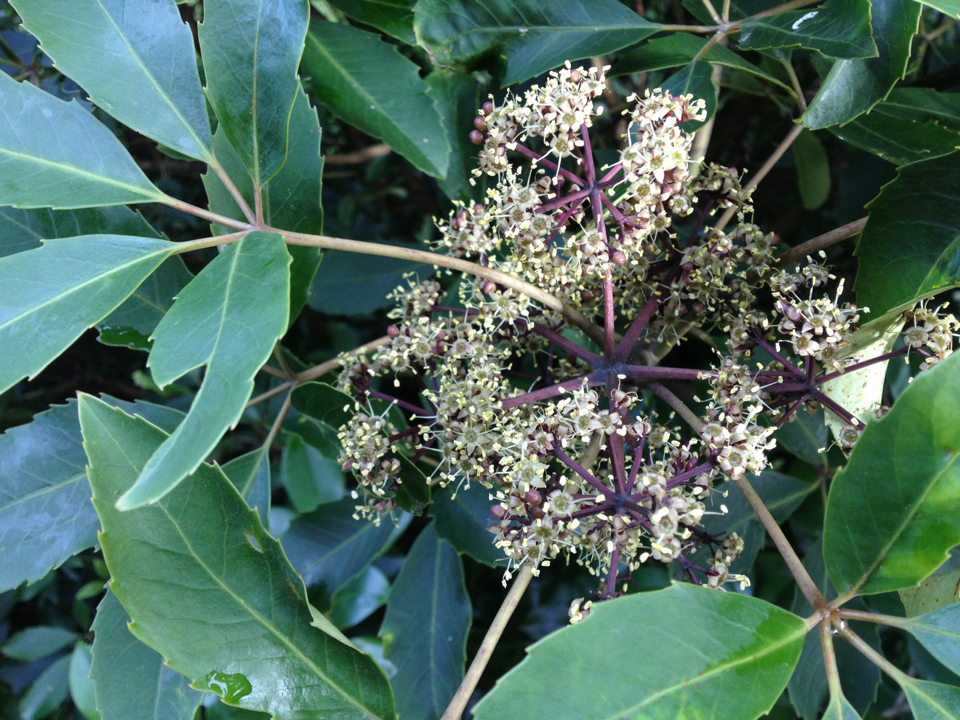
five finger
Pseudopanax arboreus
Pseudopanax arboreus, commonly known as five finger, five-finger or fivefinger (Māori: puahou or whauwhaupaku), is a New Zealand native tree belonging to the family Araliaceae. It is one of New Zealand's more common native trees, being found widely in bush, scrub and gardens throughout both islands. The compound leaves with five to seven leaflets, hence the name "five finger", are very characteristic of the tree and easily recognized.
Closely related and very similar to five finger are P. laetus, P. colensoi, and P. macintyrei.
From the article Pseudopanax arboreus on Wikipedia (CC BY-SA), quoted section by section
Description
Leaflets obovate-oblong to oblong-cuneate, thinly coriaceous, coarsely serrate-dentate. Flowers usually unisexual; inflorescences are compound umbels with 8–20 primary branchlets up to 10 centimetres (3.9 inches) long, 15–20 secondary rays, umbellules with 10–15 flowers in each. Calyx truncate or obscurely 5-toothed; flowers 5mm in diameter, sweet-scented; petals 5, white to pink flushed, ovate to triangular, acute; stamens 5; ovary 2-loculed, each containing 1(-2) ovules; style branches 2, spreading. Fruit fleshy, very dark purple, laterally compressed, 5–8 mm diam.; style branches retained on an apical disc. Seeds 2(-3) per fruit, wrinkled, 3–6 mm long.
What it does
Pseudopanax arboreus is a host species for the caterpillar of the endemic North Island moth Declana atronivea. Pseudopanax arboreus is ranked one of New Zealand's least flammable tree species.
Wikipedia: “Ecology”
Where it lives
Recorded sightings
—
geo-referenced records in GBIF, from museums, herbaria and field observers.
Drag the globe to turn it. Dots are where records exist, not a range map; darker means more records.
In the stacks
Searching the stacks…
Every page naming Pseudopanax arboreus in the Biodiversity Heritage Library →
This page is assembled live from iNaturalist, GBIF, Wikipedia, the Source Library and the Internet Archive. It is not yet part of the hand-edited codex. iNaturalist taxon 126181.