- Animals
- ›Arthropods
- ›Hexapods
- ›Insects
- ›Winged and Once-winged Insects
- ›Grasshoppers, Crickets, and Katydids
- ›Grasshoppers, Locusts, and Allies
- ›Grasshoppers
- ›Short-horned Grasshoppers and Locusts
- ›Short-horned Grasshoppers
- ›Bandwing Grasshoppers
- ›Trimerotropini
- ›Dissosteira
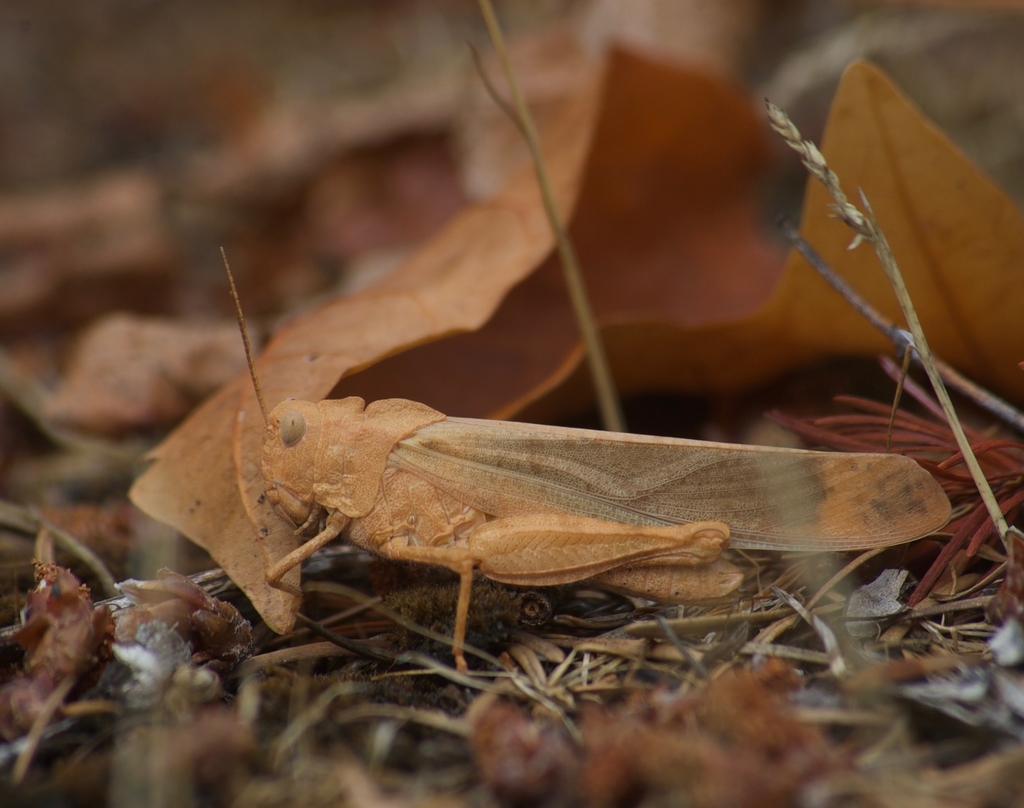
Carolina Grasshopper
Dissosteira carolina
Dissosteira carolina, the Carolina grasshopper, Carolina locust, black-winged grasshopper, road-duster or quaker, is a band-winged species of grasshopper which ranges widely in North America inhabiting weedy grasslands.
The Carolina Locust is a short-horned grasshopper (Family Acrididae) found in most of the United States and other parts of North America (Fig 1). These grasshoppers can be anywhere between 32 and 58 mm, with females being larger than males. Their color can range from grey to brown with contrasting black and yellow-white hind wings.
From the article Dissosteira carolina on Wikipedia (CC BY-SA), quoted section by section
Description
Individuals of Dissosteira carolina reach over 32–58 mm in length. They tend to be conspicuous due to their size, colorful wings, and because they habitually fly over dirt roads and other bare ground. The spread wings of the males measure 75 mm across, while those of the females measure 80–102 mm. The tegmina are light brown to tan to gray, tending towards camouflage with the dirt where they bask or hide, whereas the inner wings used for flight are brownish-black with yellow margins and a ridge running down the back. When taking off to escape predators, the black-and-yellow hindwings are revealed extremely quickly, causing the visible portion of the grasshopper to shift from camouflage (~100% brown) to contrast (50+% black-and-yellow) and roughly double in size in less than 9 ms; when landing, the reverse transition occurs in less than 15 ms. Due to these rapid transitions, human observers may see the grasshopper as appearing and disappearing instantaneously. Additionally, during flight, the hindwings transition ~6 times per second between pauses and periods of active wing-beating, during which the wings beat over 30 times per second. This creates an unstable, confusing image. Because of their large size and rather lazy bobbing flight, they are often mistaken for a butterfly, especially the mourning cloak Nymphalis antiopa. …
Range & habitat
Dissosteira carolina is found in North America in southern Canada from British Columbia to the Atlantic Coast and in the United States from the east Coast as far south as Florida and as far west as Idaho.
Wikipedia: “Distribution”
Listen
Looking for field recordings…
Where it lives
Recorded sightings
—
geo-referenced records in GBIF, from museums, herbaria and field observers.
Drag the globe to turn it. Dots are where records exist, not a range map; darker means more records.
In the stacks
Searching the stacks…
Every page naming Dissosteira carolina in the Biodiversity Heritage Library →
This page is assembled live from iNaturalist, GBIF, Wikipedia, the Source Library and the Internet Archive. It is not yet part of the hand-edited codex. iNaturalist taxon 126206.