- Animals
- ›Arthropods
- ›Hexapods
- ›Insects
- ›Winged and Once-winged Insects
- ›True Bugs, Hoppers, Aphids, and allies
- ›True Hoppers
- ›Planthoppers
- ›Fulgoroidea
- ›Flatid Planthoppers
- ›Flatinae
- ›Nephesini
- ›Metcalfa
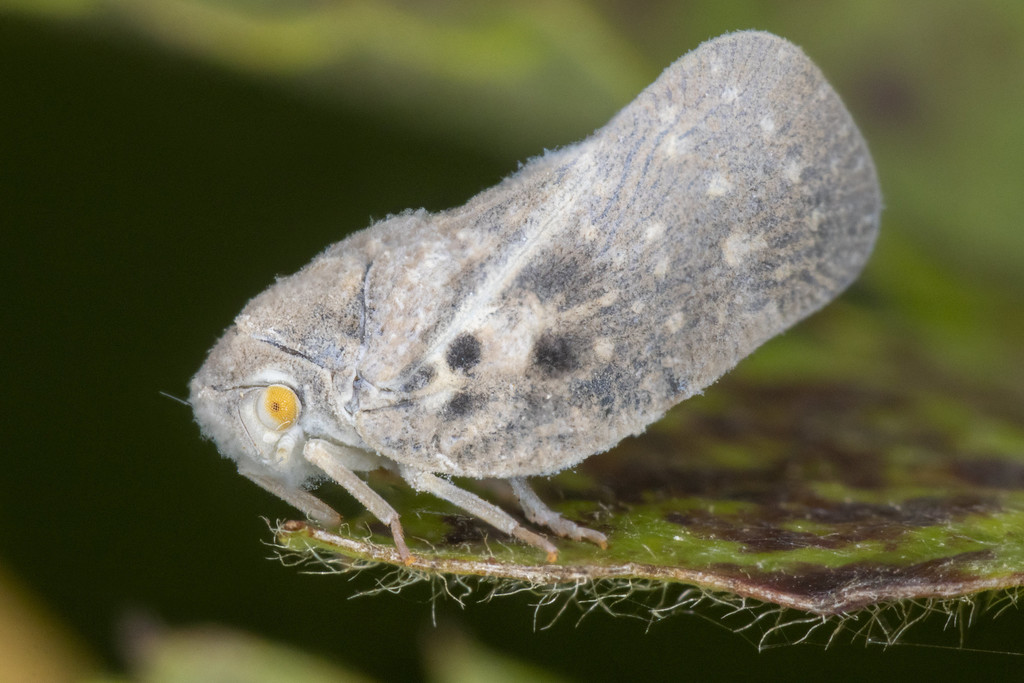
Citrus Flatid Planthopper
Metcalfa pruinosa
Metcalfa pruinosa, the citrus flatid planthopper, is a species of insect in the Flatidae family of planthoppers first described by Thomas Say in 1830.
From the article Metcalfa pruinosa on Wikipedia (CC BY-SA), quoted section by section
Description
Adults of Metcalfa pruinosa can reach a length of 5.5–8 millimetres (7⁄32–5⁄16 in) and a width of 2–3 millimetres (5⁄64–1⁄8 in) at the widest point. They are initially whitish. The color of adults may vary from brown to gray, in connection with the presence of a bluish white epicuticular wax, covering especially the nymphs. The large and prominent compound eyes are yellow. The mouthparts are adapted for piercing and sucking. The trapezoidal forewings are held vertically, wrapping the body when the insect is at rest. The front wings have veined costal cell and several characteristic whitish spots. The hind tibiae usually have two lateral spines in addition to the other spines at the apex. Nymphs may reach a length of about 3.2 millimetres (1⁄8 in). Color varies from whitish to light green, with relative large tufts of white wax on the abdomen.
Range & habitat
The species is native to North America (Nearctic realm), but it is today found throughout Europe (Austria, Britain, France, Spain, Italy, Hungary, Romania, Slovenia, Poland, Switzerland, and Moldova), in the Neotropical realm and in South Korea.
Wikipedia: “Distribution”
What it does
The species is univoltine, producing one generation per year. Adults mate in fall during the night. The females lay about 100 eggs, usually in the bark of host plants. Eggs overwinter, hatching the following spring. The adults are seen mainly in summer and fall, when they feed gregariously on sap. When they feed on sap, they eject excess sugar in the form of honeydew. This attracts bees, which convert it to honey. As it feeds, it causes serious damage to field crops and ornamental plants. It is polyphagous, feeding on a variety of plant taxa. Host plants include maples, dogwoods, hawthorns, willows, elms, privet, black locust, and elder. It lives on crop plants such as grape, citrus, apricot, peach, blackberry, and raspberry.
Wikipedia: “Behavior and ecological impact”
Listen
Looking for field recordings…
Where it lives
Recorded sightings
—
geo-referenced records in GBIF, from museums, herbaria and field observers.
Drag the globe to turn it. Dots are where records exist, not a range map; darker means more records.
In the stacks
Searching the stacks…
Every page naming Metcalfa pruinosa in the Biodiversity Heritage Library →
This page is assembled live from iNaturalist, GBIF, Wikipedia, the Source Library and the Internet Archive. It is not yet part of the hand-edited codex. iNaturalist taxon 126209.