- Plants
- ›Vascular Plants
- ›flowering plants
- ›Dicots
- ›Mints, Plantains, Olives, and Allies
- ›Plantain Family
- ›Penstemon and allies
- ›Chionophila
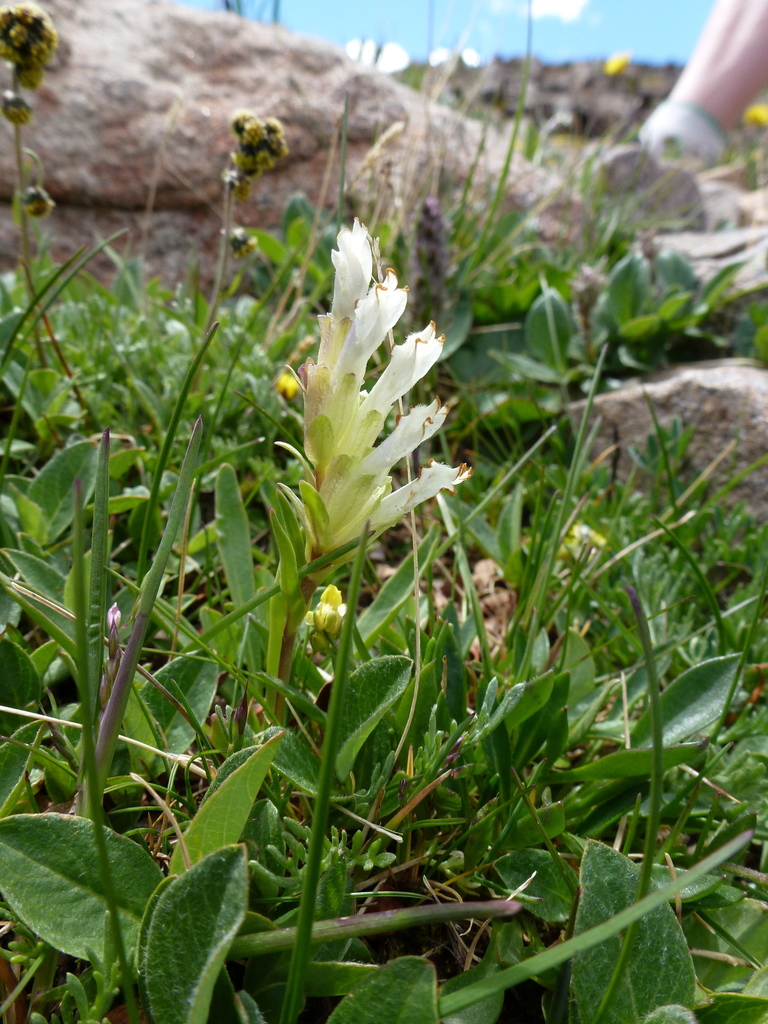
Rocky Mountain snowlover
Chionophila jamesii
Chionophila jamesii, the Rocky Mountain snowlover, is one of the two species in the snowlover genus. It only grows at high elevations in the Southern Rocky Mountains of the western United States.
From the article Chionophila jamesii on Wikipedia (CC BY-SA), quoted section by section
Description
Rocky Mountain snowlover is a small plant that usually has one or two flowering stems, though it can occasionally have three. These typically grow 5 to 12 centimeters (2–4.5 in) tall, but they can be as short as 3 cm (1 in) or as tall as 15 cm (6 in). It is a perennial that has slightly tuberous roots and short rhizomes. Its stems are usually puberulent, covered in thin, short, erect hairs, or covered in backwards pointing hairs, but occasionally can be almost hairless. Plants have both basal leaves and cauline ones attached to the stems, but the leaves attached to the stems are smaller and very few in number. The basal leaves are 1.2–7.8 centimeters long, but just 0.2–1.8 cm wide. They are spatulate, shaped like a spoon, to oblanceolate, like a reversed spear head, but sometimes quite narrowly. There are just one to three pairs of leaves attached to the stems measuring 8–28 millimeters long and only 1–3 mm wide. They are linear, like blade of grass, to narrowly lanceolate. In the fall its basal leaves become much more visible by turning bright salmon red. …
Range & habitat
Rocky Mountain snowlover is endemic to the Southern Rocky Mountains in southern Wyoming, Colorado, and north-central New Mexico. Its range stretches from the Medicine Bow Mountains in Wyoming south through Colorado to the Culebra Range in northernmost New Mexico. In Wyoming it grows in one area extending across the boarder of Carbon County and Albany County with the largest single population found on the western slopes of Medicine Bow Peak in Carbon County. The species is widespread in the mountains of Colorado with most specimens found in areas near the Continental Divide, but with some sightings significantly to the east or west. To the south it is only known from Taos County, New Mexico. The lowest elevation for the species is 3,300 meters (10,800 ft), and Ackerfield reports it can grow as high as 4,300 meters (14,000 ft). The habitat for Rocky Mountain snowlover is mostly moist, gravelly slopes in alpine tundra, although it is also found in bogs in the subalpine zone. Above timberline it grows in meadows, scree fields at cliff bases, and also clay soils on slopes. However, the species only grows in areas with winter snowcover. Research on the Niwot Ridge in the 1990s found the optimal snow depth for Rocky Mountain snowlover is 2 to 3 meters (6.5–10 ft) and confirms its dependence on deep snowbanks.
Wikipedia: “Range and habitat”
What it does
Rocky Mountain snowlover is one many plants that will establish itself in the cushions of moss campion (Silene acaulis) after they pioneer newly open ground in the alpine tundra. In a study on the Niwot Ridge published in 2018 the researchers found that the average first date of blooming was 16 July, plus or minus eight days.
Wikipedia: “Ecology”
In human culture
Rarely, Rocky Mountain snowlover is cultivated in rock gardens. It is grown in moist, but well drained, raised beds with gravel soil. The other species in the genus is not in cultivation. Though the most common of the rare alpine plants of Colorado, it is rarely seen by tourists due to the isolated nature of its habitat. The easiest places to view the plants in their native habitat are along the Trail Ridge Road in Rocky Mountain National Park and in alpine areas near the Mount Blue Sky Scenic Byway.
Wikipedia: “Use and culture”
Where it lives
Recorded sightings
—
geo-referenced records in GBIF, from museums, herbaria and field observers.
Drag the globe to turn it. Dots are where records exist, not a range map; darker means more records.
In the stacks
Searching the stacks…
Every page naming Chionophila jamesii in the Biodiversity Heritage Library →
This page is assembled live from iNaturalist, GBIF, Wikipedia, the Source Library and the Internet Archive. It is not yet part of the hand-edited codex. iNaturalist taxon 126255.