- Fungi Including Lichens
- ›Basidiomycete Fungi
- ›Higher Basidiomycetes
- ›Mushrooms, Bracket Fungi, Puffballs, and Allies
- ›Shelf Fungi
- ›Laetiporaceae
- ›Laetiporus
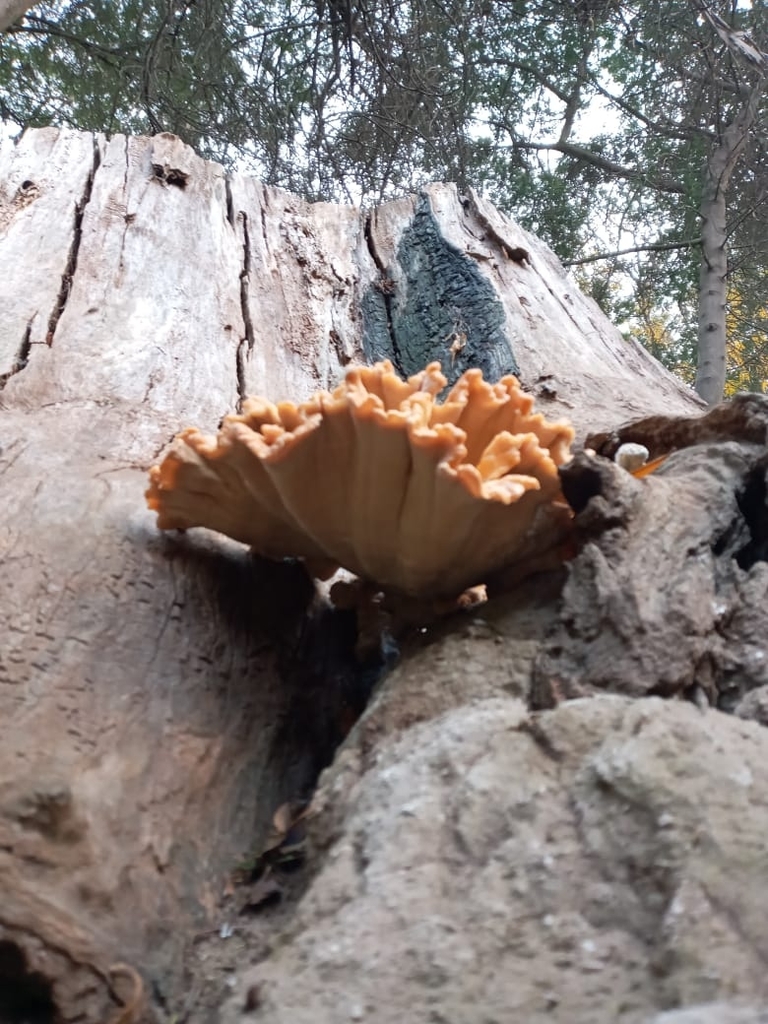
Laetiporus speciosus
Laetiporus sulphureus is a species of bracket fungus (fungi that grow on trees). Its common names include sulphur polypore, sulphur shelf, and chicken-of-the-woods. Its fruit bodies grow as striking golden-yellow shelf-like structures on tree trunks and branches. Old fruitbodies fade to pale beige or pale grey. The undersurface of the fruit body is made up of tubelike pores rather than gills.
Found in Europe and North America, L. sulphureus is a saprophyte and occasionally a weak parasite, causing brown cubical rot in the heartwood of trees on which it grows. Unlike many bracket fungi, it is edible when young, although adverse reactions have been reported.
From the article Laetiporus sulphureus on Wikipedia (CC BY-SA), quoted section by section
Description
The fruiting body emerges directly from the trunk of a tree and is initially knob-shaped, but soon expands to fan-shaped shelves, typically growing in overlapping tiers. It is sulphur-yellow to bright orange in color and has a suedelike texture. Old fruitbodies fade to tan or whitish. Each shelf may be anywhere from 5 to 60 centimetres (2 to 23+1⁄2 inches) across and up to 4–12 cm (1+1⁄2–4+1⁄2 in) thick. The fertile surface is sulphur-yellow with small pores or tubes and produces a white spore print. When fresh, the flesh is succulent with a strong fungal aroma and exudes a yellowish, transparent juice, but soon becomes dry and brittle. Although fairly distinct, it can resemble Laetiporus persicinus.
Range & habitat
Laetiporus sulphureus is widely distributed across Europe (April to November) and North America, although its range may be restricted to areas east of the Rockies. It grows on dead or mature hardwoods and has been reported from a very wide variety of host trees, such as Quercus, Prunus, Pyrus, Populus, Salix, Robinia, and Fagus, occasionally also from conifers, from August to October or later, sometimes as early as June. In the Mediterranean region, this species is usually found on Ceratonia and Eucalyptus. It can usually be found growing in clusters.
Parasitism. The fungus causes brown cubical rot of heartwood in the roots, tree base and stem. After infection, the wood is at first discolored yellowish to red but subsequently becomes reddish-brown and brittle. At the final stages of decay, the wood can be rubbed like powder between the fingers.
Guinness world record. A specimen weighing 45 kilograms (100 lb) was found in the New Forest, Hampshire, United Kingdom, on 15 October 1990.
Wikipedia: “Distribution and habitat”
At the table
Due to its taste, Laetiporus sulphureus has been called the chicken polypore and chicken-of-the-woods (not to be confused with Grifola frondosa, the so-called hen-of-the-woods). Many people think that the mushroom tastes like crab or lobster leading to the nickname lobster-of-the-woods. The authors of Mushrooms in Color said that the mushroom tastes good sauteed in butter or prepared in a cream sauce served on toast or rice. It is highly regarded in Germany and North America. Young specimens are edible if they exude large amounts of a clear to pale yellow watery liquid. Only the young outer edges of larger specimens should be collected, as older portions tend to be tough, unpalatable, and bug-infested. The mushroom should not be eaten raw.
Adverse effects. Some people have experienced gastrointestinal upset after eating this mushroom, and it should not be consumed raw. Severe adverse reactions can occur, including vomiting and fever, in about 10% of the population, but this is now thought to be the result of confusion with morphologically similar species such as Laetiporus huroniensis, which grows on hemlock trees, and L. gilbertsonii, which grows on Eucalyptus.
Wikipedia: “Uses”
How it is grown
Compared with species such as Agaricus bisporus (Swiss Brown mushroom) and the oyster mushroom, commercial cultivation of Laetiporus occurs at a much smaller and less mechanized scale.
Wikipedia: “Cultivation”
Where it lives
Recorded sightings
—
geo-referenced records in GBIF, from museums, herbaria and field observers.
Drag the globe to turn it. Dots are where records exist, not a range map; darker means more records.
In the stacks
Searching the stacks…
Every page naming Laetiporus speciosus in the Biodiversity Heritage Library →
This page is assembled live from iNaturalist, GBIF, Wikipedia, the Source Library and the Internet Archive. It is not yet part of the hand-edited codex. iNaturalist taxon 126312.