- Plants
- ›Vascular Plants
- ›flowering plants
- ›monocots
- ›Agaves, Orchids, Irises, and Allies
- ›amaryllis, onions, and allies
- ›amaryllis subfamily
- ›Hippeastreae
- ›Hippeastrinae
- ›Zephyranthes
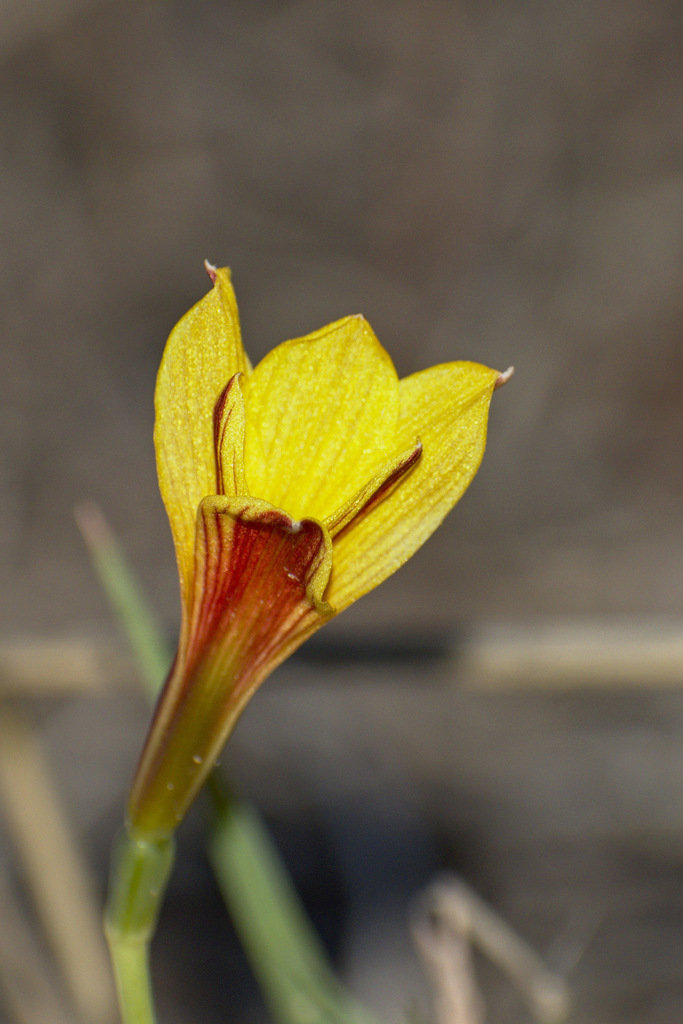
Rio Grande copper lily
Zephyranthes tubispatha
Zephyranthes tubispatha, synonym Habranthus tubispathus, the Rio Grande copperlily or Barbados snowdrop, is a species of flowering plant in the family Amaryllidaceae. It is a perennial bulb native to southern South America (Brazil, Argentina, Paraguay and Uruguay). It is widely cultivated as an ornamental and reportedly naturalized in the southeastern United States (Texas, Louisiana, Mississippi, Alabama, Georgia, Florida), much of the West Indies as well as Bermuda, eastern Mexico, India, Easter Island, and central Chile.
From the article Zephyranthes tubispatha on Wikipedia (CC BY-SA), quoted section by section
Description
Flowers are produced sporadically during late summer and autumn, singly on stems 10 to 20 centimetres (4 to 8 in) tall. Flowers are usually yellow with copper tones on the outside, with tepals about 3 centimetres (1.2 in) long, fused for a short distance at the base to form a tube. As with all former Habranthus species, the flowers are not upright on the stem but held at a slight angle. The leaves are not normally present at flowering time, appearing later; they are narrowly linear.
How it is grown
Zephyranthes tubispatha tolerates some frost down to 0 °C (32 °F) if planted in a sheltered sunny position, but will not survive being frozen. It seeds freely. A form with pinkish flowers is grown as var. rosea, but may be a hybrid. Z. tubispatha has gained the Royal Horticultural Society's Award of Garden Merit. The name Habranthus andersonii is commonly found in horticultural sources.
== References ==
Wikipedia: “Cultivation”
Where it lives
Recorded sightings
—
geo-referenced records in GBIF, from museums, herbaria and field observers.
Drag the globe to turn it. Dots are where records exist, not a range map; darker means more records.
In the stacks
Searching the stacks…
Every page naming Zephyranthes tubispatha in the Biodiversity Heritage Library →
This page is assembled live from iNaturalist, GBIF, Wikipedia, the Source Library and the Internet Archive. It is not yet part of the hand-edited codex. iNaturalist taxon 1264667.