- Plants
- ›Vascular Plants
- ›flowering plants
- ›Dicots
- ›Heathers, Balsams, Primroses, and Allies
- ›camellia family
- ›Camellia
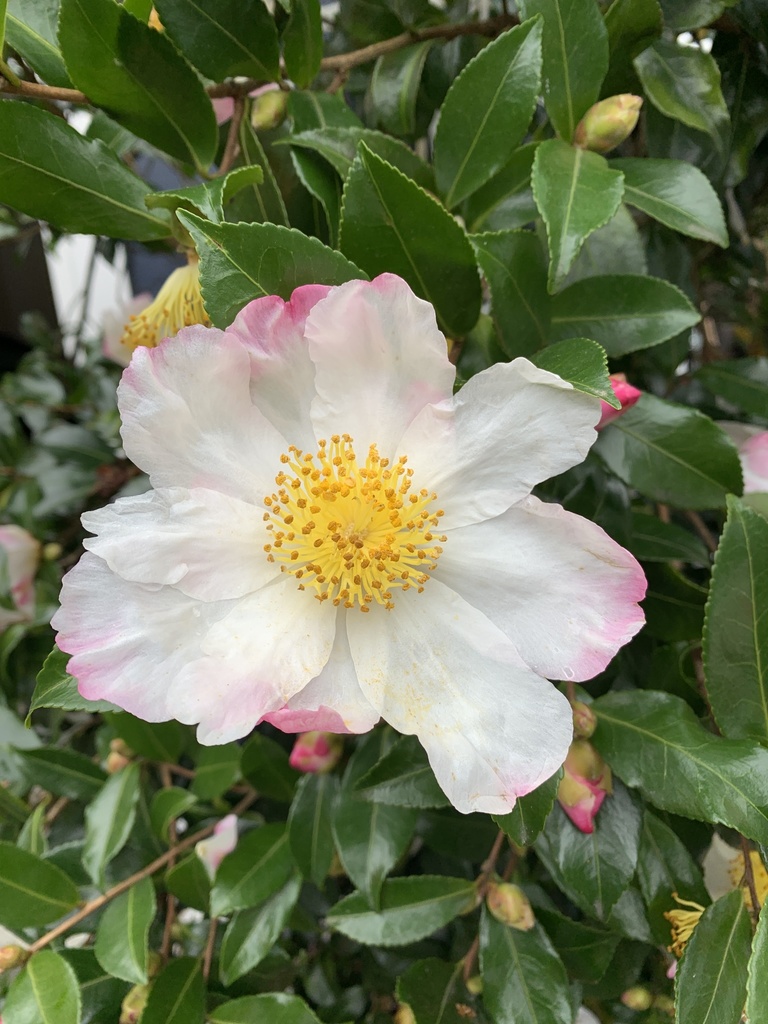
sasanqua camellia
Camellia sasanqua
Camellia sasanqua, with common name Sasanqua camellia or Christmas camellia (茶梅, サザンカ), is an evergreen shrub or small tree in the genus Camellia, section Oleifera of the family Theaceae. It is native to southern Japan (Shikoku, Kyushu) and the Ryukyu Islands. It has a long cultivation history in East Asia, used both as an ornamental plant and for seed oil extraction and leaf tea.
From the article Camellia sasanqua on Wikipedia (CC BY-SA), quoted section by section
Description
Camellia sasanqua is an evergreen shrub or small tree, usually reaching 6 m (20 ft) in height (wild specimens can reach 10 m (33 ft)). The leaves are alternate, leathery, elliptic to ovate, 2.6–6.3 cm (1.0–2.5 in) long and 0.9–3.2 cm (0.35–1.26 in) wide, with finely serrate margins. The upper surface is dark green and glossy, and young twigs, petioles, and midribs are covered with short pubescence. Flowers are solitary, terminal or axillary, 5–7.6 cm (2.0–3.0 in) in diameter. Wild-type flowers have 6–7 white petals; cultivated varieties may have pink, red, or bicolored petals, sometimes more than 20. Flowering time varies by cultivar group: early-flowering groups begin blooming from September–October, while late-flowering groups can continue until April. The fruit is a capsule, irregularly globose to pear-shaped, 1.4–2.6 cm (0.55–1.02 in) long, densely tomentose, containing 1–3 seeds per locule.
At the table
The leaves can be used as a tea substitute. Oil pressed from the seeds (sasanqua camellia oil), once refined, is suitable for cooking. Because its fatty acid composition resembles that of olive oil (oleic acid content about 82%), it is often called "Oriental olive oil". Unrefined oil can be used for lighting, lubrication, soap making, and the silk industry. The seed cake (residue after oil extraction) contains saponins and is toxic to fish. It was historically used in Hong Kong to poison fish, and in modern times is used in aquaculture to control unwanted predatory fish. The fragrant petals can be used as a raw material for perfumes. In landscaping, sasanqua camellia can be used for hedges, ground cover, specimen trees, or street trees. Its autumn–winter flowering compensates for the scarcity of blooming plants in that season. It is also suitable for container gardening, bonsai, and cut flowers. Extracts of sasanqua camellia oil exhibit antioxidant and antimicrobial activities, including inhibitory effects against pathogens such as Escherichia coli.
Wikipedia: “Uses”
How it is grown
Camellia sasanqua is adaptable to a range of light conditions, from full sun to partial shade. Compared to Camellia japonica, it exhibits greater tolerance to drought and high temperatures. During full summer sun, leaf surface temperatures may exceed 40 °C (104 °F), yet the plant continues normal growth provided that soil moisture is adequate. Most cultivars are capable of overwintering outdoors; the semi-lethal temperature for leaves is approximately −14 to −12.5 °C (6.8 to 9.5 °F). The species displays broad soil adaptability and grows well within a pH range of 5.5–7.5, although it prefers well-drained, fertile, slightly acidic sandy loam. Propagation is achieved primarily through cuttings. Semi-hardwood cuttings taken with a heel during the rainy season and maintained under high humidity and sealed conditions yield a high success rate. Grafting onto Camellia oleifera rootstock is also practiced.
Wikipedia: “Cultivation”
In human culture
The scientific name of Camellia sasanqua was formally published in 1784 by Swedish botanist Carl Peter Thunberg. While serving the Dutch East India Company, he visited Japan and recorded his findings in Flora Japonica. In Europe, true Camellia sasanqua was not introduced until 1896. Earlier, between 1811 and 1823, plants brought from China by East India Company captains and cultivated in Europe under the name C. sasanqua were actually its close relative, tea-oil camellia (C. oleifera). In China, written records of sasanqua camellia cultivation date back to the Tang dynasty. The poet Liu Zhangqing (709–786) mentioned "Haihong" (海红, "sea red") – the ancient name for the plant – in a poem praising its ability to bloom when other flowers had faded. During the Northern Song dynasty, the poet Tao Bi (1015–1078) wrote a verse distinguishing the large-flowered Camellia japonica (shanchahua) from the smaller "Haihong", clearly referring to C. sasanqua. The Luoyang Huamu Ji (《洛阳花木记》, Record of Flowers and Trees of Luoyang, 1082) by Zhou Shihou already listed "sasanqua camellia" and "double-petalled sasanqua camellia", indicating that double-flowered cultivars existed by the late 11th century. The Quanfang Beizu (《全芳备祖》, Complete Encyclopedia of Flora), compiled by Chen Jingyi (陈景沂) in 1253, also recorded a cultivar named "Haihong". …
Wikipedia: “History”
Where it lives
Recorded sightings
—
geo-referenced records in GBIF, from museums, herbaria and field observers.
Drag the globe to turn it. Dots are where records exist, not a range map; darker means more records.
In the stacks
Searching the stacks…
Every page naming Camellia sasanqua in the Biodiversity Heritage Library →
This page is assembled live from iNaturalist, GBIF, Wikipedia, the Source Library and the Internet Archive. It is not yet part of the hand-edited codex. iNaturalist taxon 126549.