- Plants
- ›Vascular Plants
- ›flowering plants
- ›Dicots
- ›Sunflowers, Bellflowers, Fanflowers, and Allies
- ›Sunflowers, Daisies, Asters, and Allies
- ›Asteroideae
- ›groundsels and allies
- ›Senecioninae
- ›Senecio
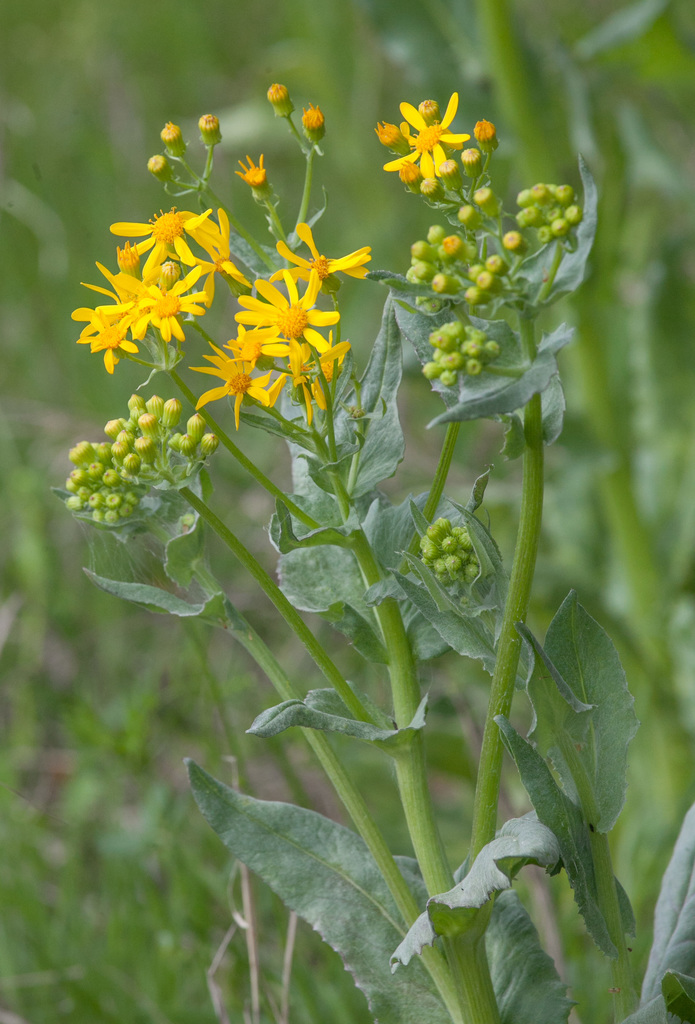
Texas ragwort
Senecio ampullaceus
Senecio ampullaceus also known as Texas ragwort, Texas squaw-weed, Texas groundsel, and Texas butterweed is a species of Senecio in the family Asteraceae and gets its Latin name ampullaceus from its flask shaped flower-head and is a recommended native for landscape use in Texas where it came from.
From the article Senecio ampullaceus on Wikipedia (CC BY-SA), quoted section by section
Description
The seedlings of S. ampullaceus often have a purplish color on the undersides of their leaves in the winter, especially along their midrib. Flowering in early–mid spring, Texas ragwort is a tall annual, growing from 20 centimeters (7.9 in) to 80 centimeters (31 in) tall and similar to S. quaylei. Stems and leaves: The leaves with broadly winged leaf stalks grow from single stems; the nodes between leaves getting shorter and shorter higher on the stem. Ovate leaves with pointed tips 3 centimeters (1.2 in) to 10 centimeters (3.9 in) long by 1.5 centimeters (0.59 in) to 4 centimeters (1.6 in) wide with tapered bases. Leaves at the lower portion of the plant have more teeth on their edges than the leaves at the upper portion of the mature plant. Stems and leaves are covered loosely and unevenly with a mat of fine hairs, though occasionally they have no hairs. Flowers: Flowering stalks have 10 to 30 flower heads which as a group make a flat top to the whole plant. Each flower head is surrounded by 2 to 8 bractlets or mini-leaves, each 1 millimeter (0.039 in) to more than 2 millimeters (0.079 in). Approximately 13 green to grayish bracts, 7 millimeters (0.28 in) to 10 millimeters (0.39 in) long, surround 8 ray florets and an 8 millimeters (0.31 in) to 10 millimeters (0.39 in) corolla. Fruits: One-seeded fruits with rigid pappus. Roots: Roots are relatively thin and branching.
Range & habitat
S. ampullaceus prefers altitudes of 100 meters (330 ft) to 800 meters (2,600 ft) in open sandy or disturbed sites. Native:
Nearctic: North-central United States: Missouri Southeastern United States: Arkansas South-central United States: Texas or
Southeastern United States: Arkansas South central United States: Texas Current:
Nearctic: North-central United States: Missouri, Oklahoma Southeastern United States: Arkansas South-central United States: Texas
Wikipedia: “Distribution”
Where it lives
Recorded sightings
—
geo-referenced records in GBIF, from museums, herbaria and field observers.
Drag the globe to turn it. Dots are where records exist, not a range map; darker means more records.
In the stacks
Searching the stacks…
Every page naming Senecio ampullaceus in the Biodiversity Heritage Library →
This page is assembled live from iNaturalist, GBIF, Wikipedia, the Source Library and the Internet Archive. It is not yet part of the hand-edited codex. iNaturalist taxon 126605.