- Plants
- ›Vascular Plants
- ›flowering plants
- ›Dicots
- ›Mallows, Rock Roses, and Allies
- ›Mallow and Hibiscus Family
- ›Malvoideae
- ›Malveae
- ›Sphaeralcea
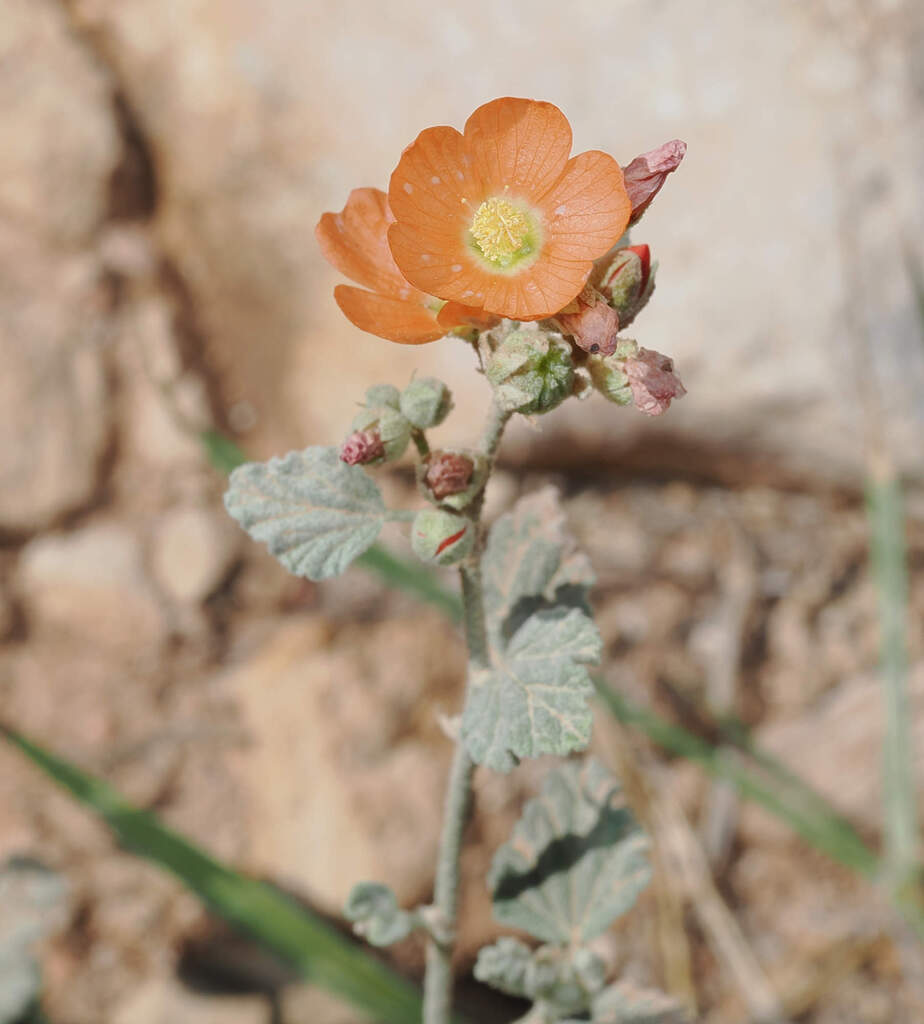
Small-leaf Globemallow
Sphaeralcea parvifolia
Sphaeralcea parvifolia, commonly called small-leaved globe-mallow or small-leaf globemallow, is a species of plant native to the western United States in the Great Basin and Colorado River drainage. It is medium sized herbaceous species that has showy orange flower spikes. It is used in wildflower and dry gardens.
From the article Sphaeralcea parvifolia on Wikipedia (CC BY-SA), quoted section by section
Description
Sphaeralcea parvifolia is a perennial plant with stems that grow straight upwards to as much as 1 meter (3.3 ft), but more often grows to between 15 and 40 centimeters (6 and 16 in). The stems sprout from an underground branched, slightly woody structure called a caudex. The surface of the stems are covered in short, fine white to yellow hairs. The leaves of Sphaeralcea parvifolia are egg shaped (ovate) with the widest part between the midpoint and base, but may also be nearly circular in outline, kidney shaped, or a shape halfway between a heart-shaped leaf and an egg shaped one. Leaves may have smooth edges or have three to five shallow lobes. They are gray to green in color and range in size from 1 to 5.5 centimeters long and 1.2 to 5.2 cm wide. The leaves emerge in the spring and die back in summer to conserve water and do not do much stem photosynthesis.
Flowers. Though each flower is not very large the clusters are quite noticeable. The inflorescence is a crowded and narrow panicle, it has determinate growth on the branches of the flowering stem making it a thyrse. Usually there is more than one flower at each node on the stem. The tip of the flowering stem is not leafy. The flowers are most often orange or salmon colored, but may, very occasionally, be white or somewhat pink. The five petals measure just 7-15 millimeters long. …
Range & habitat
Sphaeralcea parvifolia grows in much of the Four Corners region of the United States west to the Sierra Nevada. They grow throughout the state of Nevada, most of Utah and Arizona, and the western portions of Colorado and New Mexico. They also are found in Idaho, but listed as an introduced species in that state by Plants of the World Online. It grows in especially large numbers in north-central and northern Arizona. It grows in amid salt desert shrub, blackbrush, sagebrush, and pinyon–juniper woodlands. In addition it frequently grows alongside roads. It grows at elevations of 1500 to 2100 meters.
Wikipedia: “Range and habitat”
What it does
Small-leaf globemallow is a host for the caterpillars of the common checkered-skipper along with many other plants in the mallow family.
Wikipedia: “Ecology”
How it is grown
Small-leaf globemallow is used in xeriscape gardening and as a naturalizing plant. It prefers productive soils rather than a barren soils. It is winter hardy in USDA zones 5–10.
== References ==
Wikipedia: “Cultivation”
Where it lives
Recorded sightings
—
geo-referenced records in GBIF, from museums, herbaria and field observers.
Drag the globe to turn it. Dots are where records exist, not a range map; darker means more records.
In the stacks
Searching the stacks…
Every page naming Sphaeralcea parvifolia in the Biodiversity Heritage Library →
This page is assembled live from iNaturalist, GBIF, Wikipedia, the Source Library and the Internet Archive. It is not yet part of the hand-edited codex. iNaturalist taxon 126667.