- Plants
- ›Vascular Plants
- ›flowering plants
- ›Dicots
- ›Roses, Elms, Figs, and Allies
- ›mulberry and fig family
- ›Moreae
- ›Morus
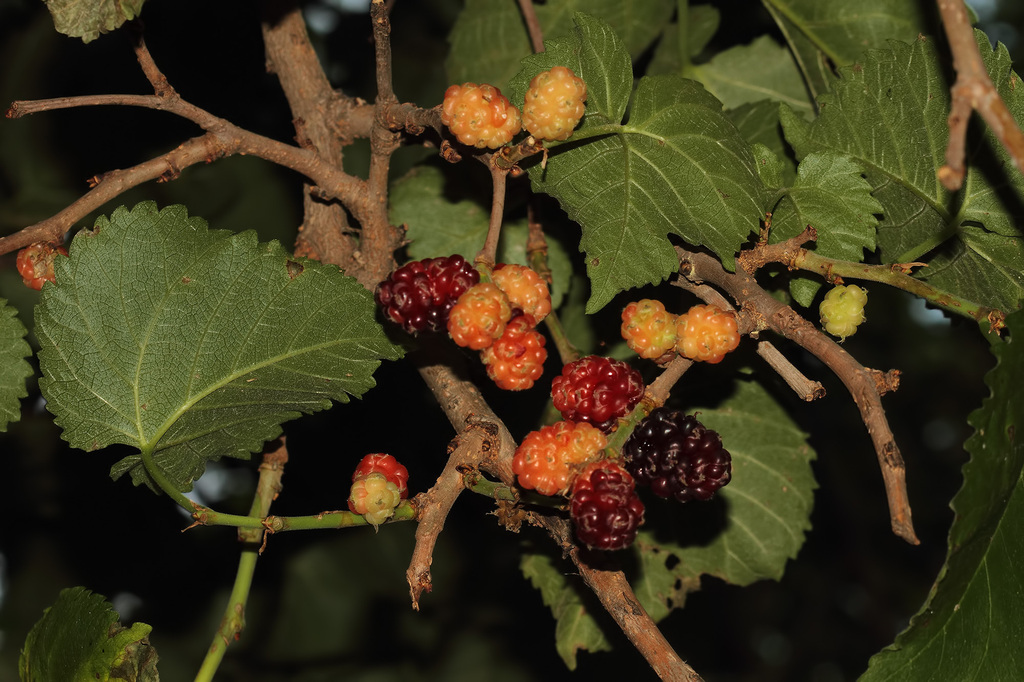
black mulberry
Morus nigra
Morus nigra, called black mulberry or blackberry (not to be confused with the blackberries which are various species of Rubus), is a species of flowering plant in the family Moraceae, native to southwestern Asia, where it has been cultivated for so long that its precise natural range is unknown. It is known for its large number of chromosomes, as it has 154 pairs (308 individuals). Other mulberry species are sometimes confused with black mulberry, particularly black-fruited...
From the article Morus nigra on Wikipedia (CC BY-SA), quoted section by section
Description
Morus nigra is a deciduous tree growing to 12 metres (39 feet) tall by 15 m (49 ft) broad. The leaves are 10–20 centimetres (4–8 inches) long by 6–10 cm (2–4 in) broad – up to 23 cm (9 in) long on vigorous shoots, downy on the underside, the upper surface rough with very short, stiff hairs. Each somatic cell has 308 chromosomes in total, and exhibits tetratetracontaploidy (44x), meaning that its genome contains seven chromosomes, and each somatic cell has 44 copies of each. This is reported as ”the highest number of polyploidies among any known spermatophyte species“. The fruit is a compound cluster of several small drupes that are dark purple, almost black when ripe, and they are 2.5 cm (1 in) in diameter. Black mulberry is richly flavoured, similar to the red mulberry (Morus rubra) rather than the more insipid fruit of the white mulberry (Morus alba). Mulberry fruit color derives from anthocyanins. Sometimes other mulberry species are confused with black mulberry, particularly black-fruited individuals of the white mulberry. Black mulberry may be distinguished from the white mulberry by the uniformly hairy lower surface of its leaves.
At the table
Black mulberries (Morus nigra) are thought to have originated in the mountainous areas of Mesopotamia and Persia (i.e. Armenian highlands). Black mulberry is planted, and often naturalised, west across much of Europe, including Ukraine, and east into China. Now they are widespread throughout Armenia, Afghanistan, Iraq, Iran, India, Pakistan, Syria, Lebanon, Jordan, Palestine, and Turkey. The fruit is edible and the tree has long been cultivated for this property. Both the tree and the fruit are known by the Persian-derived names toot (mulberry) or shahtoot (شاه توت) (king's or "superior" mulberry), or, in Arabic, as shajarat tukki. Often, jams and sherbets are made from the fruit in this region. The fruit has been present in the Southern Levant since antiquity. In the Books of Maccabees, it is noted that the Greeks used the fruit to provoke their war elephants in preparation for battle against Jewish rebels during the Maccabean Revolt in the 2nd century BCE. The fruit is also mentioned in the Mishnah and later rabbinic texts. In the 9th century CE, Al-Kindi referenced the fruit as having healing seeds, while Ibn Badis, writing in the 11th century, noted its use in the production of ink. In Europe, the largest-documented local concentration of black mulberries may be found in the vineyards of Pukanec in Slovakia, which contain 470 black mulberry trees. …
Wikipedia: “Cultivation and uses”
Where it lives
Recorded sightings
—
geo-referenced records in GBIF, from museums, herbaria and field observers.
Drag the globe to turn it. Dots are where records exist, not a range map; darker means more records.
In the stacks
Searching the stacks…
Every page naming Morus nigra in the Biodiversity Heritage Library →
This page is assembled live from iNaturalist, GBIF, Wikipedia, the Source Library and the Internet Archive. It is not yet part of the hand-edited codex. iNaturalist taxon 126741.