- Plants
- ›Vascular Plants
- ›flowering plants
- ›monocots
- ›Agaves, Orchids, Irises, and Allies
- ›agave and allies
- ›cabbage tree subfamily
- ›Thysanotus
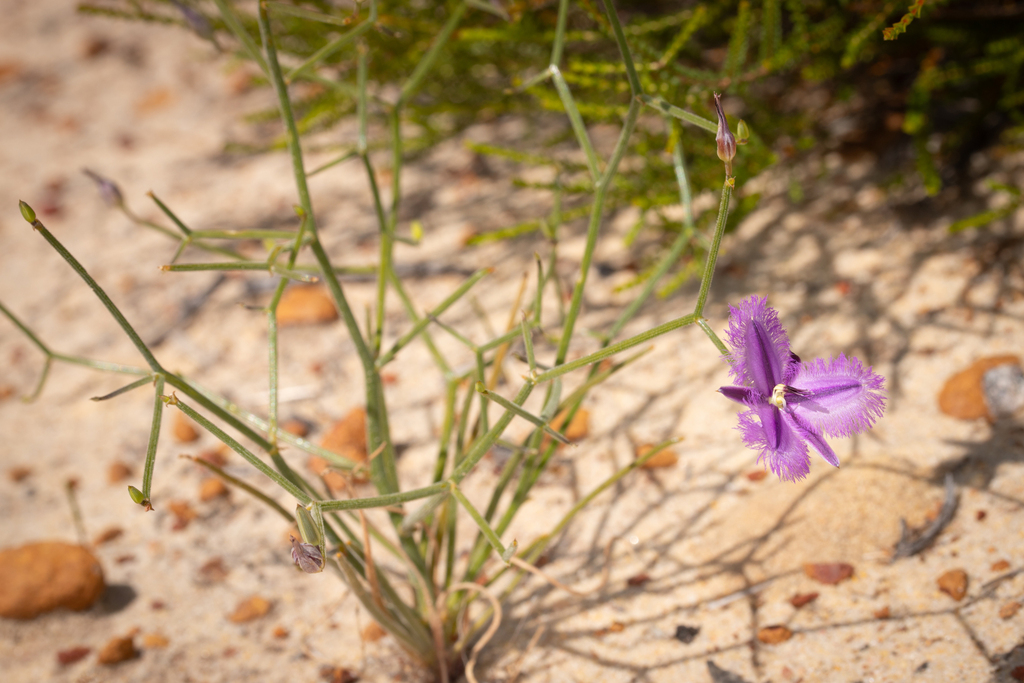
Thysanotus kalbarriensis
Thysanotus kalbarriensis, commonly known as Kalbarri fringe lily, is a species of flowering plant in the Asparagaceae family, and is endemic to Kalbarri National Park the north-west of Western Australia. It is a short-lived perennial with six to nine insignificant leaves or sometimes absent, purple flowers with clustered stamens, and a style strongly bent to one side and well-separated from the stamen cluster.
From the article Thysanotus kalbarriensis on Wikipedia (CC BY-SA), quoted section by section
Description
Thysanotus kalbarriensis is a short-lived, self-supporting perennial with a compact rootstock and fibrous roots. It has six to nine insignificant leaves 14–53 mm (0.55–2.09 in) long and 0.8–1.6 mm (0.031–0.063 in) wide, sometimes with no leaves. In the first season, the stem are much-branched and form a dense, interlocking tangle 10–25 cm (3.9–9.8 in) high. Later stems are several to many, erect to ascending, 30–55 cm (12–22 in) long, with up to three flowers in umbels, each flower on a pedicel 3–5.5 mm (0.12–0.22 in) long. The perianth is 9.5–12 mm (0.37–0.47 in) long with broadly linear, dark purple on the upper surface with pale edges, the petals purple with a darker purple central stripe. There are six stamens in a tight cluster, the anthers of two different lengths. The ovary is more or less cylindrical, and the style is strongly beneficial to one side, well separated from the stamen cluster. Flowering has been recorded from August to early November.
Range & habitat
This species of Thysanotus grows in sand in shrublands that are often dominated by species of Banksia and Grevillea, and the species is only known from Kalbarri National Park in the Geraldton Sandplains bioregion of north-western Western Australia.
Wikipedia: “Distribution and habitat”
Where it lives
Recorded sightings
—
geo-referenced records in GBIF, from museums, herbaria and field observers.
Drag the globe to turn it. Dots are where records exist, not a range map; darker means more records.
In the stacks
Searching the stacks…
Every page naming Thysanotus kalbarriensis in the Biodiversity Heritage Library →
This page is assembled live from iNaturalist, GBIF, Wikipedia, the Source Library and the Internet Archive. It is not yet part of the hand-edited codex. iNaturalist taxon 1268036.