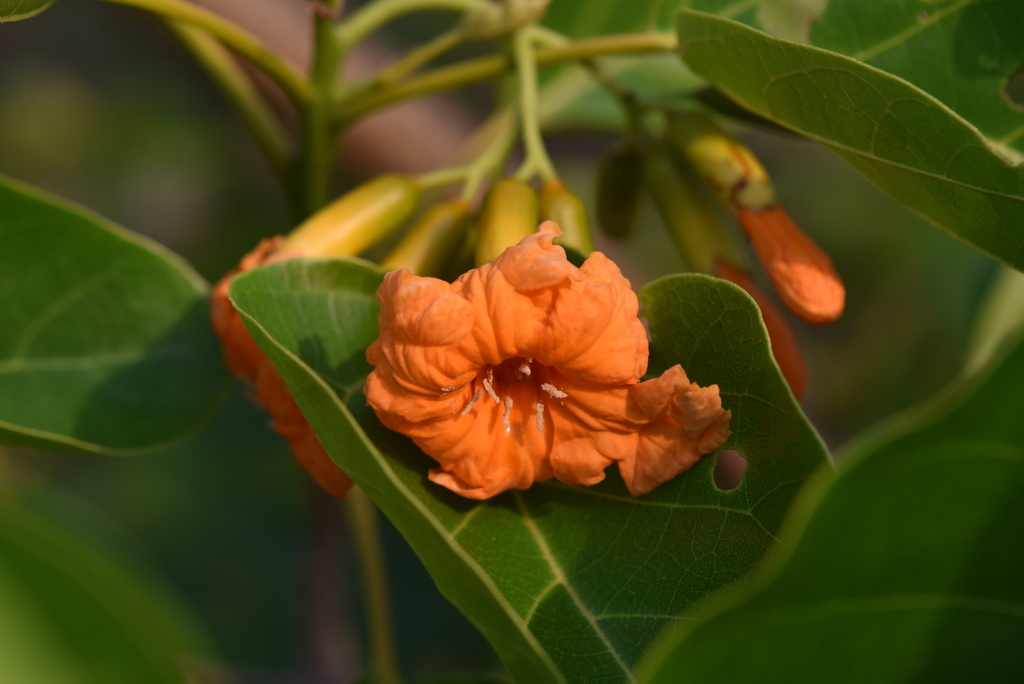
Kerosene Tree
Cordia subcordata
Cordia subcordata is a species of flowering tree in the borage family, Boraginaceae, that occurs in eastern Africa, South Asia, Southeast Asia, northern Australia and the Pacific Islands. The plant is known by a variety of names including mareer, kerosene wood, manjak, snottygobbles, glueberry, narrow-leafed bird lime tree, "kanawa," tou, and kou. In Java and Madura, it is known as kalimasada, purnamasada, or pramasada; Javanese folklore consider the tree to contain spiritual power.
From the article Cordia subcordata on Wikipedia (CC BY-SA), quoted section by section
Description
Cordia subcordata often grows to about 7–10 m (23–33 ft), but can reach up to 15 m (49 ft). It has ovate leaves that are 8–20 cm (3.1–7.9 in) and 5–13 cm (2.0–5.1 in) wide with short hairs on the upper surface.
Flowers and fruit. Blooming occurs throughout the year, but most flowers are produced in the spring. The flowers are funnel- or tube-shaped 1–2 cm (0.39–0.79 in) long and 0.4–0.8 cm (0.16–0.31 in) in diameter, with orange petals and pale green sepals. The flowers are produced in cymes or panicles. The fruit are spherical 2–3 cm (0.79–1.18 in) long, brown, and woody when mature, and are produced all year round. Each fruit contains up to four that are 10–13 mm (0.39–0.51 in) long. The fruit are buoyant and may be carried very far by ocean currents.
Range & habitat
C. subcordata has a very wide range from the east coast of Africa east throughout tropical Asia and Oceania, as far as Hawaii. This distribution arose from the special characteristics of its fruit, which allowed successful oceanic dispersal. Prior to 2001, C. subcordata was considered to be a Polynesian introduction to Hawaii by many authorities, but subfossil evidence from Makauwahi Cave in Kauai indicates that it was an abundant species in Hawaiian lowland forests well before humans arrived, confirming its status as an indigenous species. The species is found along coasts at elevations from sea level to 30 m (98 ft) that receive 1,000–4,000 mm (39–157 in) of annual rainfall. They prefer neutral to alkaline soils (pH of 6.1 to 7.4), such as those originating from basalt, limestone, clay, or sand. Allowable soil textures include sand, sandy loam, loam, sandy clay loam, sandy clay, clay loam, and clay. It can also grow on the margins of rocky shores and mangrove swamps.
Wikipedia: “Distribution and habitat”
At the table
The seeds are edible and have been eaten during famine. The wood of the tree has a specific gravity of 0.45, is soft, durable, easily worked, and resistant to termites. In ancient Hawaiʻi kou wood was used to make ʻumeke (bowls), utensils, and ʻumeke lāʻau (large calabashes) because it did not impart a foul taste to food. ʻUmeke lāʻau were 8–16 litres (2–4 gal) and used to store and ferment poi. Kou was also used to carve kiʻi ('religious images'). The wood burns readily, and this led to the nickname of "kerosene tree" in Papua New Guinea. The flowers were used to make lei, while a dye for kapa cloth and aho (fishing lines) was derived from the leaves. Fijians obtain fibre to make baskets and garlands from its inner bark by soaking it in seawater. In the western Solomon Islands, in Vanuatu, on Waya Island, and in Tonga, it is used for carving. On New Ireland, its wood is always used for the ceremonial entrances to men's houses.
Wikipedia: “Uses”
Where it lives
Recorded sightings
—
geo-referenced records in GBIF, from museums, herbaria and field observers.
Drag the globe to turn it. Dots are where records exist, not a range map; darker means more records.
In the stacks
Searching the stacks…
Every page naming Cordia subcordata in the Biodiversity Heritage Library →
This page is assembled live from iNaturalist, GBIF, Wikipedia, the Source Library and the Internet Archive. It is not yet part of the hand-edited codex. iNaturalist taxon 126840.