- Plants
- ›Vascular Plants
- ›flowering plants
- ›monocots
- ›Agaves, Orchids, Irises, and Allies
- ›Aloe family
- ›Aloes and allies
- ›Aloe
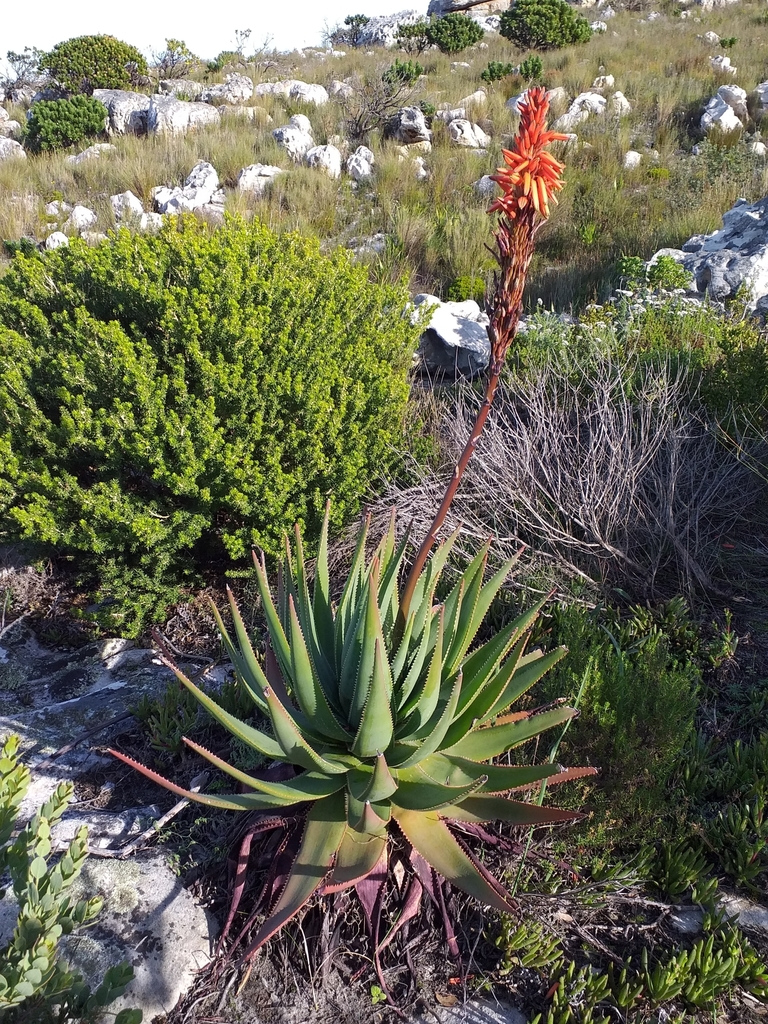
Fynbos Aloe
Aloe succotrina
Aloe succotrina, the Fynbos aloe, is an aloe which is endemic to Cape Town and the south-western corner of the Western Cape, South Africa.
From the article Aloe succotrina on Wikipedia (CC BY-SA), quoted section by section
Description
The Aloe succotrina plant forms clusters of between 1–2 metres (3.3–6.6 ft) diameter, with its leaves forming dense rosettes. In winter when it flowers (June to September) it produces a tall raceme, bearing shiny red flowers that are pollinated by sunbirds. Taxonomically, it forms part of the Purpurascentes series of very closely related Aloe species, together with Aloe microstigma, Aloe gariepensis, Aloe khamiesensis and Aloe framesii.
Range & habitat
Aloe succotrina is naturally found on the Cape Peninsula, and as far as Mossel Bay to the east. This aloe is common in Peninsula Sandstone Fynbos vegetation, and typically grows high up on cliff faces and rocky outcrops where seasonal fires do not reach it. It is one of the few Aloes that naturally occur in fynbos habitats - along with the Fan Aloe and Aloiampelos commixta of Table Mountain. It is one of only three aloes and their relatives, with Aloiampelos commixta and Aloe maculata, that are indigenous to the city of Cape Town.
Wikipedia: “Distribution”
At the table
Aloe succotrina can easily be grown as an ornamental plant in Mediterranean climate gardens, rockeries, and in containers. It is particularly striking in winter, when it flowers. Western Cape gardens use it in Fynbos native plant themed natural landscaping. The plant prefers a sunny, well drained spot. Space should be provided for maturity, as it eventually grows into a large and dense cluster. The Fynbos aloe can be propagated both by cuttings/offshoots or by seed. This species has uses as a medicinal plant.
Wikipedia: “Cultivation and uses”
Where it lives
Recorded sightings
—
geo-referenced records in GBIF, from museums, herbaria and field observers.
Drag the globe to turn it. Dots are where records exist, not a range map; darker means more records.
In the old herbals & bestiaries

In the stacks
Searching the stacks…
Every page naming Aloe succotrina in the Biodiversity Heritage Library →
This page is assembled live from iNaturalist, GBIF, Wikipedia, the Source Library and the Internet Archive. It is not yet part of the hand-edited codex. iNaturalist taxon 126883.