- Plants
- ›Vascular Plants
- ›flowering plants
- ›Dicots
- ›Heathers, Balsams, Primroses, and Allies
- ›sapodilla family
- ›Pouteria
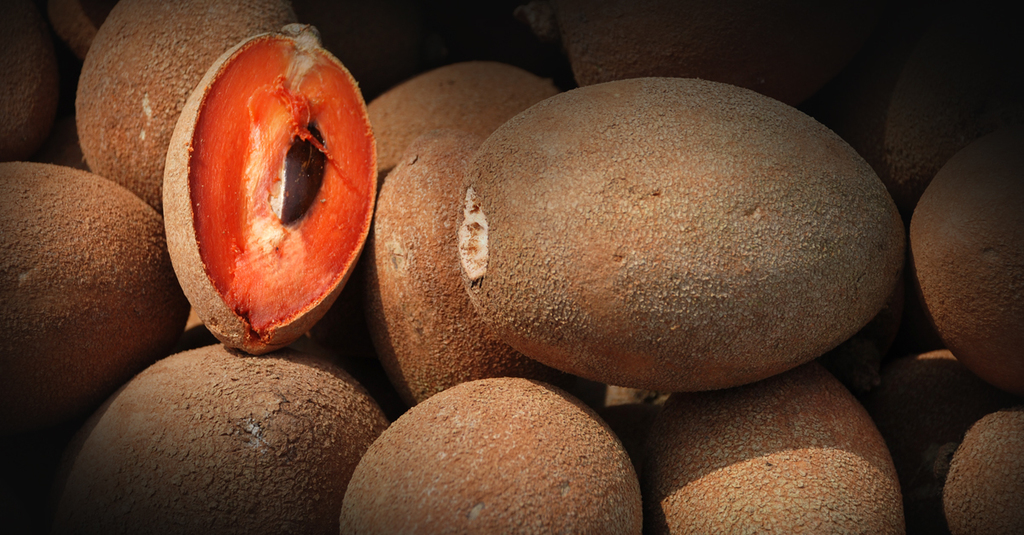
Mamey sapote
Pouteria sapota
Pouteria sapota, mamey sapote, is a species of tree native to Mexico and Central America, naturally ranging from southern Mexico to southern Costa Rica, plus Cuba. Today, the tree is cultivated not only in Mexico, but also in Central America, the Caribbean, and South Florida for its fruit, which is commonly eaten in many Latin American countries. Mamey can be found in many Latin American communities throughout the USA, where it is made into milkshakes and...
From the article Pouteria sapota on Wikipedia (CC BY-SA), quoted section by section
Description
Mamey sapote is a large evergreen tree that can reach a height of 15 to 45 m (49 to 148 ft) at maturity. It is sometimes grown for its ornamental value in addition to its fruit. The fruit, botanically a berry, is about 10 to 25 cm (4 to 10 in) long and 8 to 12 cm (3 to 4.5 in) wide and has flesh ranging in color from pink to orange to red. The brown skin has a texture somewhat between sandpaper and the fuzz on a peach. The fruit's texture is creamy and soft, and the flavor is a mix of sweet potato, pumpkin, honey, prune, peach, apricot, cantaloupe, cherry, and almond. A mamey sapote is ripe when the flesh is vibrant salmon in color when a fleck of the skin is removed. The flesh should give slightly, as with an overripe avocado. The leaves are pointed at both ends, 4 to 12 inches in length, and grow in clusters at the ends of branches. The mamey sapote is in the same family as, and thus closely botanically related to, other sapotes such as sapodilla (Manilkara zapota), abiu (P. caimito), and canistel (Lucuma campechiana). However, other fruits that go by the common name 'sapote' are less closely related, such as the black sapote (Diospyros nigra) and white sapote (Casimiroa edulis).
Range & habitat
The native range probably extends from the southern Mexican states of Veracruz, Tabasco, and Chiapas through Nicaragua, Belize, and northern Honduras. This is uncertain, however, because the tree was already widely cultivated in the tropical Americas prior to European colonization. Today, it is cultivated in most Mexican states, many Caribbean islands, and tropical continental America from Florida to Brazil. The first record of cultivation in south Florida dates to the 1880s. It has also been introduced to the Philippines, Indonesia, Malaysia, and Vietnam.
Wikipedia: “Distribution”
At the table
The fruit is eaten raw or made into milkshakes, smoothies, ice cream, and paletas. It can be used to produce marmalade and jelly. Some beauty products use oil pressed from the seed, otherwise known as sapayul oil.
Nutrition. The fruit is an excellent source of vitamins B6 and C, and is a good source of riboflavin, niacin, vitamin E, manganese, potassium, and dietary fiber. Research has identified several new carotenoids from the ripe fruit.
Wikipedia: “Uses”
How it is grown
It prefers smooth sandy, deep, clay and fertile soils, with pH of 5.5 to 6.5. The species does not tolerate low temperatures, prolonged periods of drought, or soils with bad drainage or where the water table is very high. It is mainly propagated by grafting, which ensures the new plant has the same characteristics as the parent, especially its fruit, as it does not grow true to seed. Grafting also produces fruiting trees considerably faster than growing by seed - grafted trees produce fruit in 3–5 years while trees grown from seed require 7 or more years of growth before fruiting. Seeds lose viability within a month of harvest, so should be sown immediately. Pouteria sapota trees are quite productive fruiters. A typical mature tree may produce 200–500 fruits per year, while vigorous established trees may produce more than twice this amount. The 2017 production average for Mexican growers was 12.4 tons/hectare. In Florida, the fruit is harvested from May to July with some cultivars producing year-round.
Pests and diseases. Pouteria sapota is not often troubled by significant insect damage. …
Wikipedia: “Cultivation”
Where it lives
Recorded sightings
—
geo-referenced records in GBIF, from museums, herbaria and field observers.
Drag the globe to turn it. Dots are where records exist, not a range map; darker means more records.
In the stacks
Searching the stacks…
Every page naming Pouteria sapota in the Biodiversity Heritage Library →
This page is assembled live from iNaturalist, GBIF, Wikipedia, the Source Library and the Internet Archive. It is not yet part of the hand-edited codex. iNaturalist taxon 126925.