- Animals
- ›Molluscs
- ›Gastropods
- ›Caenogastropods
- ›Littorinimorpha
- ›Looping Snails and Allies
- ›Bithyniidae
- ›Bithyniinae
- ›Bithynia
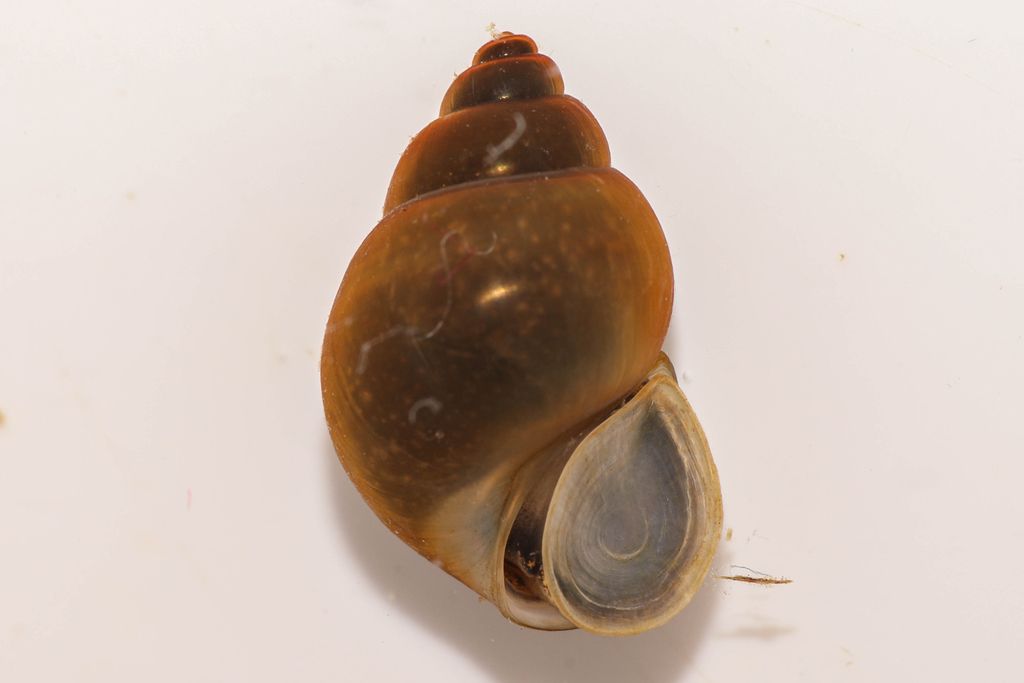
Mud Bithynia
Bithynia tentaculata
Bithynia tentaculata, common names the mud bithynia or common bithynia, or faucet snail is a relatively small species of freshwater snail with gills and an operculum, an aquatic prosobranch gastropod mollusk in the family Bithyniidae.
From the article Bithynia tentaculata on Wikipedia (CC BY-SA), quoted section by section
Description
The height of shell is usually no larger than 12–15 mm. The snail is sexually mature by the time the height of shell reaches 8 mm in size. The width of the shell is 5–7 mm. The faucet snail has a shiny pale brown shell, oval in shape, with a relatively large and rounded spire consisting of 5–6 somewhat flattened whorls, no umbilicus, and a very thick lip. The aperture is less than half the height of the shell. Adult Bithynia tentaculata possess a white, calcareous, tear-drop to oval-shaped operculum with distinct concentric rings. The operculum of juveniles, however, is spirally marked. The operculum (on the back of the foot) is always situated very close to the aperture of the shell. The animal itself has pointed, long tentacles and a simple foot with the right cervical lobe acting as a channel for water.
Range & habitat
The distribution of Bithynia tentaculata is Palearctic. The species occurs in: Northern Europe:
Scandinavia Central Europe:
Czech Republic – least concern (LC) Germany – common species overall in Germany, but is listed as endangered (gefährdet) in Saxony and in Thuringia Poland Slovakia Western Europe:
British Isles: Great Britain and Ireland Netherlands Eastern Europe:
Ukraine Southeastern Europe:
Bulgaria – There is southern distribution border of Bithynia tentaculata in northern Bulgaria. Croatia Bithynia tentaculata has been mentioned from Greece, but it does not occur there. It probably does not occur in Turkey and in Iran.
Wikipedia: “Indigenous distribution”
What it does
This species functions as both a scraper and a collector-filterer, grazing on algae on the substrate, as well as using its gills to filter suspended algae from the water column. When filter feeding, algae is sucked in, condensed, and then passed out between the right tentacle and exhalant siphon in pellet-like packages which are then eaten. The ability to filter feed may play a role in allowing populations of the faucet snail to survive at high densities in relatively eutrophic, anthropogenically influenced water bodies. Bithynia tentaculata feeds selectively on food items. The faucet snail is known in Eurasia to feed on black fly larvae.
Wikipedia: “Feeding habits”
Where it lives
Recorded sightings
—
geo-referenced records in GBIF, from museums, herbaria and field observers.
Drag the globe to turn it. Dots are where records exist, not a range map; darker means more records.
In the stacks
Searching the stacks…
Every page naming Bithynia tentaculata in the Biodiversity Heritage Library →
This page is assembled live from iNaturalist, GBIF, Wikipedia, the Source Library and the Internet Archive. It is not yet part of the hand-edited codex. iNaturalist taxon 127189.