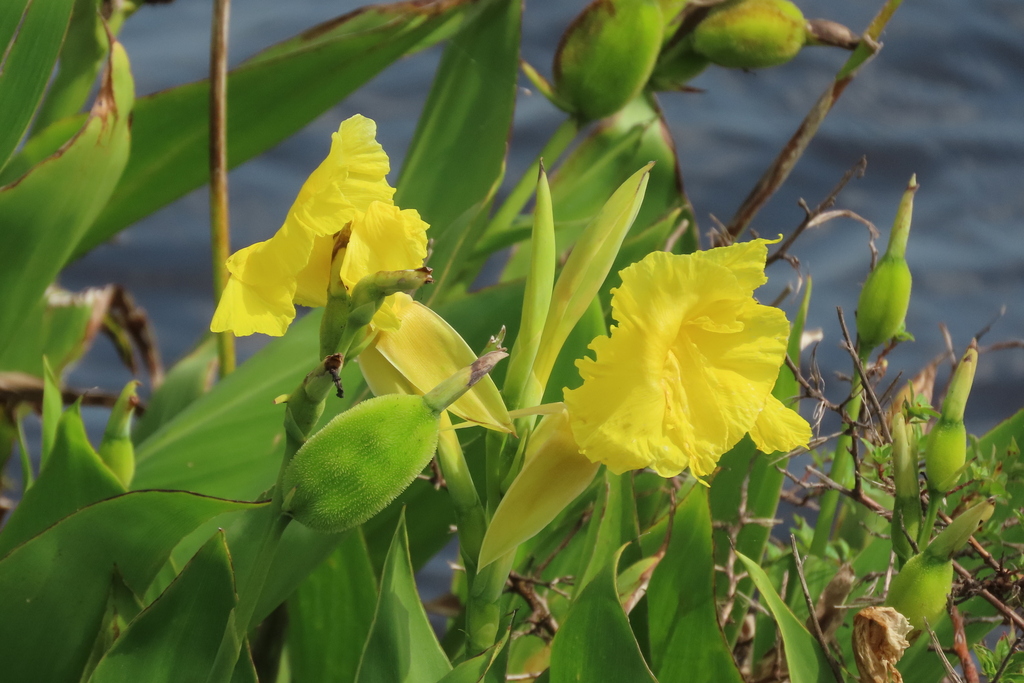
Golden Canna
Canna flaccida
Canna flaccida, sometimes referred to as the bandanna of the Everglades, is a species of the Canna genus, a member of the family Cannaceae. The species is indigenous to the wetlands of the south-central and south-eastern United States from Texas to South Carolina. It is also reportedly naturalized in India, the Philippines, Mexico, Panama, Cuba, the Dominican Republic, Peru and southern Brazil.
Canna flaccida was a parent to many of the early-hybridised cannas originally known as orchid flowered cannas, but now correctly named as Italian Group cannas. It grows well as a water canna. Originally described by the early American explorer, William Bartram, when he found these plants blooming near the rivers of coastal Georgia. The seed floats down the rivers and becomes easily established on shorelines. Introduced to England in 1788.
From the article Canna flaccida on Wikipedia (CC BY-SA), quoted section by section
Description
Canna flaccida is an aquatic species, with narrow, blue-green (glaucous) leaves, and large, lightly perfumed, canary yellow flowers growing in clusters at the tops of long stalks. The lip of the flower is wavy. Flowers emerge in the evening and wither in the heat of the following day, the only member of the genus that behaves in this manner; all others open early in the morning and are strong enough to survive at least one day. It grows as a marginal plant in up to about 15 cm (5.9 in) of still or slow-moving water.
Where it lives
Recorded sightings
—
geo-referenced records in GBIF, from museums, herbaria and field observers.
Drag the globe to turn it. Dots are where records exist, not a range map; darker means more records.
In the stacks
Searching the stacks…
Every page naming Canna flaccida in the Biodiversity Heritage Library →
This page is assembled live from iNaturalist, GBIF, Wikipedia, the Source Library and the Internet Archive. It is not yet part of the hand-edited codex. iNaturalist taxon 127279.