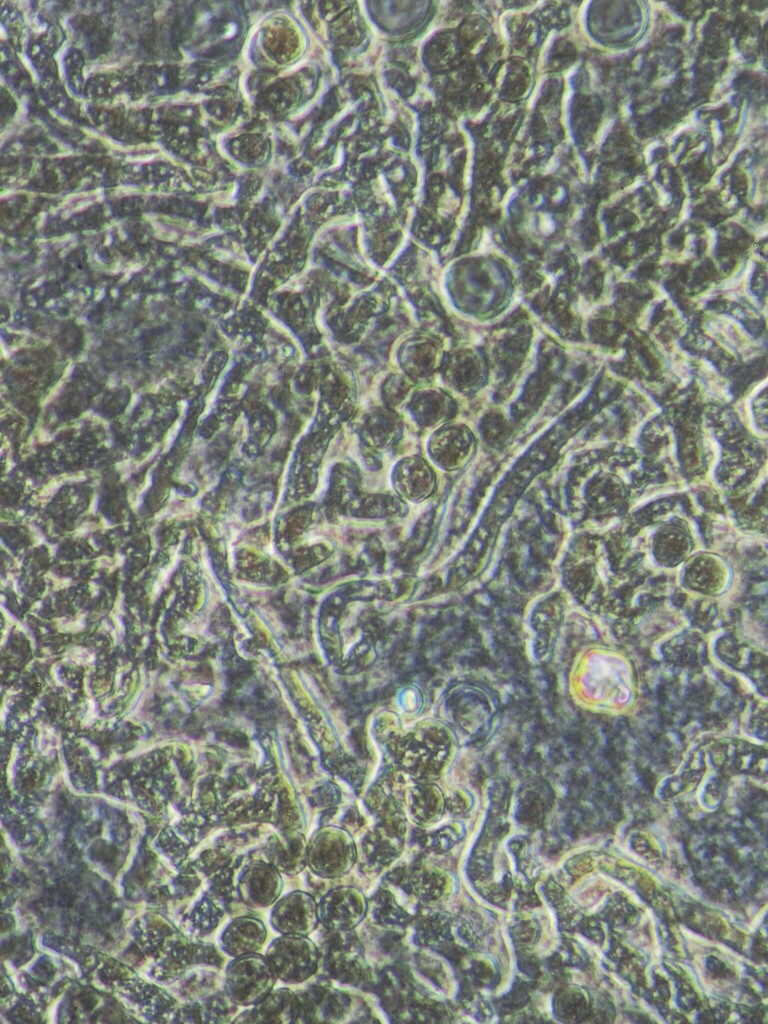
Lagenidium giganteum
Lagenidium giganteum forma caninum is a fungus-like organism that belongs to the genus Lagenidium. In some mammal species, it causes lagenidiosis, a disease characterized by progressive, severe, and invasive cutaneous, subcutaneous, and disseminated infection. Clinical and pathological aspects of the disease are almost identical to pythiosis. The first cases of lagenidiosis in mammals were officially reported in dogs in 2003. Since then, it has become increasingly recognized in dogs and cats as a cause of skin lesions.
From the article Lagenidium giganteum f. caninum on Wikipedia (CC BY-SA), quoted section by section
What it does
The life cycle and habitat of L. giganteum f. caninum is similar to its related species, L. giganteum, which can grow without a host. It can be found in bodies of fresh water and is observed to sustain mosquito populations. The life cycle of L. giganteum is initiated by a biflagellate zoospore that infects a mosquito larvae host by attachment, and undergoes encystment, penetration, and growth. The zoospore production can occur either by sexual or asexual reproduction that seems to require exogenous sources of sterols structurally related to cholesterol. For mycelial growth, the organism kills the host by starvation. Cells can reproduce asexually while forming an exit tube, where the content migrates to the tube's tip and quickly matures into zoospores, or alternately, two cells can fuse, forming oospores as seen in Saprolegnia sp. cycle. Lagenidum giganteum can undergo a latent stage surviving for long periods (months to years). The saprophytic or vegetative stage of the oomycetes from the genus Lagenidium is characterized by filamentous mycelial growth and requires little carbon and nitrogen sources. Hyphae can survive indefinitely as a saprophyte while using energy source from rotting vegetation, dead insects, or other organic material.
Wikipedia: “Life cycle”
Where it lives
Recorded sightings
—
geo-referenced records in GBIF, from museums, herbaria and field observers.
Drag the globe to turn it. Dots are where records exist, not a range map; darker means more records.
In the stacks
Searching the stacks…
Every page naming Lagenidium giganteum in the Biodiversity Heritage Library →
This page is assembled live from iNaturalist, GBIF, Wikipedia, the Source Library and the Internet Archive. It is not yet part of the hand-edited codex. iNaturalist taxon 1273344.