- Fungi Including Lichens
- ›Basidiomycete Fungi
- ›Higher Basidiomycetes
- ›Mushrooms, Bracket Fungi, Puffballs, and Allies
- ›Agaricomycetidae
- ›Common Gilled Mushrooms and Allies
- ›Marasmiineae
- ›Omphalotaceae
- ›Collybiopsis
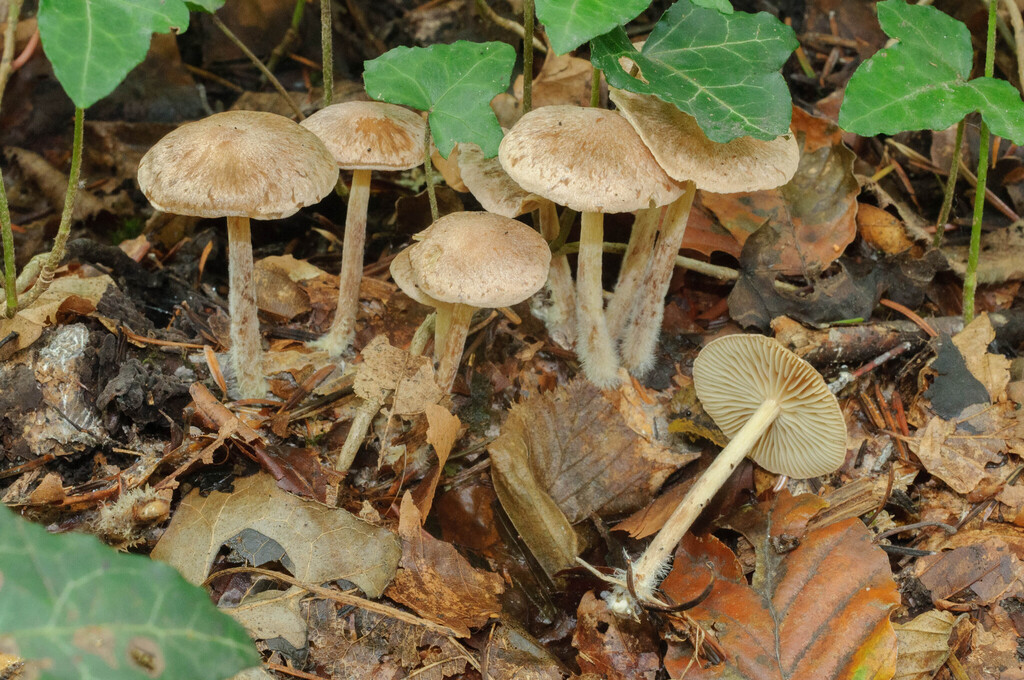
Wood Woolly-foot
Collybiopsis peronata
Collybiopsis peronata, also known as wood woolly-foot, is a species of gilled mushroom which is common in European woods.
From the article Collybiopsis peronata on Wikipedia (CC BY-SA), quoted section by section
Range & habitat
This saprobic mushroom grows generally in smaller or larger clumps on leaves or needles in deciduous or coniferous woods and may be found from May to December. It is common throughout Europe, and has also been reported from a few sites in America and Japan.
Wikipedia: “Distribution, habitat & ecology”
At the table
This fungus is generally regarded as inedible, mainly because of its peppery or acrid taste, and has little human impact. However, according to one Spanish web site it may be dried, ground up, and used as a condiment. One 1948 paper states that this species generates hydrogen cyanide (HCN) in detectable amounts, suggesting that it is poisonous. However the same paper lists other mushrooms normally considered edible, such as Infundibulicybe geotropa, as having the same characteristic, so it is difficult to know how much significance to attribute to this observation.
Wikipedia: “Edibility”
Where it lives
Recorded sightings
—
geo-referenced records in GBIF, from museums, herbaria and field observers.
Drag the globe to turn it. Dots are where records exist, not a range map; darker means more records.
In the stacks
Searching the stacks…
Every page naming Collybiopsis peronata in the Biodiversity Heritage Library →
This page is assembled live from iNaturalist, GBIF, Wikipedia, the Source Library and the Internet Archive. It is not yet part of the hand-edited codex. iNaturalist taxon 1275360.