- Animals
- ›Arthropods
- ›Hexapods
- ›Insects
- ›Winged and Once-winged Insects
- ›Ants, Bees, Wasps, and Sawflies
- ›Narrow-waisted Wasps, Ants, and Bees
- ›Ichneumonid and Braconid Wasps
- ›Ichneumonid Wasps
- ›Anomaloninae
- ›Gravenhorstiini
- ›Agrypon
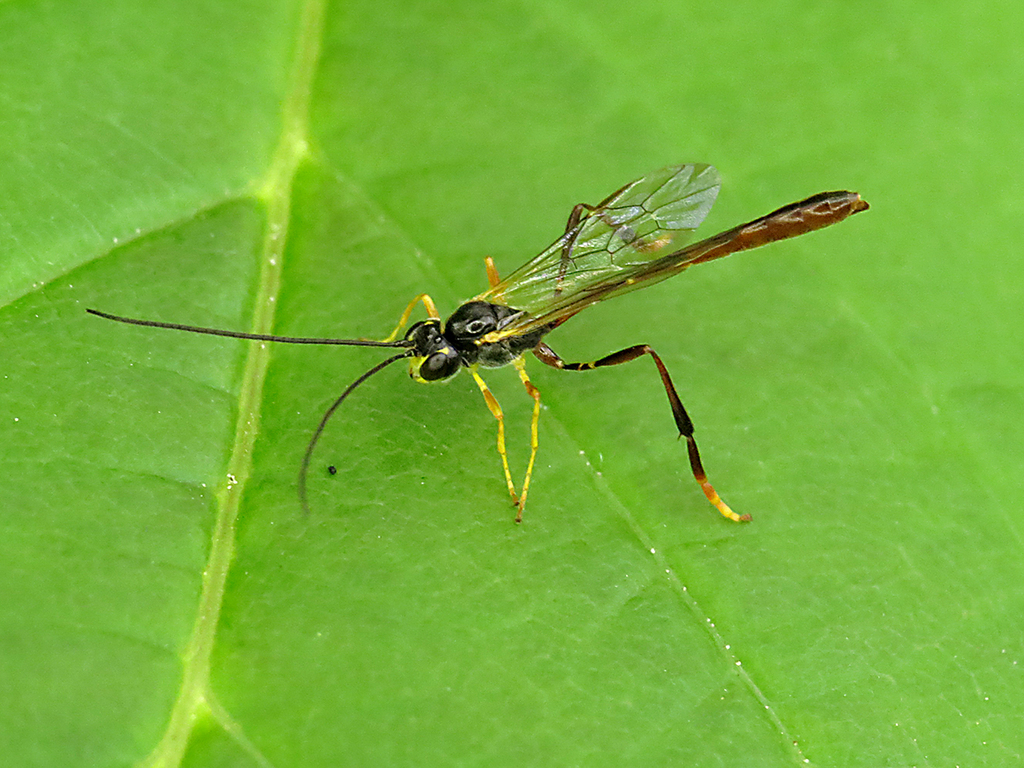
Agrypon flaveolatum
Agrypon flaveolatum is a species of parasitoid wasp belonging to the family Ichneumonidae described by Johann Ludwig Christian Gravenhorst in 1807. It is a parasite of the larva of the winter moth (Operophtera brumata), and has been used in biological pest control to control this moth, whose larvae feed on foliage and defoliate trees.
From the article Agrypon flaveolatum on Wikipedia (CC BY-SA), quoted section by section
What it does
Agrypon flaveolatum is native to Europe and Asia where it is a parasitoid of geometrid moths. When the winter moth (Operophtera brumata) was accidentally introduced into Nova Scotia, Canada, in the 1920s, it caused the damage and death of many native trees by defoliation. In 1949 it was declared to be an invasive pest species and six species of parasitic insects were imported from Europe in an attempt to control it. Two of these insects became established in Nova Scotia, the fly Cyzenis albicans as well as A. flaveolatum. Although they were unable to prevent the winter moth from spreading to other areas, they are likely to accompany their host to new locations and may reduce the rate at which it spreads. In 1954, in a study area, each tree was associated with more than a thousand adult winter moths, but by 1963, fewer than one moth per tree was present, a good example of classical biological control. Another outbreak of winter moths occurred on Vancouver Island in British Columbia, Canada, where it was accompanied by the bruce spanworm (Operophtera bruceata). Here, at high densities the winter moth was controlled by the fly and the parasitoid wasp, but at low densities, a more important factor seems to have been the native beetles that ate the moth pupae. …
Wikipedia: “Ecology”
Listen
Looking for field recordings…
Where it lives
Recorded sightings
—
geo-referenced records in GBIF, from museums, herbaria and field observers.
Drag the globe to turn it. Dots are where records exist, not a range map; darker means more records.
In the stacks
Searching the stacks…
Every page naming Agrypon flaveolatum in the Biodiversity Heritage Library →
This page is assembled live from iNaturalist, GBIF, Wikipedia, the Source Library and the Internet Archive. It is not yet part of the hand-edited codex. iNaturalist taxon 127720.