- Animals
- ›Arthropods
- ›Hexapods
- ›Insects
- ›Winged and Once-winged Insects
- ›Ants, Bees, Wasps, and Sawflies
- ›Narrow-waisted Wasps, Ants, and Bees
- ›Ants, Bees, and Stinging Wasps
- ›Vespoid Wasps
- ›Hornets, Paper Wasps, Potter Wasps, and Allies
- ›Hornets and Yellowjackets
- ›Vespula
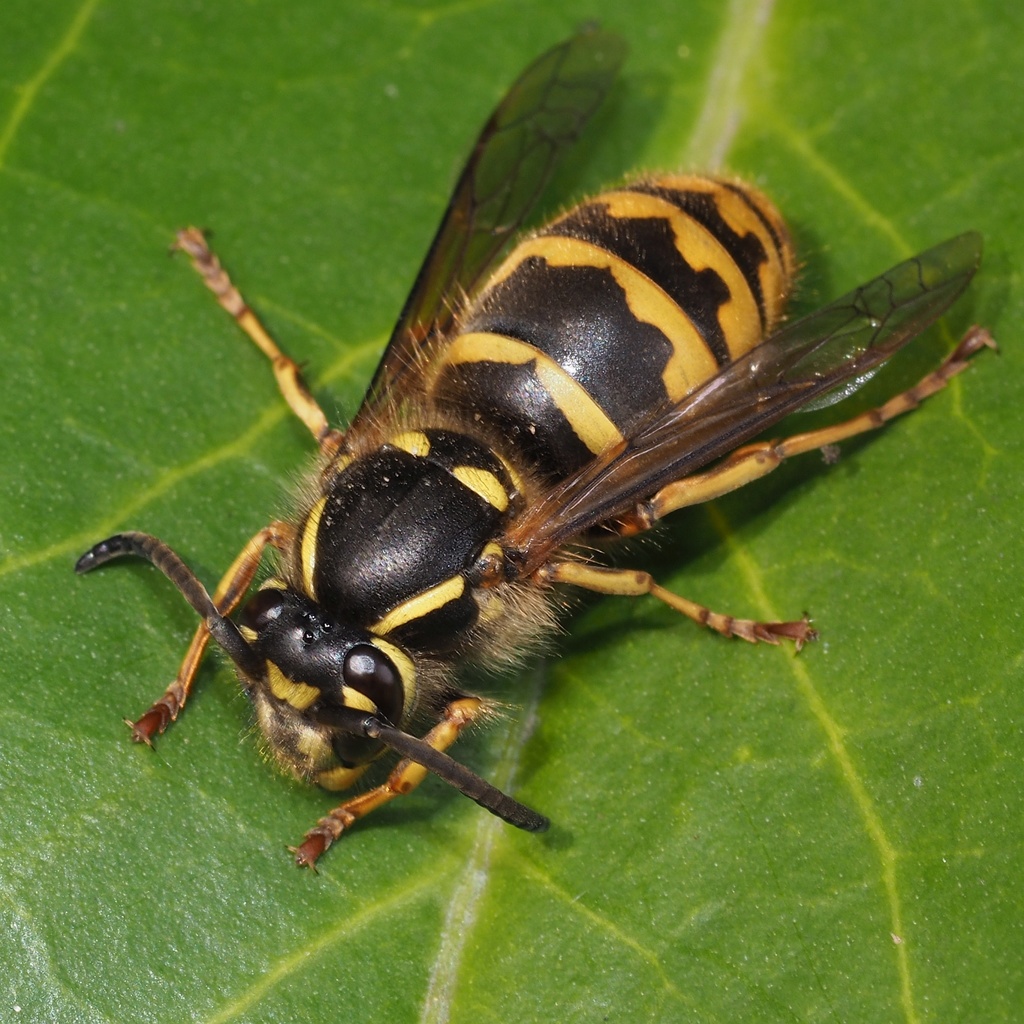
Common European Yellowjacket
Vespula vulgaris
Vespula vulgaris, known as the common wasp, is a wasp found in various regions of the world including the United Kingdom, Germany, India, China, New Zealand, and Australia. It is sometimes known as the European wasp; the same name is used for the species Vespula germanica, which is also known as the German wasp. Another name for Vespula vulgaris is the "common yellow-jacket". It was discovered in 2010 that wasps in North America thought to be...
From the article Vespula vulgaris on Wikipedia (CC BY-SA), quoted section by section
Description
Adult workers of V. vulgaris measure about 12–17 mm (0.5–0.7 in) from head to tip of abdomen, and weigh 84.1 ± 19.0 mg, whereas the queen is about 20 mm (0.8 in) long. It has aposematic colours of black and yellow; yellow pronotal bands which are almost parallel to each other and black dots and rings on its abdomen. The queens and workers appear very similar to Vespula germanica, except when they are seen head on, as the V. vulgaris face lacks the three black dots of V. germanica. Instead, each has only one black mark on its clypeus, which is usually anchor or dagger-shaped. This applies to queens and workers only. In addition, identification of this species may be difficult because the black mark on its clypeus can sometimes appear broken, making it again look similar to V. germanica. It is prudent to use multiple identifying characteristics and if in any doubt to consult experts. Still more difficult to distinguish between species are the males. Almost undetectable with the naked eye, the only confident identification of V. vulgaris males is to seek the distinct aedeagus tip shapes and lateral processes of their genitalia.
Wikipedia: “Description and identification”
Range & habitat
V. vulgaris is a Palearctic species. It has been discovered in a wide range of countries, including the United Kingdom, Germany, India, and China. It is invasive in New Zealand and Australia, and South America. Until 2010, it was thought to be in North America as well, but molecular and morphological data showed that specimens identified as V. vulgaris there were Vespula alascensis, which had previously been considered a taxonomic synonym, but is now considered a separate species. V. vulgaris has high adaptation skills for environments. It flourishes in most types of habitats, including prairie, grassland, natural and planted forests, shrub lands, and even in urban zones such as gardens, orchards, and buildings. However, it does require the temperature to be moderately warm, because its foraging activity is temperature-dependent (above 2 °C [36 °F]).
Wikipedia: “Distribution and habitat”
What it does
Only wasps leaving the nest notice a disturbance and defend or fight off an intruder. The ones returning to the nest do not detect any disturbance and try to enter the nest. The workers that detect danger show a certain gesture – they rise onto the tips of their tarsi, put forward their heads, turn down their abdomens and constantly vibrate their wings in high frequencies and short beats. This behaviour signals other workers to fly to the entrance of the nest and defend. However, if the nest is disturbed enough times, the workers stop defending the nest and instead grow tolerant to such attacks. However, when they detect life-threatening level of danger, the Vespula vulgaris workers will vigorously defend their nest. Unlike honey bees, which die after stinging, Vespula vulgaris can sting multiple times. This makes its sting viable for personal defence when away from the colony, and the common wasp is therefore more apt to sting. However, it will usually not sting without being provoked by sudden movement or other violent behaviour. Research indicates the wasps use odour to identify and attack rival wasps from other colonies, and nest odour frequently changes. Vespula vulgaris wasps have been observed aggressively competing with honey bees for the honeydew secreted by the scale insect Ultracoelostoma brittini in New Zealand's South Island black beech forests.
Wikipedia: “Defensive behaviours”
Toxicity
The painful, though rarely life-threatening sting involves the injection of a complex venom containing amines (histamine, tyramine, serotonin, catecholamines), peptides, and proteins, including many hydrolases. The alkaline venom is quite different from bee venom, which is acidic.
Wikipedia: “Venom”
Listen
Looking for field recordings…
Where it lives
Recorded sightings
—
geo-referenced records in GBIF, from museums, herbaria and field observers.
Drag the globe to turn it. Dots are where records exist, not a range map; darker means more records.
In the stacks
Searching the stacks…
Every page naming Vespula vulgaris in the Biodiversity Heritage Library →
This page is assembled live from iNaturalist, GBIF, Wikipedia, the Source Library and the Internet Archive. It is not yet part of the hand-edited codex. iNaturalist taxon 127777.