- Plants
- ›Vascular Plants
- ›flowering plants
- ›Dicots
- ›Roses, Elms, Figs, and Allies
- ›rose family
- ›Amygdaloideae
- ›Maleae
- ›Aria
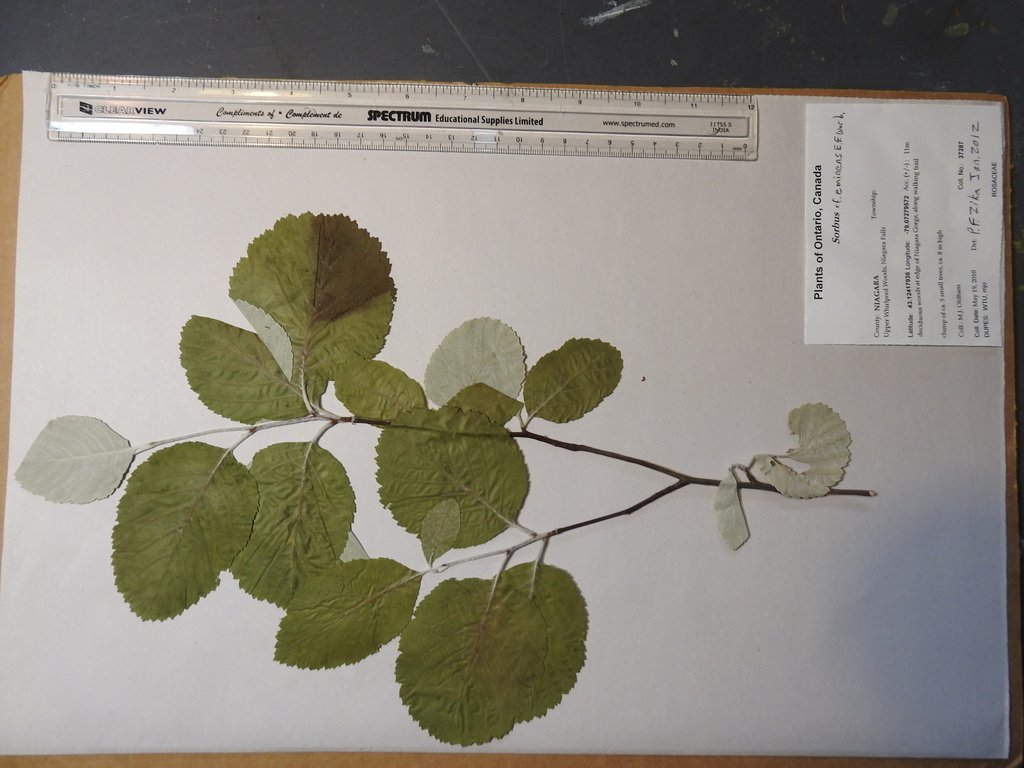
Round-leaved Whitebeam
Aria eminens
Aria eminens, commonly known as the round-leaved whitebeam, is a species of plant in the family Rosaceae. It is endemic to Great Britain and is threatened by habitat loss.
From the article Aria eminens on Wikipedia (CC BY-SA), quoted section by section
Description
Aria eminens is broadly similar to Aria edulis. It is a shrub or small tree up to 10 m (33 ft) tall. The undersides of the leaves are greyish-white due to the many hairs. The leaves are more or less round, usually with a length 1–1.3 times the width, rarely up to 1.5 times as long as wide; they usually have 9–11 veins on either side. The leaf margins usually have a single series of teeth ("uniserrate") although there can be evidence of a second series ("biserrate"). The fruits have many lenticels, small and large, mainly towards the base.
Range & habitat
Aria eminens is endemic to parts of south-west England and south Wales. It is considered to be native to calciferous woodland in north Somerset, west Gloucestershire, Herefordshire and Monmouthshire. It has also been recorded in Sutton Park, Birmingham, well outside its expected range, where it is assumed to have been planted originally.
Wikipedia: “Distribution and habitat”
Where it lives
Recorded sightings
—
geo-referenced records in GBIF, from museums, herbaria and field observers.
Drag the globe to turn it. Dots are where records exist, not a range map; darker means more records.
In the stacks
Searching the stacks…
Every page naming Aria eminens in the Biodiversity Heritage Library →
This page is assembled live from iNaturalist, GBIF, Wikipedia, the Source Library and the Internet Archive. It is not yet part of the hand-edited codex. iNaturalist taxon 1277869.