- Animals
- ›Arthropods
- ›Hexapods
- ›Insects
- ›Winged and Once-winged Insects
- ›Ants, Bees, Wasps, and Sawflies
- ›Narrow-waisted Wasps, Ants, and Bees
- ›Ants, Bees, and Stinging Wasps
- ›Bees and Apoid Wasps
- ›Bees
- ›Honey Bees, Bumble Bees, and Allies
- ›Apine Bees
- ›Bombini
- ›Bombus
- ›Psithyrus
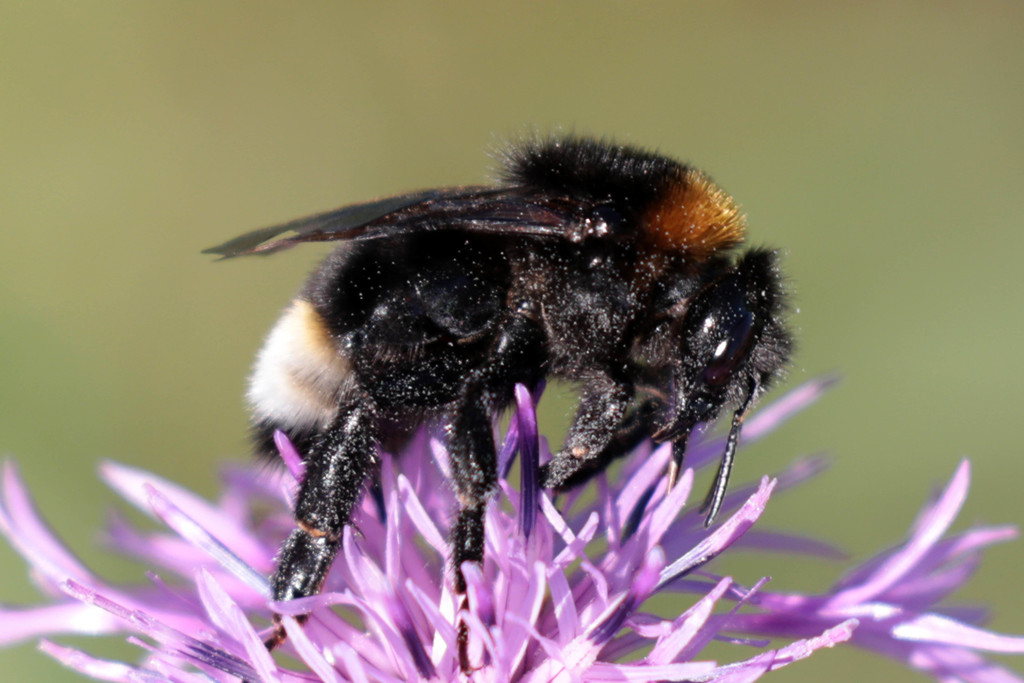
Vestal Cuckoo Bumble bee
Bombus vestalis
Bombus vestalis, the vestal cuckoo bumblebee, is a species of cuckoo bumblebee that lives in most of Europe, as well as North Africa and western Asia. It is a brood parasite that takes over the nests of other bee species. Its primary host is Bombus terrestris (the buff-tailed bumblebee). After its initial classification as Psithyrus vestalis, this bumblebee recently was reclassified into the genus Bombus, subgenus Psithyrus.
From the article Bombus vestalis on Wikipedia (CC BY-SA), quoted section by section
Description
The queen is a large bumblebee with a length up to 21 mm (0.83 in) and a wingspan of 37 mm (1.5 in); the male is considerably smaller (16 mm (0.63 in)). The bumblebee is predominantly black, with an orange collar. The third tergite has a border of yellow hairs, and the hairs on the fifth tergite are mostly white. The males are similar to the females, but smaller and with longer antennae. It is similar in appearance to another cuckoo bumblebee, Bombus bohemicus, but is distinguishable by either the length of the antennal segments or dissection and comparison of the genitalia. In Bombus vestalis, the fifth antennal segment will be the same length as the third and fourth together. A key characteristic of Bombus vestalis is the lack of corbiculae or a pollen basket on the hind legs of the bee. This is evolutionarily relevant because Bombus vestalis does not make its own nests or collect its own resources. With its larger body and poor foraging skills, the female Bombus vestalis are adapted to taking over nests of other species which have already been made and using the workers in these colonies to collect pollen.
Sex. A brood of bees successfully raised by Bombus vestalis is mainly female. This is evolutionarily beneficial since the female is the sex which takes over host species and allows Bombus vestalis to reproduce. …
Range & habitat
The bumblebee is common from North Africa in the south to southern Sweden in the north, and from Ireland in the west to northern Iran in the east. It is common throughout England and Wales, but has only been sighted in Scotland since 2009. Using data from the National Biodiversity Network gateway, Bombus vestalis is most prominent in south-east England. In Ireland the bee was believed to be all but extinct in the 20th century with the last recorded sighting in 1926 in Carlow. However, in 2014 a population was rediscovered in the walled garden at Saint Enda's Park in Rathfarnham.
Wikipedia: “Distribution”
What it does
Bombus vestalis is a cuckoo bumblebee; it does not construct any nest of its own, but usurps the nest of Bombus terrestris, kills the host queen, and forces the host workers to raise its offspring. The male bumblebees often congregate in gardens in the suburbs. The queen emerges early in the spring; the males emerge later, in late May to early June. Its food sources are flowering plants such as clover (males especially often visit white clover), tufted vetch, knapweed, and others. In the spring, the emerging queens frequently fly to flowers such as deadnettles, sallows, blackthorns, and dandelions.
Wikipedia: “Ecology”
Listen
Looking for field recordings…
Where it lives
Recorded sightings
—
geo-referenced records in GBIF, from museums, herbaria and field observers.
Drag the globe to turn it. Dots are where records exist, not a range map; darker means more records.
In the stacks
Searching the stacks…
Every page naming Bombus vestalis in the Biodiversity Heritage Library →
This page is assembled live from iNaturalist, GBIF, Wikipedia, the Source Library and the Internet Archive. It is not yet part of the hand-edited codex. iNaturalist taxon 127789.