- Animals
- ›Arthropods
- ›Hexapods
- ›Insects
- ›Winged and Once-winged Insects
- ›Ants, Bees, Wasps, and Sawflies
- ›Narrow-waisted Wasps, Ants, and Bees
- ›Ants, Bees, and Stinging Wasps
- ›Bees and Apoid Wasps
- ›Bees
- ›Honey Bees, Bumble Bees, and Allies
- ›Apine Bees
- ›Bombini
- ›Bombus
- ›Pyrobombus
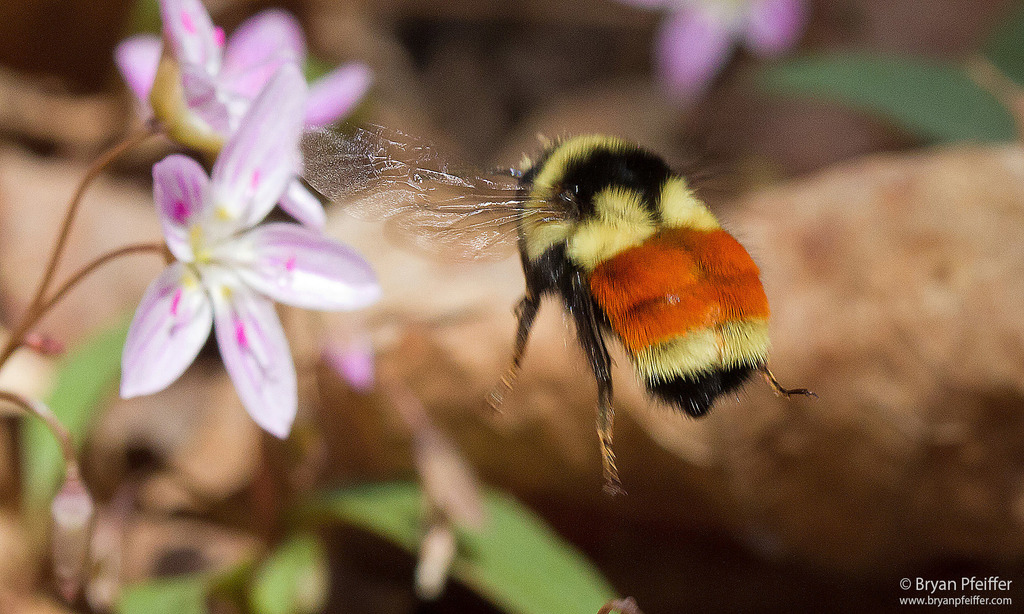
Tricolored Bumble Bee
Bombus ternarius
Bombus ternarius, commonly known as the orange-belted bumblebee or tricolored bumblebee, is a yellow, orange and black bumblebee. It is a ground-nesting social insect whose colony cycle lasts only one season, common throughout the northeastern United States and much of Canada. The orange-belted bumblebee forages on Rubus, goldenrods, Vaccinium, and milkweeds found throughout the colony's range. Like many other members of the genus, Bombus ternarius exhibits complex social structure with a reproductive queen caste and a multitude of sister workers with labor such as foraging, nursing, and nest maintenance divided among the subordinates.
From the article Bombus ternarius on Wikipedia (CC BY-SA), quoted section by section
Description
B. ternarius is a small, fairly slender bumblebee. The queen is 17–19 mm (0.67–0.75 in) long and the breadth of the abdomen is 8.5–9 mm (0.33–0.35 in). The workers are 8–13 mm (0.31–0.51 in), and the drones are 9.5–13 mm (0.37–0.51 in) in length. Both the worker and the drone have abdomens about 4.5–5.5 mm (0.18–0.22 in) in breadth. The queen and workers have black heads, with a few pale yellow hairs. The anterior and posterior thorax and the first and fourth abdominal segments are yellow, abdominal segments 2 to 3 are orange, and the terminal segments are black. The queen and the workers are close in resemblance, and the most striking difference between them is in the size of their fat deposits. Workers have very little fat, particularly in their abdomen, leaving plenty of room for the honey stomach, an enlargement of the oesophagus in which nectar can be stored on foraging trips. In contrast, in young queens, the abdomen is largely full of fat. This leads to queens being heavier for their size than workers. The drone has a yellow head with a few black hairs. The coloration of the thorax and abdomen is similar to that of the females, with the exception that the last abdominal segments are yellow on the sides. The fur of the drone is longer than that of the females. B. …
Range & habitat
B. ternarius mainly ranges in the northern parts of the US and much of Canada. Their range extends from the Yukon to Newfoundland and Labrador and British Columbia. Their United States territory extends from New York and Pennsylvania to Michigan, Washington, Wyoming, Utah and Montana. The bumblebees are most successful in the northern, temperate climate, but they can rarely be found farther south. B. ternarius, like most members of its genus, are seasonal, meaning the queen comes out of hibernation in late April to start a new colony. The bumblebee workers fly from May to October when the entire colony dies (except hibernating queens) to start the cycle again.
Wikipedia: “Range”
What it does
Drones have one function in life: reproduction. They fly in a circuit and deposit a pheromone on prominent places such as tree trunks, rocks, posts, etc., to attract the newly hatched queens. A new queen follows the pheromone trail and mates with the male. Mating among B. ternarius typically occurs on the ground or in vegetation. The male mounts the female by grabbing her thorax, the queen then extends her stinger and the male inserts his genital capsule. Mating time varies widely from about 10 to 80 minutes, with the sperm being transferred within the first two minutes of copulation. While mating, both the male and female are vulnerable to predators. After the transfer of sperm is complete, the male secretes a sticky substance that hardens into a plug that blocks new sperm for about three days. This prevents other males from impregnating the same queen and competing to fertilize eggs. The plug helps reduce competition and increases the first male's evolutionary success. Individual colonies have slightly different reproductive strategies. About half of the queens adopt an early switching strategy that produces mostly male drones, and the other half adopt a late switching strategy, giving rise to mostly new queens. …
Wikipedia: “Reproduction”
At the table
Major plants visited include Rubus, goldenrods, Vaccinium, and milkweeds. B. ternarius eats and collects both nectar and pollen. The nectar is stored in a special internal pouch called the crop, while pollen collects on the hairs on the bumblebee body. The bumblebee pushes the grains of pollen towards its hind legs, where the pollen is pushed into the pollen basket. At the nest, the contents of the nectar crop is regurgitated, where it is mixed with enzymes and allowed to air dry. As the nectar and enzyme mixture dries, honey is created. Pollen is mixed with the nectar and honey to create a protein-rich larval food. Before the introduction of western honey bees, bumblebees were the only honey-producing bees in North America; however, only small quantities are produced.
Wikipedia: “Nutrition”
Listen
Looking for field recordings…
Where it lives
Recorded sightings
—
geo-referenced records in GBIF, from museums, herbaria and field observers.
Drag the globe to turn it. Dots are where records exist, not a range map; darker means more records.
In the stacks
Searching the stacks…
Every page naming Bombus ternarius in the Biodiversity Heritage Library →
This page is assembled live from iNaturalist, GBIF, Wikipedia, the Source Library and the Internet Archive. It is not yet part of the hand-edited codex. iNaturalist taxon 127905.