- Plants
- ›Vascular Plants
- ›flowering plants
- ›Dicots
- ›Legumes, Milkworts, and Allies
- ›Legumes
- ›Peacock Flower Subfamily
- ›Cassieae
- ›Cassiinae
- ›Chamaecrista
- ›Chamaecrista
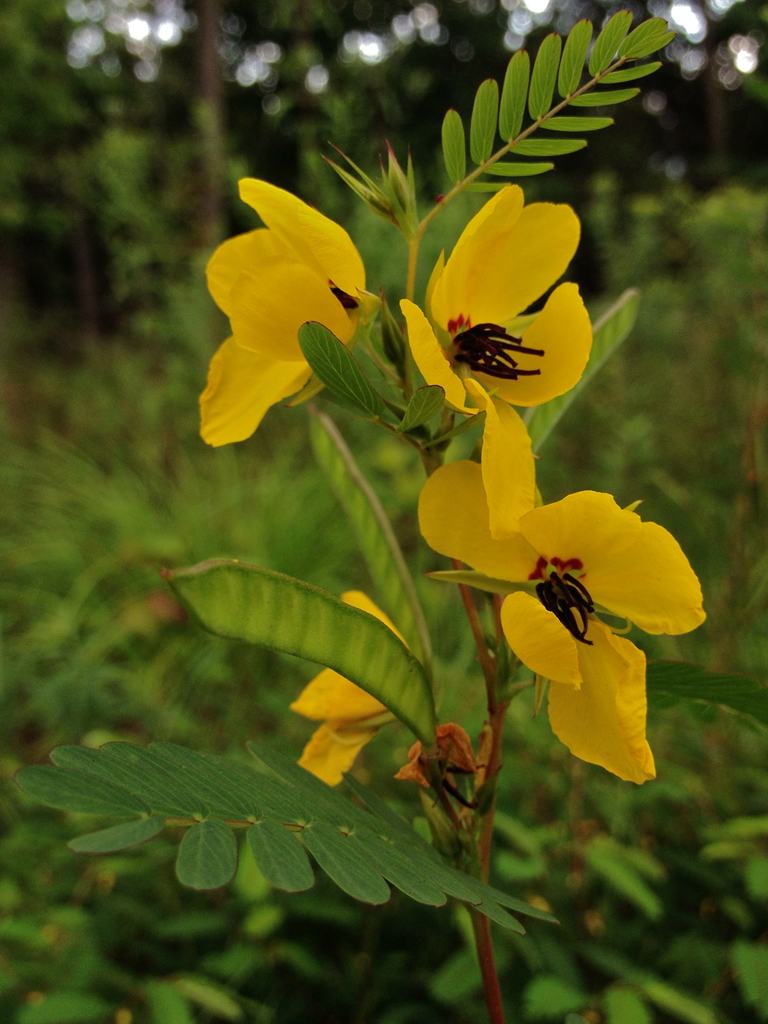
partridge pea
Chamaecrista fasciculata
Chamaecrista fasciculata, the partridge pea, is a species of legume native to most of the eastern United States. It is an annual which grows to approximately 0.5 meters (1 ft 8 in) tall. It has bright yellow flowers from early summer until first frost, with flowers through the entire flowering season if rainfall is sufficient.
The flowers are hermaphroditic, although a fraction of plants, less than 5%, do not produce sufficient pollen to reproduce as males. This phenomenon has been studied in a variety of plants as a possible evolutionary step towards dioecy, in which male and female flowers occur on separate plants. C. fasciculata is pollinated only by bees.
From the article Chamaecrista fasciculata on Wikipedia (CC BY-SA), quoted section by section
Description
The leaves consist of 10 to 15 pairs of small, narrow leaflets that are somewhat delicate to the touch. Like other legumes, the plant displays nyctinasty, which is a circadian rhythmic nastic movement wherein the leaves open and close in response to day and night cycles. The showy yellow flowers, about 1 inch (25 mm) across, grow 2 to 4 together in clusters on the stem. Flowers normally bloom July-September. The fruit is a straight, narrow pod 1.5 to 2.5 inches (38 to 64 mm) long, which splits along 2 sutures as it dries; the pod sides spiral to expel the seeds some distance from the parent plant.
Range & habitat
The partridge pea is found in the eastern United States, excluding Vermont, Maine, and New Hampshire, west to New Mexico, South Dakota, and Minnesota.
Wikipedia: “Distribution”
What it does
Like other legumes, the partridge pea is a nitrogen-fixing plant, with microorganisms helping to produce the nitrogen compounds necessary for the plant to survive. The microorganisms inhabit root nodules, which provide them with a safe habitat while giving the plant access to the nutrients. Chamaecrista fasciculata is insect pollinated and is recorded to have been visited in northern Florida by Augochloropsis metallica, Lasioglossum apopkense, Lasioglossum illinoense, Lasioglossum reticulatum, Lasioglossum weemsi/leviense, and Svastra atripes.
Wikipedia: “Ecology”
At the table
Historically, the Cherokee tribe used partridge pea as a medicinal remedy for spells of fainting and to prevent fatigue in ball players. The Seminole tribe used it to alleviate nausea and also utilized the plant as a bed for ripening persimmons. Partridge pea can be planted along roadways or streambanks to control erosion and improve soil fertility, as it establishes rapidly, fixes nitrogen, reseeds, and then decreases in frequency once other species establish.
Wikipedia: “Uses”
Where it lives
Recorded sightings
—
geo-referenced records in GBIF, from museums, herbaria and field observers.
Drag the globe to turn it. Dots are where records exist, not a range map; darker means more records.
In the stacks
Searching the stacks…
Every page naming Chamaecrista fasciculata in the Biodiversity Heritage Library →
This page is assembled live from iNaturalist, GBIF, Wikipedia, the Source Library and the Internet Archive. It is not yet part of the hand-edited codex. iNaturalist taxon 127907.