- Animals
- ›Arthropods
- ›Crustaceans
- ›Typical Crustaceans
- ›Malacostracans
- ›Decapods, Isopods, and allies
- ›Decapods and Krill
- ›Decapods
- ›Crabs, Lobsters, Shrimps, and Allies
- ›True Crabs
- ›Eubrachyuran Crabs
- ›Heterotrematan Crabs
- ›Spider Crabs and Decorator Crabs
- ›Inachoididae
- ›Stenorhynchinae
- ›Stenorhynchus
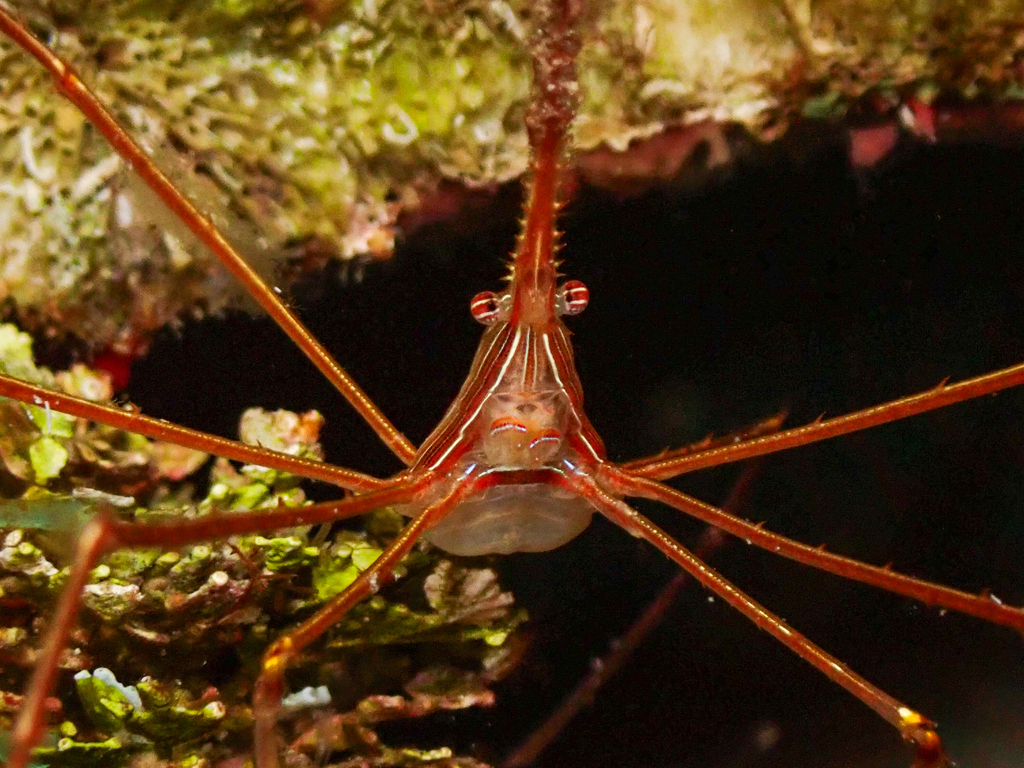
Yellowline Arrow Crab
Stenorhynchus seticornis
Stenorhynchus seticornis, the yellowline arrow crab or simply arrow crab, is a species of marine crab.
From the article Stenorhynchus seticornis on Wikipedia (CC BY-SA), quoted section by section
Description
The body of S. seticornis is triangular, and the rostrum is drawn out into a long point with serrate edges. The legs are also long and thin, up to 10 cm (3.9 in) across, and the animal's carapace may be up to 6 cm (2.4 in) long. Colouration is variable in this species; the body may be golden, yellow or cream, marked with brown, black or iridescent-blue lines; the legs are reddish or yellow, and the claws are blue or violet. This species presents as diagnostic features: triangular body with long pointed snout (rostrum), carapace decorated with fine dark lines and claws often have violet tips. S. seticornis is most commonly associated with anemones, in groups ranging from one to six individuals in south-eastern Brazil.
Range & habitat
Stenorhynchus seticornis is commonly found in the shallow sub-tidal on rock bottoms, corals, calcareous algae, and also on soft sediments, such as shelly gravel and sand. Its geographical distribution is restricted to the Occidental Atlantic, from North Carolina to Argentina. Stenorhynchus seticornis is found in the western Atlantic Ocean, from North Carolina and Bermuda to Brazil, including throughout the Caribbean Sea. It lives on coral reefs at depths of 10–30 feet (3.0–9.1 m).
Wikipedia: “Distribution”
What it does
S. seticornis is nocturnal and territorial. The species has displayed notable negative phototaxis, meaning the organism prefers to avoid sunlight, and changes location during the day and nighttime. It eats small feather duster worms and other coral reef invertebrates. This crab is commonly kept in reef aquariums to control bristle worm populations. S. seticornis is one of a number of different invertebrates that are found living in association with the sea anemone, Lebrunia danae. It is often found among the anemone's pseudotentacles along with Pederson's cleaning shrimp (Ancylomenes pedersoni) and the spotted cleaner shrimp (Periclimenes yucatanicus). The species is also notable for its propensity to decorate its body by attaching materials as camouflage, or if the attached organisms are noxious, to ward off predators through aposematism. There have been a considerable number of reports regarding cleaning symbiosis among reef fish, moray eels, and squirrelfish. This is a somewhat unexpected relationship as moray eels and squirrelfish can be considered dangerous clients, because crabs are important elements of their diets. This behavior has only been observed in the natural environment in Brazilian waters but it is believed that this behavior also exists throughout its distribution.
Wikipedia: “Ecology and behaviour”
Where it lives
Recorded sightings
—
geo-referenced records in GBIF, from museums, herbaria and field observers.
Drag the globe to turn it. Dots are where records exist, not a range map; darker means more records.
In the stacks
Searching the stacks…
Every page naming Stenorhynchus seticornis in the Biodiversity Heritage Library →
This page is assembled live from iNaturalist, GBIF, Wikipedia, the Source Library and the Internet Archive. It is not yet part of the hand-edited codex. iNaturalist taxon 128121.