- Animals
- ›Arthropods
- ›Myriapods
- ›Centipedes
- ›Tropical Centipedes
- ›Scolopendrid Centipedes
- ›Scolopendrinae
- ›Scolopendra
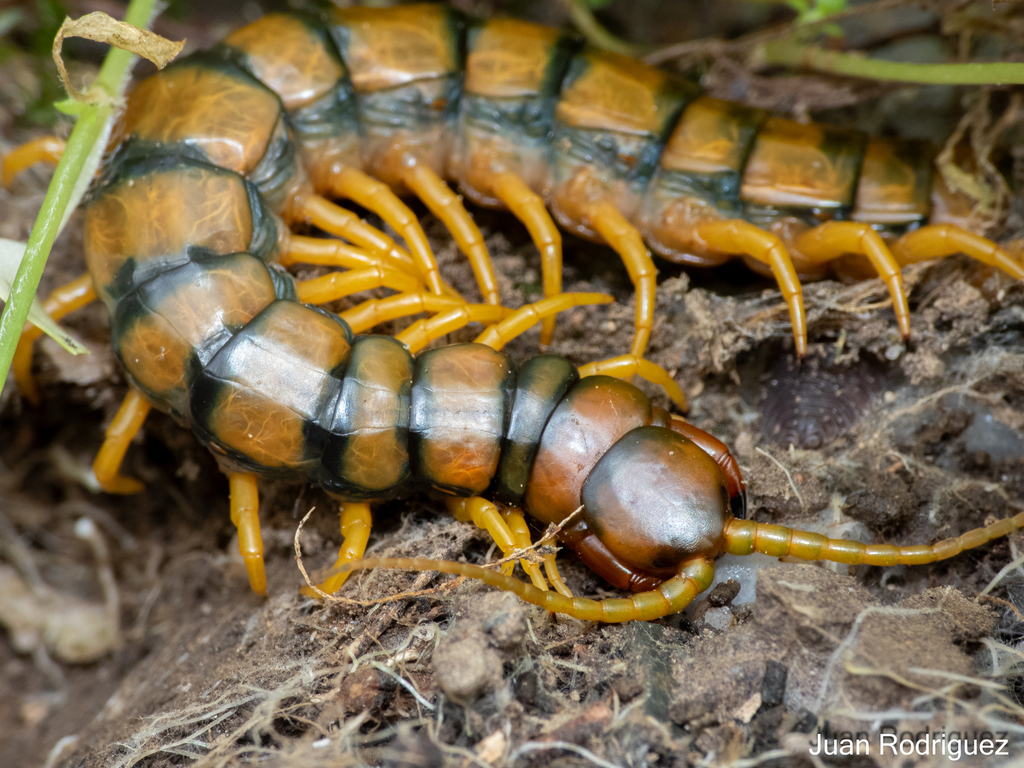
Mediterranean Banded Centipede
Scolopendra cingulata
Scolopendra cingulata, also known as Megarian banded centipede, and the Mediterranean banded centipede, is a species of centipede, and "the most common scolopendromorph species in the Mediterranean area".
From the article Scolopendra cingulata on Wikipedia (CC BY-SA), quoted section by section
Description
The species has alternating bands of black and yellow-gold. At approximately 15–18 centimetres (5.9–7.1 in), Scolopendra cingulata is one of the smallest species in the family Scolopendridae. Its venom is also not as toxic as that of other scolopendrid centipedes.
Range & habitat
Widely distributed, this species can be found throughout southern Europe, including Portugal and around the Mediterranean Sea, in such countries as Spain, France, Italy, Albania, Serbia, Croatia, Israel, and Greece, around the Black Sea in South Romania, Bulgaria, Ukraine, as well as parts of North Africa. It also has small relict populations in Austria and Hungary.
Wikipedia: “Distribution”
What it does
Scolopendra cingulata is an opportunistic carnivore. It will attack and consume almost any animal that is not larger than itself; this includes insects and small lizards.
Wikipedia: “Diet”
Where it lives
Recorded sightings
—
geo-referenced records in GBIF, from museums, herbaria and field observers.
Drag the globe to turn it. Dots are where records exist, not a range map; darker means more records.
In the stacks
Searching the stacks…
Every page naming Scolopendra cingulata in the Biodiversity Heritage Library →
This page is assembled live from iNaturalist, GBIF, Wikipedia, the Source Library and the Internet Archive. It is not yet part of the hand-edited codex. iNaturalist taxon 128145.