- Plants
- ›Vascular Plants
- ›flowering plants
- ›Dicots
- ›Mints, Plantains, Olives, and Allies
- ›figwort family
- ›Eremophila
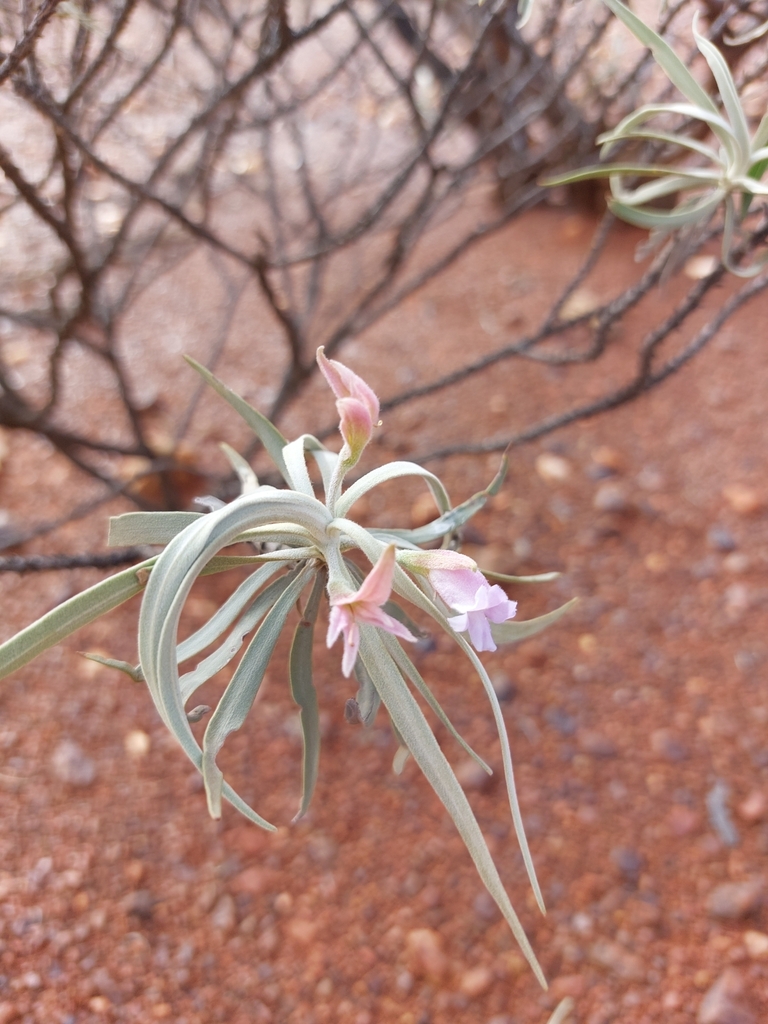
Eremophila phyllopoda
Eremophila phyllopoda is a flowering plant in the figwort family, Scrophulariaceae and is endemic to Western Australia. It is an erect or spreading shrub, sometimes round or flat-topped with sticky, hairy leaves and flowers ranging in colour from pink or lilac to purple.
From the article Eremophila phyllopoda on Wikipedia (CC BY-SA), quoted section by section
Description
Eremophila phyllopoda is a compact, flat-topped shrub or a spreading shrub depending on subspecies, and grows to a height of between 0.4 and 2 m (1 and 7 ft). Its branches and leaves are covered with a layer of silvery to dull grey simple hairs that are sometimes stained brown. The branches are rough due to the prominent, projecting leaf bases and sticky due to the presence of resin. The leaves are arranged alternately and clustered near the ends of the branches. They are linear to elliptic in shape, taper towards both ends, 18–110 mm (0.7–4 in) long, 1.5–7 mm (0.06–0.3 in) wide, have a covering of hairs which are pressed against the leaf surface and sometimes obscured by resin.
The flowers are borne singly or in pairs in leaf axils on a stalk 1.5–4.5 mm (0.06–0.2 in) long which is densely hairy. There are 5 overlapping, green to pale mauve, hairy, sticky, lance-shaped to egg-shaped, sepals which are 8.5–25 mm (0.3–1 in) long. The petals are 13.5–32 mm (0.5–1 in) long and are joined at their lower end to form a tube. The petal tube is white through pink to deep lilac-coloured or purple on the outside, white inside. The petal tube and lobes are hairy on the outside, the petal lobes are glabrous on the inside, and the inside of the tube is filled with woolly hairs. The 4 stamens are fully enclosed in the petal tube. Flowering time depends on subspecies. …
Range & habitat
Subspecies phyllopoda occurs stony plains and rocky ridges from west of Mt Augustus to Meekatharra in the Carnarvon, Gascoyne, Little Sandy Desert, Murchison and Pilbara biogeographic regions. Subspecies obliqua is found in stony soils near creek beds and on rocky hills between the Collier and Barlee ranges in the Gascoyne and Pilbara biogeographic regions.
Wikipedia: “Distribution and habitat”
How it is grown
This is one of the most attractive eremophilas with its grey, pendulous leaves and mass display of lilac to blue or pink flowers. Its colourful sepals remain on the plant long after the petal tube has fallen and it is an ideal container plant. It is usually propagated by grafting onto Myoporum rootstock and grown in well-drained soil in full sun. It only needs occasional watering during a long drought but it is frost sensitive and needs to be grown in a warm, protected position.
== References ==
Wikipedia: “Use in horticulture”
Where it lives
Recorded sightings
—
geo-referenced records in GBIF, from museums, herbaria and field observers.
Drag the globe to turn it. Dots are where records exist, not a range map; darker means more records.
In the stacks
Searching the stacks…
Every page naming Eremophila phyllopoda in the Biodiversity Heritage Library →
This page is assembled live from iNaturalist, GBIF, Wikipedia, the Source Library and the Internet Archive. It is not yet part of the hand-edited codex. iNaturalist taxon 1281890.