- Plants
- ›Vascular Plants
- ›flowering plants
- ›Dicots
- ›Sunflowers, Bellflowers, Fanflowers, and Allies
- ›Sunflowers, Daisies, Asters, and Allies
- ›Asteroideae
- ›Sunflowers and Allies
- ›Helianthinae
- ›Helianthus
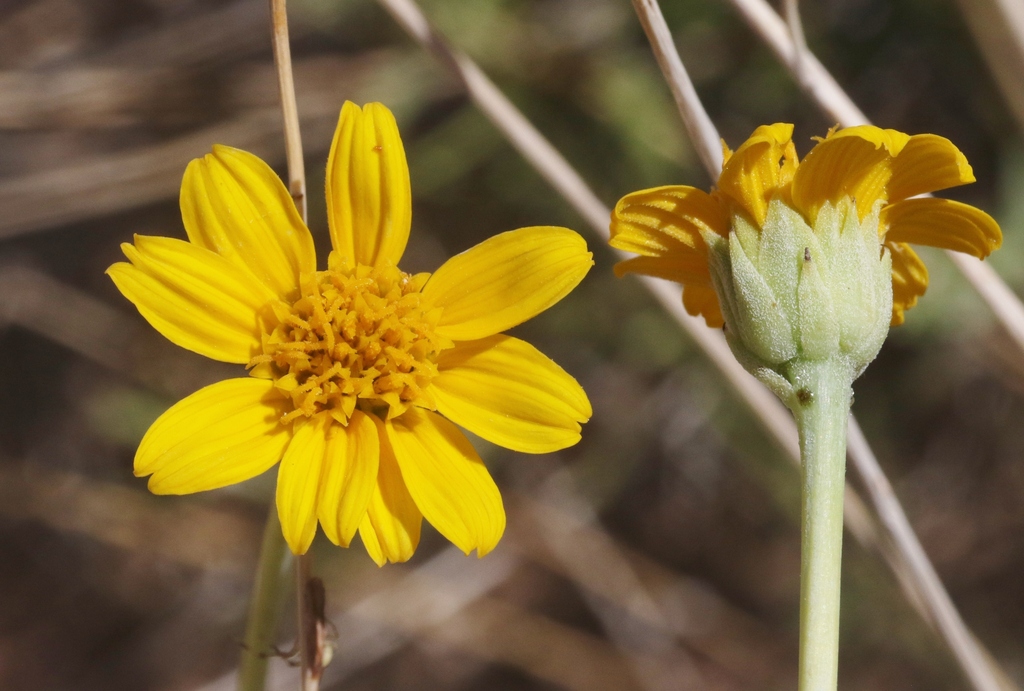
Red Rock sunflower
Helianthus devernii
Helianthus devernii is a North American species of flowering plant in the daisy family Asteraceae, known by the common name Red Rock sunflower. The perennial herbaceous plant is endemic to a portion of Nevada's Red Rock Canyon National Conservation Area measuring less than 1 acre (4,000 m2), where it grows in just two desert spring locations within the Mojave Desert.
The plant reaches up to 102 cm (40 in) in height. Its leaves tend toward the grass-like shape, with a single prominent vein, and alternate up the stem. The flower heads feature 5-8 yellow apparent petals—ray florets—surrounding a larger number of disk florets; the seeds are 3.5–4.0 mm (0.14–0.16 in) long. H. devernii can be distinguished from the closely related Helianthus cusickii by its shorter ray petals and single-veined leaves, and genetic evidence indicates it is most closely related to Helianthus pumilus. With a total known population of 725 individuals in a very small area of distribution that is also subject to a variety of threats, the species is considered critically imperiled. Conservation efforts are underway as of 2024.
From the article Helianthus devernii on Wikipedia (CC BY-SA), quoted section by section
Description
Helianthus devernii is a herbaceous plant with a perennial habit that regrows each year from an underground branched woody structure atop its roots. The stems reach as much as 102 cm (40 in) in height and lack hairs but have a waxy coating making the surface somewhat whitish. Bone white stems from previous years are persistent and intermingle with the present year's stems. The leaves are attached to the stems directly without a short leaf stem. Each leaf has one prominent vein or nerve, though lower leaves may have two additional indistinct veins. Leaf edges do not have teeth and the lower leaves are attached in pairs on opposite sides of the stems. The leaves nearer the midpoint of the stems are largest measuring 6.8–10.3 cm (2.7–4.1 in) long and usually just 2.8–7.6 mm (0.11–0.30 in) but occasionally as much as 10.3 mm (0.41 in) wide. They have a very narrow, almost grass-like leaf shape but with gently curved sides. Lower leaves of Helianthus devernii have the same shape, but are shorter, 4.1–5.6 cm (1.6–2.2 in) long and 4.4–9.0 mm (0.17–0.35 in) wide, and are usually shed by the time the plant flowers. Leaves get shorter and thinner further up the stems ranging from 2.6–6.4 cm (1.0–2.5 in), though usually shorter than 5.1 cm (2.0 in), and just 1.2–1.7 mm (0.05–0.07 in) wide with a very thin and grasslike shape. …
Range & habitat
The perennial herb is found within and around a small portion of Red Rock Canyon National Conservation Area in Clark County, Nevada—a BLM-managed National Conservation Area within the Mojave Desert. Helianthus devernii has been found at two desert spring locations with moist alkaline soils. About 38% of the plants are located on BLM lands, 62% of the plants are on adjacent private inholdings. Original counts put the total number of individuals at around 400. Further surveys increased the total known number of individual plants to 725.
Wikipedia: “Distribution and habitat”
Where it lives
Recorded sightings
—
geo-referenced records in GBIF, from museums, herbaria and field observers.
Drag the globe to turn it. Dots are where records exist, not a range map; darker means more records.
In the stacks
Searching the stacks…
Every page naming Helianthus devernii in the Biodiversity Heritage Library →
This page is assembled live from iNaturalist, GBIF, Wikipedia, the Source Library and the Internet Archive. It is not yet part of the hand-edited codex. iNaturalist taxon 1282247.