- Plants
- ›Vascular Plants
- ›flowering plants
- ›monocots
- ›Agaves, Orchids, Irises, and Allies
- ›Aloe family
- ›daylilies and allies
- ›Corynotheca
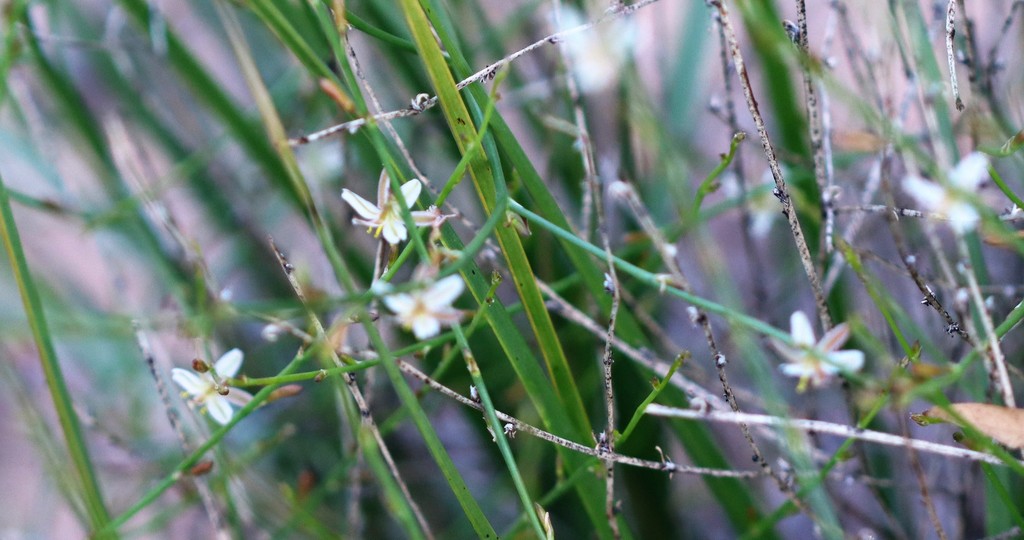
Antler Zigzag Lily
Corynotheca licrota
Corynotheca licrota, otherwise known as the antler zig-zag lily, club-fruit lily, or sand lily, is a perennial herbaceous member of the family Asphodelaceae and is found in arid inland areas of Australia.
From the article Corynotheca licrota on Wikipedia (CC BY-SA), quoted section by section
Description
Corynotheca licrota is a tufted shrub that grows up to 700mm and is grass-like in appearance. The leaves are linear in shape and can grow up to 600mm. Stems are much shorter at 5mm long. Inflorescence are widely branched with solitary flowers. Petals are white to cream to pale yellow in colour and sepals are often a darker pink to purple to brown colour. The petals are a narrow elliptical shape that are 3.9-5.5mm long and 0.7-0.9mm wide. The pendulous capsules are brown and wrinkly looking and ovoid to obovoid in shape. They are 2.8-7.5mm long and 2.1-2.8mm wide. 1-5 seeds are found in each fruit. They are glossy black to iridescent in colour and have a smooth or slightly corrugated texture. Flowering occurs mostly from September to February but can also occur in April and August after rainfall.
Range & habitat
This species is endemic to Australia and occurs mostly in the arid areas of the country. However, it has been found in all states excepting Tasmania. Three fairly distinct populations have been noted in the central ranges, Murray-Darling Basin and southern SA. Distribution has been tracked along drainage paths of the Darling and lower Murray, which suggests seeds may be carried from Central Australia by the rivers. It is common that C. licrota grows on sandy plains or dunes in low rainfall areas, and often in conjunction with mallee scrub or pine-buloke forests. Corynotheca species are key in their habitat because of the dense shelter they provide invertebrates and small vertebrates and their ability to resprout rapidly after fires.
Wikipedia: “Distribution and habitat”
Where it lives
Recorded sightings
—
geo-referenced records in GBIF, from museums, herbaria and field observers.
Drag the globe to turn it. Dots are where records exist, not a range map; darker means more records.
In the stacks
Searching the stacks…
Every page naming Corynotheca licrota in the Biodiversity Heritage Library →
This page is assembled live from iNaturalist, GBIF, Wikipedia, the Source Library and the Internet Archive. It is not yet part of the hand-edited codex. iNaturalist taxon 1282294.