- Fungi Including Lichens
- ›Basidiomycete Fungi
- ›Higher Basidiomycetes
- ›Mushrooms, Bracket Fungi, Puffballs, and Allies
- ›Agaricomycetidae
- ›Common Gilled Mushrooms and Allies
- ›Agaricineae
- ›puffballs
- ›Bovista
- ›Bovista
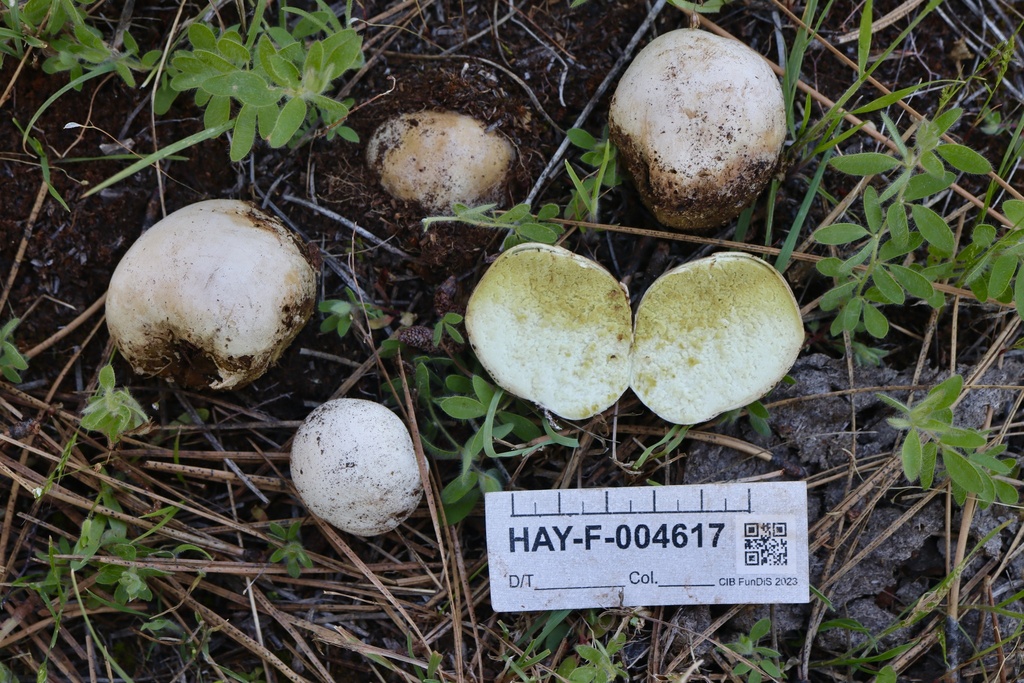
Tumbling puffball
Bovista pila
Bovista pila, commonly known as the tumbling puffball, is a species of puffball fungus in the family Lycoperdaceae.
The puffballs are initially attached to the ground by a small cord that readily breaks off, leaving the mature puffball to be blown about. The egg-shaped to spherical puffball of B. pila measures up to 8 cm (3 in) in diameter. Its white outer skin flakes off in age to reveal a shiny, bronze-colored inner skin that encloses a spore sac. The spores are more or less spherical, with short tube-like extensions. B. pila closely resembles the European B. nigrescens, from which it can be reliably distinguished only by microscopic characteristics.
From the article Bovista pila on Wikipedia (CC BY-SA), quoted section by section
Description
B. pila has an egg-shaped to roughly spherical fruit body measuring up to 8 cm (3 in) in diameter. The thin (0.25 millimeter) outer tissue layer (exoperidium) is white to slightly pink. Its surface texture, initially appearing as if covered with minute flakes of bran (furfuraceous), becomes marked with irregular, crooked lines (rivulose). The exoperidium flakes off in maturity to reveal a thin, inner peridium (endoperidium). The color of this shiny inner skin, splotched with darker areas, resembles the metallic colors of bronze and copper. Bovista pila puffballs are attached to the ground by a small cord (a rhizomorph) that typically breaks off when the puffball is mature. The interior flesh, or gleba, comprises spores and surrounding capillitial tissue. Initially white and firm with tiny, irregularly shaped chambers (visible with a magnifying glass), the gleba later becomes greenish and then brown and powdery as the spores mature. In age, the upper surface of the puffball cracks and tears open. The resilient texture of the inner peridium enables the puffball to maintain its ball-like shape after it has detached from the ground. As the old puffballs get blown around, spores get shaken out of the tears.
The spores of Bovista pila are spherical, smooth (when viewed with a light microscope), and measure 3.5–4.5 μm. They have thick walls and very short pedicels. …
Range & habitat
Bovista pila is found in corrals, stables, roadsides, pastures and open woods. The puffballs fruit singly, scattered, or in groups on the ground. It is also known to grow in lawns and parks. The puffball spore cases are persistent and may overwinter. Fruiting occurs throughout the mushroom season. Bovista pila is widely distributed in North America (including Hawaii). There are few well-documented occurrences of B. pila outside North America. Hanns Kreisel recorded it from Russia, in what is now known as the Sakha Republic. The puffball has been tentatively identified from the Galápagos Islands, and has been collected from Pernambuco and São Paulo, Brazil. The South American material, however, has grayish-yellow coloration in the gleba, which may be indicative of not yet fully matured specimens. This renders identification of this material tentative, as unripe material may have different microscopic characteristics from mature material. Although the puffball has been reported from both the European part of Turkey as well as Anatolia, reports without supporting microscopic or macroscopic information are viewed with skepticism.
Wikipedia: “Habitat and distribution”
At the table
Edible when the interior gleba is still firm and white, Bovista pila puffballs have a mild taste and odor. The puffball was used by the Chippewa people of North America as a charm, and medicinally as a hemostat. In British Columbia, Canada, it is used by livestock farmers who are not allowed to use conventional drugs under certified organic programs. The spore mass of the puffball is applied to bleeding hoof trimming 'nicks', and then wrapped with breathable first-aid tape. It is also similarly used on bleeding areas resulting from disbudding, and wounds resulting from sternal abscesses.
Wikipedia: “Uses”
Where it lives
Recorded sightings
—
geo-referenced records in GBIF, from museums, herbaria and field observers.
Drag the globe to turn it. Dots are where records exist, not a range map; darker means more records.
In the stacks
Searching the stacks…
Every page naming Bovista pila in the Biodiversity Heritage Library →
This page is assembled live from iNaturalist, GBIF, Wikipedia, the Source Library and the Internet Archive. It is not yet part of the hand-edited codex. iNaturalist taxon 128580.