- Plants
- ›Vascular Plants
- ›flowering plants
- ›Dicots
- ›Heathers, Balsams, Primroses, and Allies
- ›heath family
- ›blueberries, cranberries, huckleberries, and allies
- ›Vaccinieae
- ›Gaylussacia
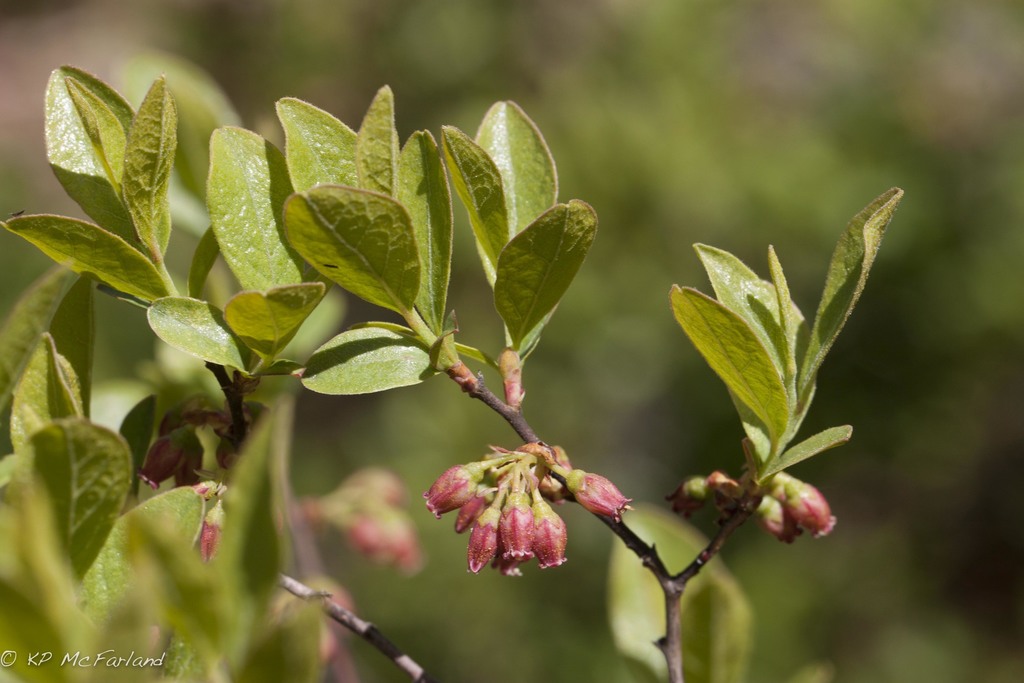
black huckleberry
Gaylussacia baccata
Gaylussacia baccata, the black huckleberry, is a common huckleberry found throughout a wide area of eastern North America.
From the article Gaylussacia baccata on Wikipedia (CC BY-SA), quoted section by section
Description
Gaylussacia baccata is a shrub up to 150 cm (5 feet) tall, forming extensive colonies. Flowers are in dangling groups of 3–7, orange or red, bell-shaped. The berries are dark blue, almost black, rarely white.
Similar species. The plant closely resembles the native blueberry plants (Vaccinium species) with which it grows in the same habitats, though it is distinct by the numerous resin dots on the undersides of the leaves which glitter in light.
Range & habitat
The plant is native to Eastern Canada and the Great Lakes region, the Midwestern and Northeastern United States, and the Appalachian Mountains, the Ohio/Mississippi/Tennessee Valley, and Southeastern United States. The range extends from Newfoundland west to Manitoba and Minnesota, south as far as Arkansas, Alabama, and Georgia.
Wikipedia: “Distribution”
What it does
The shrub is considered fire-resistant due to surviving rhizomes quickly sending out new shoots following fires. It is a larval host to the brown elfin, Gordian sphinx, Henry's elfin, and huckleberry sphinx.
Wikipedia: “Ecology”
At the table
The berries are sweet, and are eaten raw, jellied, or baked into foods such as pancakes, muffins.
Wikipedia: “Uses”
Where it lives
Recorded sightings
—
geo-referenced records in GBIF, from museums, herbaria and field observers.
Drag the globe to turn it. Dots are where records exist, not a range map; darker means more records.
In the stacks
Searching the stacks…
Every page naming Gaylussacia baccata in the Biodiversity Heritage Library →
This page is assembled live from iNaturalist, GBIF, Wikipedia, the Source Library and the Internet Archive. It is not yet part of the hand-edited codex. iNaturalist taxon 128805.