On eBird ↗
Banded Martin
Live sightings near you, the range map, bar charts of when it is seen, and Macaulay Library photos and recordings.
Banded Martin
Neophedina cincta
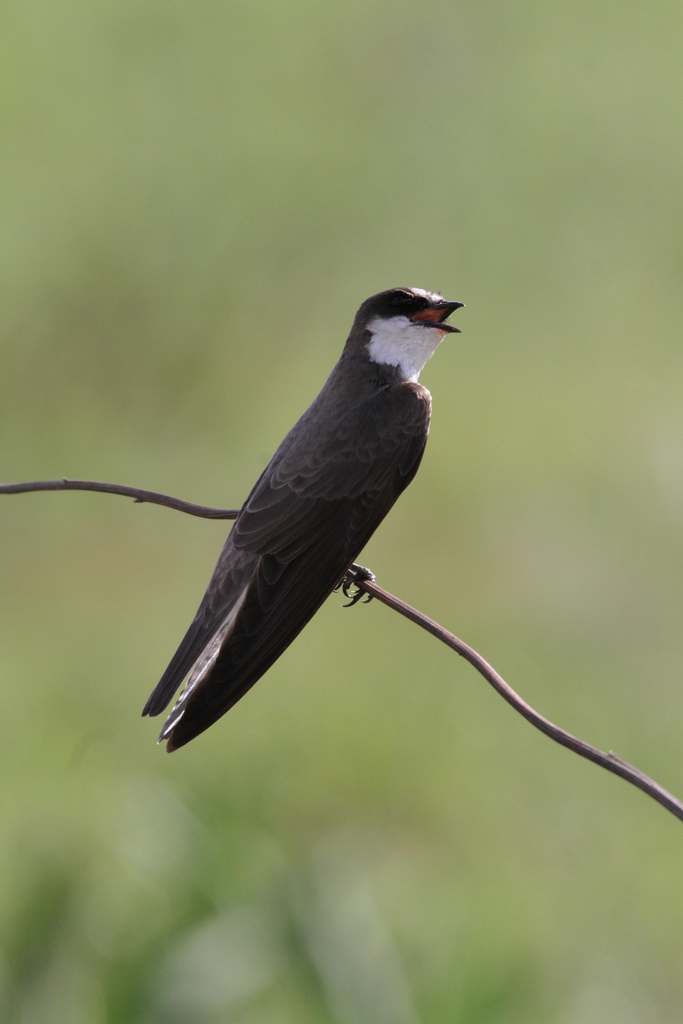
The banded martin or banded sand martin (Neophedina cincta) is a small passerine bird in the swallow family Hirundinidae that is endemic to Africa. It is the only species placed in the genus Neophedina.
From the article Banded martin on Wikipedia (CC BY-SA), quoted section by section
Description
The 15–17 cm (5.9–6.7 in) long banded martin has earth-brown upper parts, except for a white stripe above the eye. Its underparts are white, as are the underwing coverts, and it has a dark brown breast band, and sometimes a thin dark line across the vent. Sexes are similar, but the young have a paler breast band and golden tips to the upper part feathers. It is easily distinguished from the smaller sand martin by its square tail and white on the underwings, and from the brown-throated sand martin by its white throat. It is less gregarious than those species, and is typically seen in pairs or small flocks. The subspecies differ in size and in the plumage tones of the upper parts or breast band. The nominate R. c. cincta of southern Africa is the palest form.
Range & habitat
The banded martin is found in open habitats such as farmland, grassland and savannah, usually near water. It breeds across Africa from Cameroon and Zaire to Ethiopia south to the Cape in South Africa, although it is absent from the driest regions of western South Africa and southern Namibia. The southern nominate subspecies of South Africa and Zimbabwe, is migratory, wintering further north, particularly in the west, where it can move sometimes as far as Gambia. N. c. xerica also leaves its drier breeding grounds in Botswana and northern Namibia in the southern winter. Other subspecies undertake local or altitudinal movements often dependent on the rainfall pattern.
Wikipedia: “Distribution and habitat”
What it does
This species has a slow erratic flight and frequently perches. Its diet consists of insects, usually taken in flight over grassland. The flight call is che-che-che, and the song is a twittering jumble of chip choop sounds. The banded martin, unlike the other members of its genus, is not colonial in its nesting habits. Its nest is at the end of a 60–90 cm (24–35 in) long tunnel usually excavated by the birds in a natural sand bank or earth mound. The actual nest is a litter of straw and feathers in a chamber at the end of the burrow. The two to five white eggs are incubated by both parents.
Wikipedia: “Behaviour and ecology”
Listen
Looking for field recordings…
Where it lives
Recorded sightings
—
geo-referenced records in GBIF, from museums, herbaria and field observers.
Drag the globe to turn it. Dots are where records exist, not a range map; darker means more records.
In the stacks
Searching the stacks…
Every page naming Neophedina cincta in the Biodiversity Heritage Library →
This page is assembled live from iNaturalist, GBIF, Wikipedia, the Source Library and the Internet Archive. It is not yet part of the hand-edited codex. iNaturalist taxon 1289491.