- Plants
- ›Vascular Plants
- ›Ferns
- ›Leptosporangiate Ferns
- ›Polypod Ferns
- ›eupolypods II
- ›marsh fern family
- ›Maiden Ferns
- ›Coryphopteris
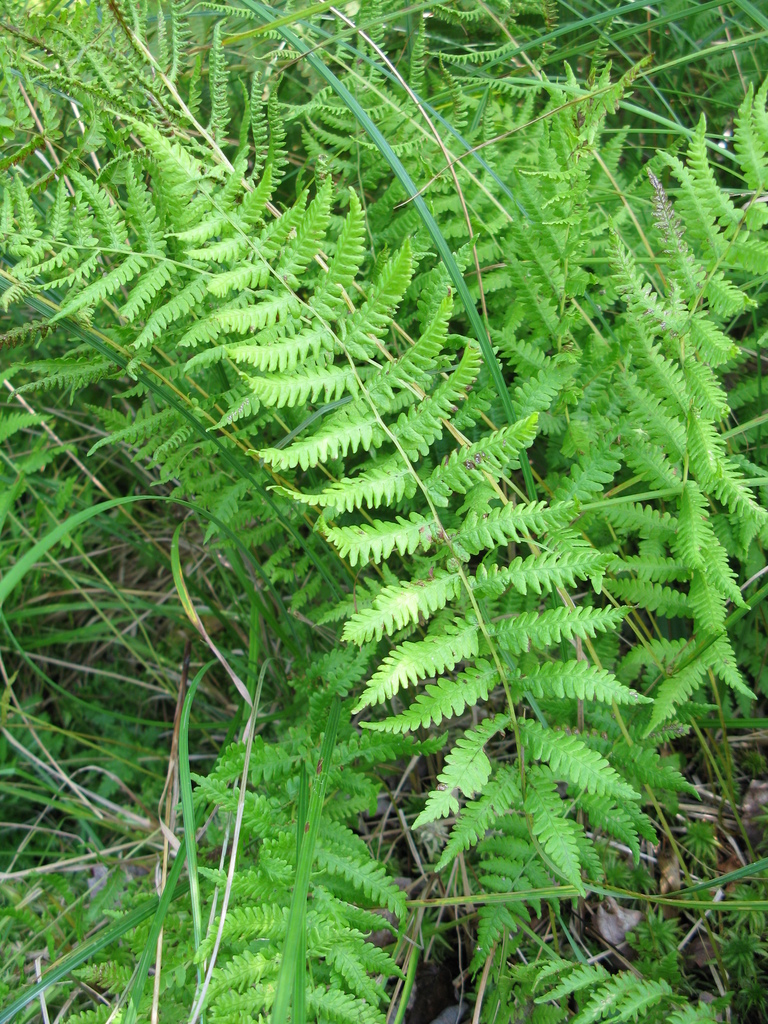
Massachusetts fern
Coryphopteris simulata
Coryphopteris simulata, synonym Thelypteris simulata, is a species of fern native to the Northeastern United States. It is known by two common names: bog-fern and Massachusetts fern. It is often confused with the silvery spleenwort, New York fern, and the marsh fern due to similarities in shape and size.
From the article Coryphopteris simulata on Wikipedia (CC BY-SA), quoted section by section
Description
Coryphopteris simulata is bright green in color. The frond has some variation in shape, but it is around 61 cm (24 in) long, and its stalk is long and slender at 20.3 cm (8 in). The stalks are thin and slightly scaly, or hairy. The upwards portion is yellow-green in color, and the base is a light brown color. The leaves are monomorphic and pinnately compounded; they can be between 10 and 40 cm (3.9-15.7 in) long and 7.6-15.3 cm (3–6 in) wide. The branching pattern appears to be opposite, but upon close observation it is clearly a slight alternate pattern. The leaf veins are for the most part unbranched, although some branching can be seen towards the lower part of the blade.
Coryphopteris simulata produces both fertile and sterile leaflets. The leaflets are twice-compounded and divided mid-vein into between fifteen and eighteen lobes. They are oblong in shape and become narrower near the axis, noticeably more so near the base. The majority of the leaflets are erect, but the bottom pair point downward. They are around 25–80 cm (9.8-31.5 in) long. The fertile and sterile leaflets are similar in shape in size, but the fertile leaflets tend to be slightly longer than the sterile leaflets. Sori (singular sorus), are found on the underside of the leaflets, and they are round in shape. …
Range & habitat
Coryphopteris simulata is a terrestrial plant native to Eastern Canada (New Brunswick, Nova Scotia, Ontario and Québec), the North-Central United States (Wisconsin), the Northeastern United States (Connecticut, Maine, Massachusetts, New Hampshire, New Jersey, New York, Pennsylvania, Rhode Island, Vermont and West Virginia) and the Southeastern United States (Alabama, Delaware, the District of Columbia, Maryland, North Carolina, Tennessee and Virginia). The isolated patch discovered in southwestern Wisconsin was far outside its expected distribution. Generally speaking, this plant is uncommon.
Wikipedia: “Distribution”
What it does
Coryphopteris simulata grows in shaded, marshy wetlands and bog areas such as cedar, spruce, larch, and sphagnum swamps. It likes to grow among bryophytes, particularly Sphagnum. It prefers and is most often found in moist, acidic soil that is soft and spongy.
== References ==
Wikipedia: “Ecology”
Where it lives
Recorded sightings
—
geo-referenced records in GBIF, from museums, herbaria and field observers.
Drag the globe to turn it. Dots are where records exist, not a range map; darker means more records.
In the stacks
Searching the stacks…
Every page naming Coryphopteris simulata in the Biodiversity Heritage Library →
This page is assembled live from iNaturalist, GBIF, Wikipedia, the Source Library and the Internet Archive. It is not yet part of the hand-edited codex. iNaturalist taxon 1294081.