- Plants
- ›Vascular Plants
- ›flowering plants
- ›Dicots
- ›beeches, oaks, walnuts, and allies
- ›Southern Beeches
- ›Nothofagus
- ›Lophozonia
Australian beech
Nothofagus moorei
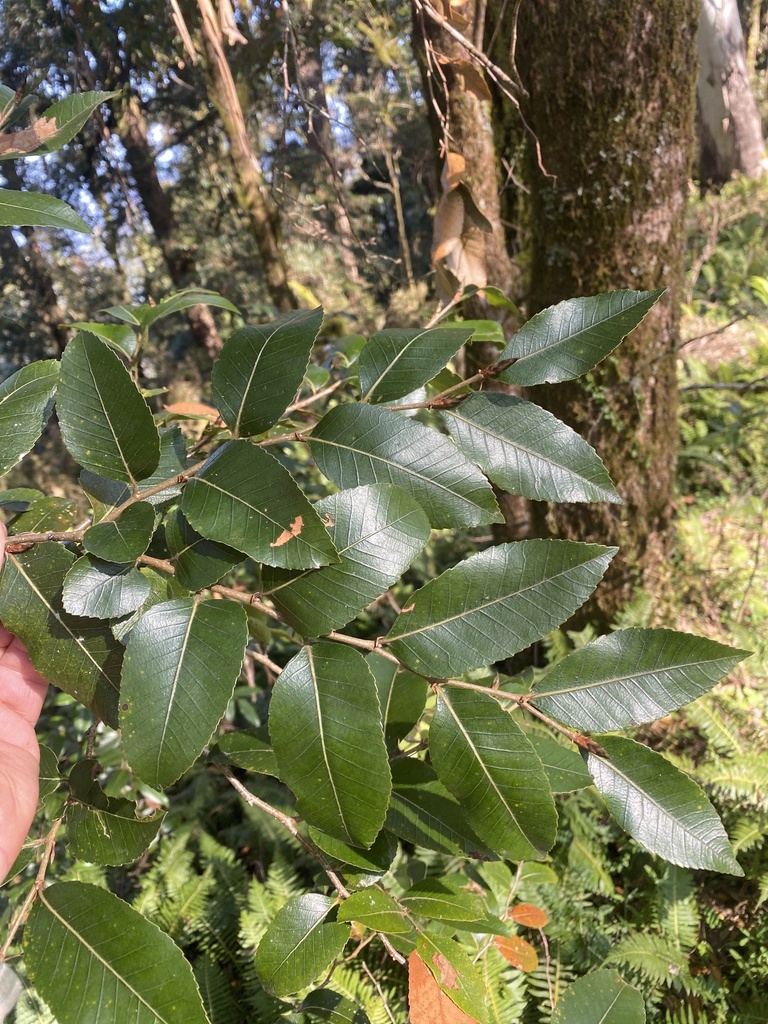
Nothofagus moorei, commonly known as Antarctic beech, is a species of flowering plant in the family Nothofagaceae that is endemic to high elevation areas of eastern Australia. It is a tree, with simple leathery, glossy, egg-shaped to lance-shaped leaves.
From the article Nothofagus moorei on Wikipedia (CC BY-SA), quoted section by section
Description
Nothofagus moorei is a tree that typically grows to a height of up to 50 m (160 ft), often with a massive trunk up to 1.5 m (4 ft 11 in) in diameter, with suckers at the base. The leaves are simple, more or less egg-shaped to elliptic or lance-shaped, mostly 30–100 mm (1.2–3.9 in) long, glossy, leathery and more or less glabrous on a petiole 3–5 mm (0.12–0.20 in) long. New leaves in spring are reddish-brown to red. Male flowers are in rounded or flattened clusters about 10 mm (0.39 in) in diameter, with up to three flowers with a total of 15 to 40 stamens surrounded by 8 to 12 bracts, forming a cup-shaped structure. Female flowers are in oval clusters of three about 5 mm (0.20 in) long, and are more or less sessile, surrounded by an involucre of bracts. Flowering occurs in spring, but not every year, and the fruit is a prickly cupule 8–10 mm (0.31–0.39 in), containing one or two nuts.
Range & habitat
Antarctic beech grows in cool temperate rainforests from the Barrington Tops plateau in New South Wales, north to the Lamington Plateau and Springbrook Plateau, in southern Queensland, between altitudes of 480 m and 1550 m. It occurs in temperate to cool temperatures and with occasional snowfalls. Antarctic beech achieves its finest development at Werrikimbe National Park and Mount Banda Banda.
Comboyne. There are four known populations of the Antarctic beech in the Comboyne area of New South Wales. In 1925, the botanist E.C. Chisholm wrote that the Antarctic Beech at Comboyne was "extremely rare, although many trees were undoubtedly destroyed during clearing." The Comboyne Plateau was mostly cleared between 1900 and 1925. The Comboyne plateau is a scarp-bounded paleoplain located between the Mid North Coast of New South Wales and the Great Dividing Range. Miocene basalts overlie much of the plateau, creating relatively fertile red/brown soils. In the southern third of the plateau are underlying Triassic sediments of the Lorne basin. The plateau has a wet, sub tropical climate, though subject to frost and occasional snow. The population at Comboyne was considered likely to be extinct by the scientific community, until published in 1994 by the botanists Bale and Williams. …
Wikipedia: “Distribution and habitat”
In human culture
At one time it was assumed that the Eastern Australian populations of this tree could not reproduce in present-day conditions, except by suckering (asexual reproduction), being remnant forest from a cooler time. It has since been shown that sexual reproduction may occur, but distribution in cool, isolated high-altitude environments at temperate and tropical latitudes is consistent with the theory that the species was more prolific in a cooler age. The pattern of distribution around the southern Pacific Ocean rim dates the dissemination of the genus to the time when Antarctica, Australia and South America were connected, the theoretical common land-mass referred to as Gondwana.
It is an ornamental tree and cultivated specimens tolerate −7 °C (19 °F), though wild plants growing on Barrington Tops have withstood record low temperatures of −17 °C (1 °F), no source provenance have been selected from there and other mountains, highlands or plateaus for cultivation.
Wikipedia: “History”
Where it lives
Recorded sightings
—
geo-referenced records in GBIF, from museums, herbaria and field observers.
Drag the globe to turn it. Dots are where records exist, not a range map; darker means more records.
In the stacks
Searching the stacks…
Every page naming Nothofagus moorei in the Biodiversity Heritage Library →
This page is assembled live from iNaturalist, GBIF, Wikipedia, the Source Library and the Internet Archive. It is not yet part of the hand-edited codex. iNaturalist taxon 129481.