- Plants
- ›Vascular Plants
- ›flowering plants
- ›Dicots
- ›Soapberries, Cashews, Mahoganies, and Allies
- ›mahogany family
- ›Aglaia
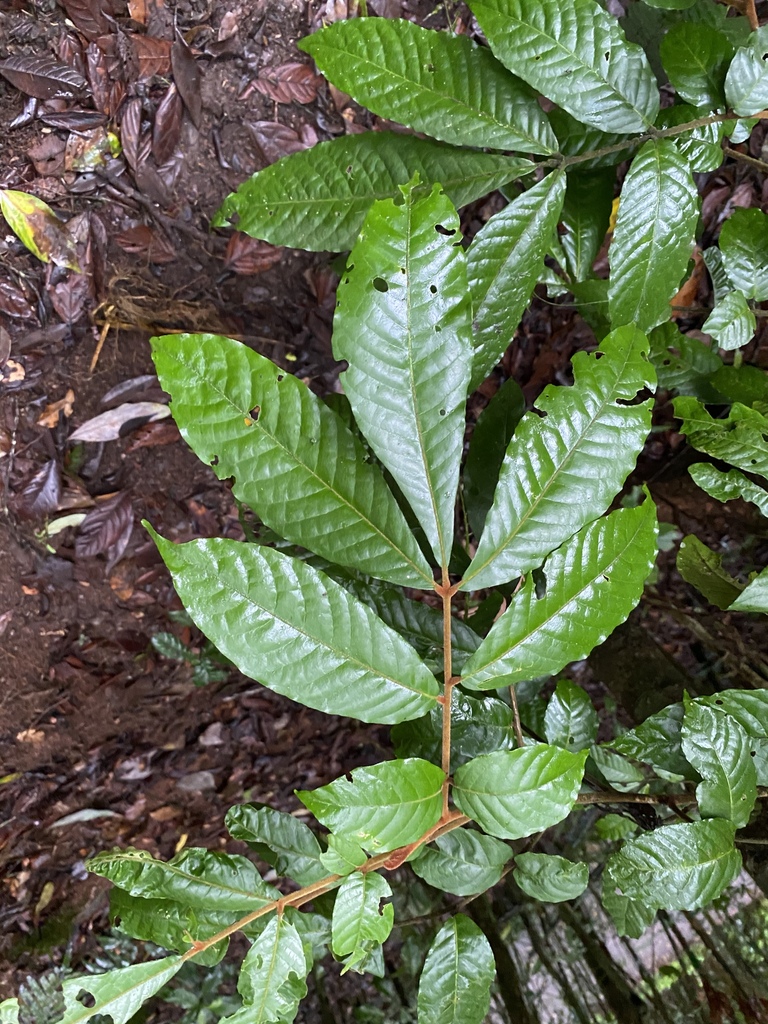
Aglaia ferruginea
Aglaia ferruginea, commonly known as rusty boodyarra or rusty Aglaia, is a plant in the mahogany family Meliaceae that is native to northern Queensland, Australia. The name A. tomentosa has been misapplied to the species in the past.
From the article Aglaia ferruginea on Wikipedia (CC BY-SA), quoted section by section
Description
Aglaia ferruginea is a small tree growing to a height of about 15 m (49 ft). Branchlets, twigs, leaf stems (petioles), midribs of the compound leaves, floral and fruiting structures, and the fruit itself are all covered in a dense indumentum of red-brown to orange-brown hairs, while other parts such as the lower leaf surfaces have a more moderate covering. The compound leaves may reach up to 60 cm (24 in) long with between 5 and 11 leaflets, each measuring up to 15 cm (5.9 in) long by 6 cm (2.4 in) wide. The leaflets may have up to 25 pairs of lateral veins and are held on very short stalks. The inflorescences are panicles up to 18 cm (7.1 in) long, produced from the leaf axils. They carry numerous small white or yellow flowers about 4 mm (0.2 in) long. The outer surface of the calyx is hairy while the five petals are glabrous (hairless). The fruit is, in botanical terminology, a berry, yellow or orange, indehiscent, ellipsoidal, rusty-hairy, with two locules each with one or no seed.
Phenology. Flowering occurs from October to February, and fruit ripen from August to February.
Range & habitat
This species is found from the islands of the Torres Strait to the Atherton Tableland (including the adjacent coastal area). It is an understorey tree in well developed rainforest, at altitudes up to 1,000 m (3,300 ft).
Wikipedia: “Distribution and habitat”
What it does
The fruit are eaten by king parrots (Alisterus scapularis) and Victoria's riflebirds (Ptiloris victoriae).
Wikipedia: “Ecology”
In human culture
The genus is named after Aglaea (Ancient Greek: Ἀγλαΐα), one of the three Graces of Greek mythology. The species epithet ferruginea is a Latin word meaning 'rust coloured', referring to the indumentum on the branches and leaves.
Wikipedia: “Etymology”
Where it lives
Recorded sightings
—
geo-referenced records in GBIF, from museums, herbaria and field observers.
Drag the globe to turn it. Dots are where records exist, not a range map; darker means more records.
In the stacks
Searching the stacks…
Every page naming Aglaia ferruginea in the Biodiversity Heritage Library →
This page is assembled live from iNaturalist, GBIF, Wikipedia, the Source Library and the Internet Archive. It is not yet part of the hand-edited codex. iNaturalist taxon 1295676.