- Plants
- ›Vascular Plants
- ›flowering plants
- ›Dicots
- ›Sunflowers, Bellflowers, Fanflowers, and Allies
- ›Sunflowers, Daisies, Asters, and Allies
- ›Asteroideae
- ›asters and allies
- ›Symphyotrichinae
- ›Symphyotrichum
- ›Symphyotrichum
- ›Symphyotrichum
- ›Heterophylli
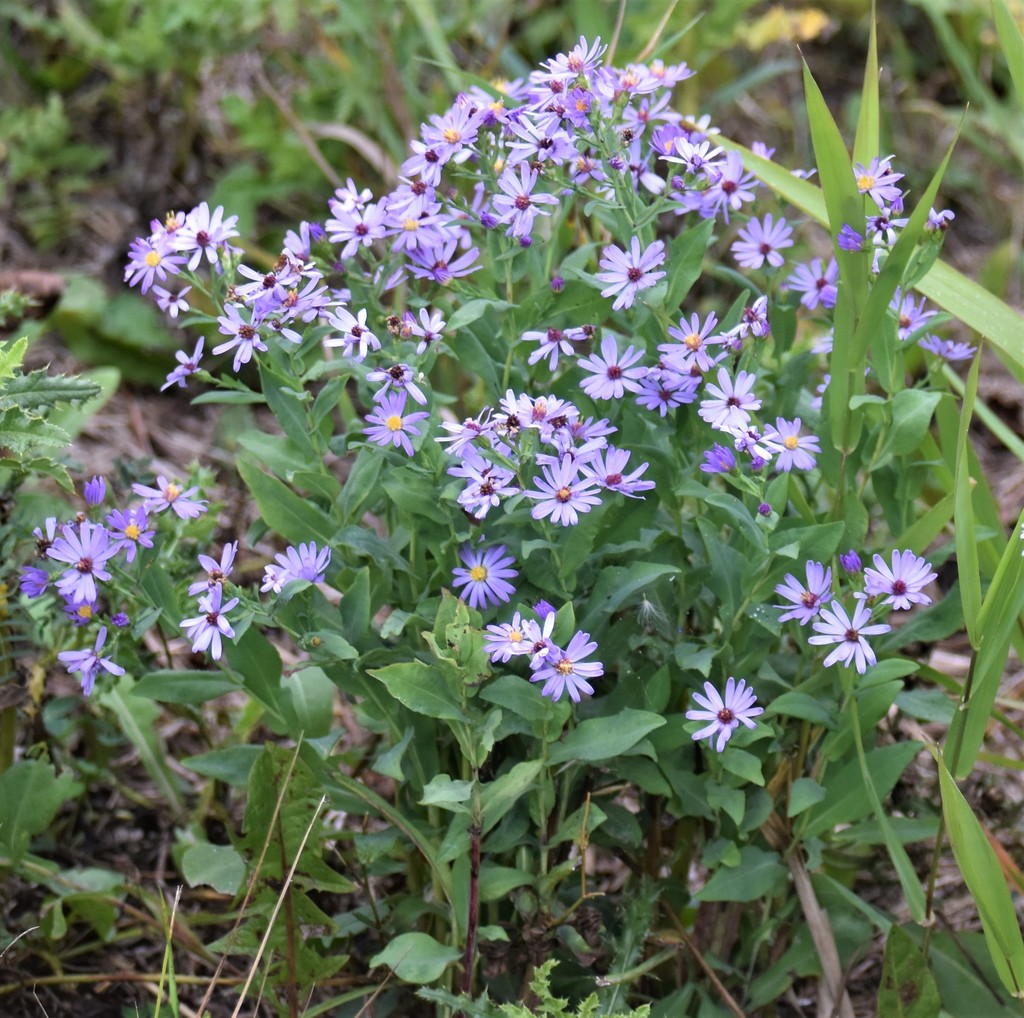
smooth blue aster
Symphyotrichum laeve
Symphyotrichum laeve (formerly Aster laevis) is a flowering plant native to Canada, the United States, and Coahuila (Mexico). It has the common names of smooth blue aster, smooth aster, smooth-leaved aster, glaucous Michaelmas-daisy and glaucous aster.
From the article Symphyotrichum laeve on Wikipedia (CC BY-SA), quoted section by section
Description
Smooth aster is 20 to 70 centimeters (8 to 28 inches) tall. Its leaves are arranged alternately on the stems, and their shape varies among lanceolate, oblong-ovate, oblong-obovate, and ovate. They measure from 3 to 20 centimeters (1 to 8 inches) long and from 1 to 2.5 cm (3⁄8 to 1 in) wide. They are usually hairless, and the leaf edges are entire or bluntly or sharply toothed (crenate or serrate), sometimes with smaller teeth (serrulate).
The flower heads are arranged in clusters (panicles). Each flower head has 13 to 23 ray florets with pale to dark blue or purple petals (laminae), and 19 to 33 disc florets that start out yellow and eventually turn purplish-red. The whole flowerhead measures 13 to 25 millimeters (1⁄2 to 1 in) across.
The seeds are cypselae with pappi (bristles at their tips). Like the hairs on dandelion seeds, the pappi allow the seeds to be spread by the wind.
Range & habitat
Symphyotrichum laeve varieties are native to Canada, the United States, and Coahuila (Mexico). The species is introduced in Québec and New Brunswick. Symphyotrichum laeve grows in fields, open woods, and along roadsides in rocky or dry soil and full sun.
Wikipedia: “Distribution and habitat”
What it does
Symphyotrichum laeve blooms in late summer and early fall. It is pollinated by many native bees and attracts butterflies. It is a larval host for the pearl crescent butterfly (Phyciodes tharos).
Wikipedia: “Ecology”
Where it lives
Recorded sightings
—
geo-referenced records in GBIF, from museums, herbaria and field observers.
Drag the globe to turn it. Dots are where records exist, not a range map; darker means more records.
In the stacks
Searching the stacks…
Every page naming Symphyotrichum laeve in the Biodiversity Heritage Library →
This page is assembled live from iNaturalist, GBIF, Wikipedia, the Source Library and the Internet Archive. It is not yet part of the hand-edited codex. iNaturalist taxon 129607.