- Fungi Including Lichens
- ›Basidiomycete Fungi
- ›Higher Basidiomycetes
- ›Mushrooms, Bracket Fungi, Puffballs, and Allies
- ›Agaricomycetidae
- ›Common Gilled Mushrooms and Allies
- ›Agaricineae
- ›Strophariaceae
- ›Hypholoma
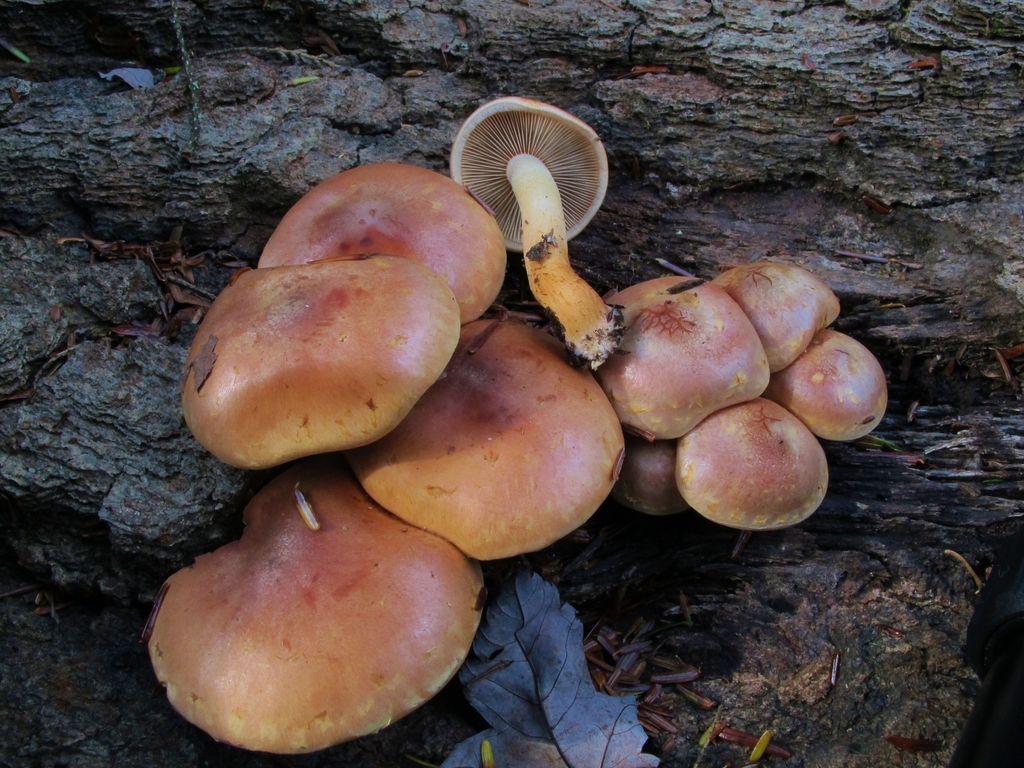
Brick Cap
Hypholoma lateritium
Hypholoma lateritium, sometimes called brick cap, is rarer and less well-known than its relatives, the inedible, and poisonous sulfur tuft (Hypholoma fasciculare) and the edible Hypholoma capnoides. Its fruiting bodies are generally larger than either of these. Hypholoma sublateritium is a synonym.
From the article Hypholoma lateritium on Wikipedia (CC BY-SA), quoted section by section
Description
The cap is 3.5–9 centimetres (1+1⁄2–3+1⁄2 in) in diameter, usually with a brick-red coloration in the center and a paler margin. It is smooth, sometimes with red-brown flecks in the middle and sometimes with flaky veil remnants, which can easily be washed off in the rain, on the outside. The gills are crowded, starting yellowish and becoming grayish with age. They do not have the green color of Hypholoma fasciculare. The stipe is up to 12 cm (4+3⁄4 in) long, light yellow and darker below. The spore print is purple-brown. The spores have a germ pore and are 6.0–7.5 × 3.5–4.0 μm, ellipsoid; smooth; thin-walled. Pleurocystidia are abundant, fusoid-ventricose to mucronate, and up to 40 x 10 μm. Cheilocystidia are fusoid-ventricose, cylindric or irregular, with subcapitate apices; hyaline; thin-walled; up to 35 x 8 μm.
Similar species. It could be confused with highly toxic species such as Galerina marginata or Hypholoma fasciculare. It can also resemble Pholiota mixta and members of Pyrrhulomyces.
Range & habitat
In Pennsylvania, New Jersey, and West Virginia they are found in dense clusters on stumps and roots from October until long after frosts.
Wikipedia: “Distribution and habitat”
At the table
Hypholoma lateritium is sometimes considered edible but caution must be taken to avoid confusing it with similar-looking deadly species. In Europe the species is often considered inedible or even poisonous. Specimens are best when collected young; older specimens tend to be bitter from being fouled by insects. The taste is mild to somewhat bitter, but when cooked the mushrooms have a nutty flavor. They are especially delicious when sauteed in olive oil. Brick tops have been considered one of the better edibles of late fall in the Northeast United States. It is considered a choice edible in Japan.
Wikipedia: “Edibility”
Where it lives
Recorded sightings
—
geo-referenced records in GBIF, from museums, herbaria and field observers.
Drag the globe to turn it. Dots are where records exist, not a range map; darker means more records.
In the stacks
Searching the stacks…
Every page naming Hypholoma lateritium in the Biodiversity Heritage Library →
This page is assembled live from iNaturalist, GBIF, Wikipedia, the Source Library and the Internet Archive. It is not yet part of the hand-edited codex. iNaturalist taxon 130203.