- Plants
- ›Vascular Plants
- ›flowering plants
- ›Dicots
- ›Sunflowers, Bellflowers, Fanflowers, and Allies
- ›Sunflowers, Daisies, Asters, and Allies
- ›Asteroideae
- ›asters and allies
- ›Solidagininae
- ›Solidago
- ›Pleiactila
- ›Unilaterales
- ›Junceae
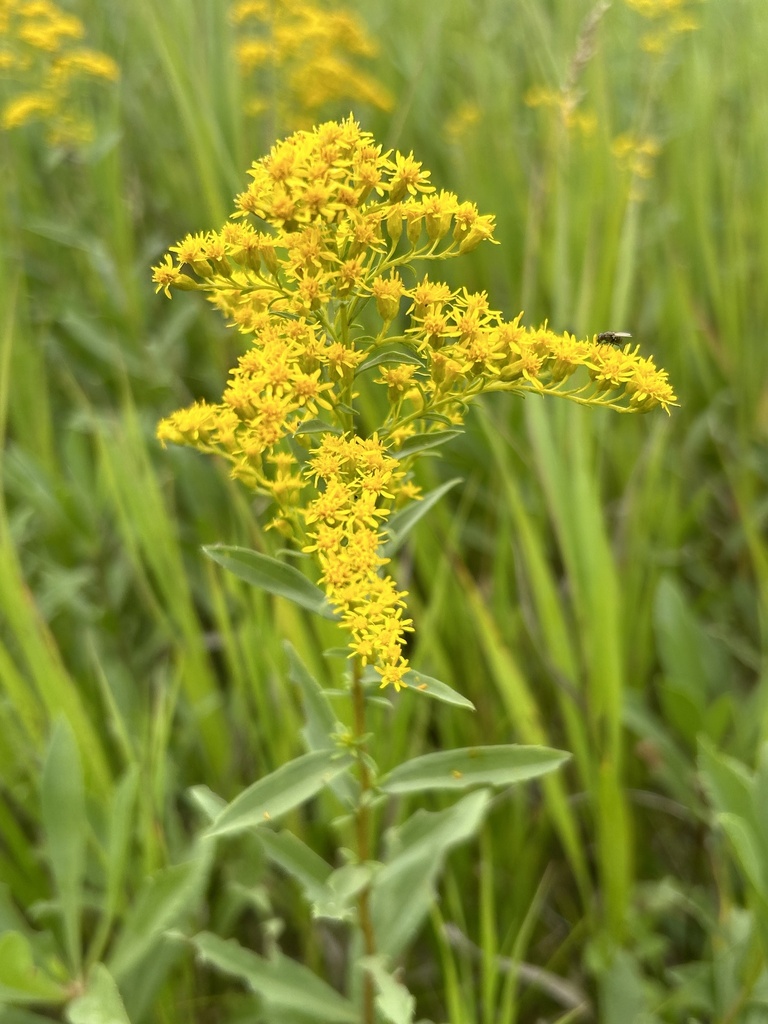
Missouri goldenrod
Solidago missouriensis
Solidago missouriensis is a species of flowering plant in the family Asteraceae known by the common names Missouri goldenrod and prairie goldenrod. It is native to North America, where it is widespread across much of Canada, the United States, and northern Mexico. It grows from British Columbia east to Manitoba, south as far as Sonora, Coahuila, Texas, and Mississippi.
From the article Solidago missouriensis on Wikipedia (CC BY-SA), quoted section by section
Description
Solidago missouriensis is variable in appearance, and there are a number of varieties. In general, it is a perennial herb growing from an underground caudex or rhizome, or both. It reaches one meter (40 inches) in maximum height. The roots may reach 2 m (6.6 ft) deep in the soil. The rigid leaves are up to 30 centimeters (12 inches) long, becoming smaller farther up the stem. The inflorescence is a branching panicle of many yellow flower heads at the top of the stem, sometimes with over 200 small heads. Each head contains about 5-14 yellow ray florets a few millimeters long surrounding 6-20 disc florets. The fruit is an achene tipped with a pappus of bristles.
Range & habitat
Solidago missouriensis can be found in many types of habitat. It is common on the Great Plains. It grows preferably in dry, open habitat and can occur at high elevations. It colonizes disturbed soils. During the Dust Bowl-era drought, when many of the native grasses and plants died, the goldenrod flourished in the dry, cleared soil. As the drought ended and the grasses returned, the goldenrod became less common, disappearing in many areas. It grows in soils turned over by burrowing animals and on roadsides and mining sites. The goldenrod is common in a number of regions, including tallgrass prairie in west-central Missouri, sandhills prairie in southeastern North Dakota, the Cypress Hills of southeastern Alberta, riparian habitat in northwestern Montana, and the sand barrens of northern Wisconsin.
Galls. This species is host to the following insect induced gall:
Asteromyia carbonifera (Osten Sacken, 1862) external link to gallformers
== References ==
Wikipedia: “Distribution and habitat”
Where it lives
Recorded sightings
—
geo-referenced records in GBIF, from museums, herbaria and field observers.
Drag the globe to turn it. Dots are where records exist, not a range map; darker means more records.
In the stacks
Searching the stacks…
Every page naming Solidago missouriensis in the Biodiversity Heritage Library →
This page is assembled live from iNaturalist, GBIF, Wikipedia, the Source Library and the Internet Archive. It is not yet part of the hand-edited codex. iNaturalist taxon 130378.