- Animals
- ›Chordates
- ›Vertebrates
- ›Reptiles
- ›Turtles and Tortoises
- ›Side‑necked turtles
- ›Austro-American Side-necked Turtles
- ›Australasian Side-necked Turtles
- ›Chelodina
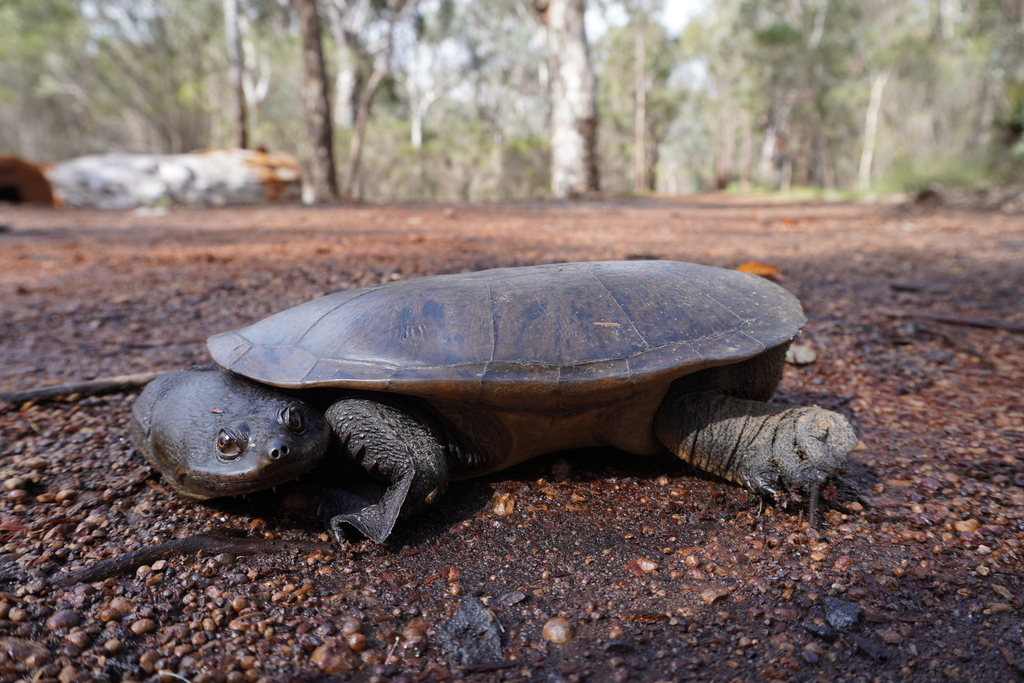
Southwestern Snake-necked Turtle
Chelodina oblonga
The oblong turtle (Chelodina oblonga), also known commonly as the narrow-breasted snake-necked turtle, southwestern snake-necked turtle, (western) long-neck(ed) turtle, and as yaakan or booyi in Noongar language, is a species of turtle in the family Chelidae. The species is endemic to the southwestern part of Western Australia.
The species has been successfully bred in captivity in Cologne Zoological Garden and was once largely bred in captivity for the pet trade in Western Australia. There’s currently not enough research to determine the species’ exact lifespan, but it’s widely agreed upon that they live for at least 40 years, with many reports indicating they likely live for up to twice that long.
From the article Oblong turtle on Wikipedia (CC BY-SA), quoted section by section
Description
Adults: female carapace length is larger than that of males, reaching lengths of up to 40cm. Combined with their head and neck length, a female may reach lengths of over 80cm in total body size. Males have an average carapace length of 25-28cm and reach sexual maturity when their carapace is approximately 140mm, while females reach maturity at a carapace length of 160-170mm. Hatchlings: no ethical, non-invasive methods of sex determination are known for hatchlings, which very rarely display significant size variation between individuals of the same or separate nest. Upon emerging from their nest, hatchlings are typically 29-33mm.
Range & habitat
The natural distribution of the oblong turtle is southwestern Australia, from the Fitzgerald River National Park in the south-eastern edge of the distribution, up to Jurien Bay (Hill River) in the north. There is also a suspected introduced population around Geraldton, another 170 km north of Jurien Bay. There is a slight overlap of native geographical range with the Flat-shelled turtle (Chelodina steindachneri), however there has only been one recorded occurrence of the two species co-existing in the same waterbody. The oblong turtle lives in a wide range of freshwater habitats, including wetlands, lakes and rivers. They are known to be capable of living in urban and agricultural environments, such as urban lakes and dams. The turtle is an opportunistic carnivore and the apex predator of the wetlands within its native range. Using their distinct "snake-neck" they deploy a recoil and strike technique to capture prey, feeding mainly on macro-invertebrates such as yabbies, fish, tadpoles, frogs, ducklings and carrion, usually that of the noxious European carp. Hatchlings feed on mosquito larvae and other small aquatic invertebrates.
Wikipedia: “Distribution, habitat and diet”
In human culture
The specific name/epithet, oblonga, comes directly from the Latin word oblonga (or oblongum), meaning "long, elongated, or oblong." This refers to the oblong-shaped shell of the species.
Wikipedia: “Etymology”
Where it lives
Recorded sightings
—
geo-referenced records in GBIF, from museums, herbaria and field observers.
Drag the globe to turn it. Dots are where records exist, not a range map; darker means more records.
In the stacks
Searching the stacks…
Every page naming Chelodina oblonga in the Biodiversity Heritage Library →
This page is assembled live from iNaturalist, GBIF, Wikipedia, the Source Library and the Internet Archive. It is not yet part of the hand-edited codex. iNaturalist taxon 1304684.