- Animals
- ›Arthropods
- ›Hexapods
- ›Insects
- ›Winged and Once-winged Insects
- ›Beetles
- ›Water, Rove, Scarab, Long-horned, Leaf, and Snout Beetles
- ›Scarabaeiform Beetles
- ›Scarabs, Stag Beetles, and Allies
- ›Scarabs
- ›June Beetles
- ›Macrodactylini
- ›Macrodactylus
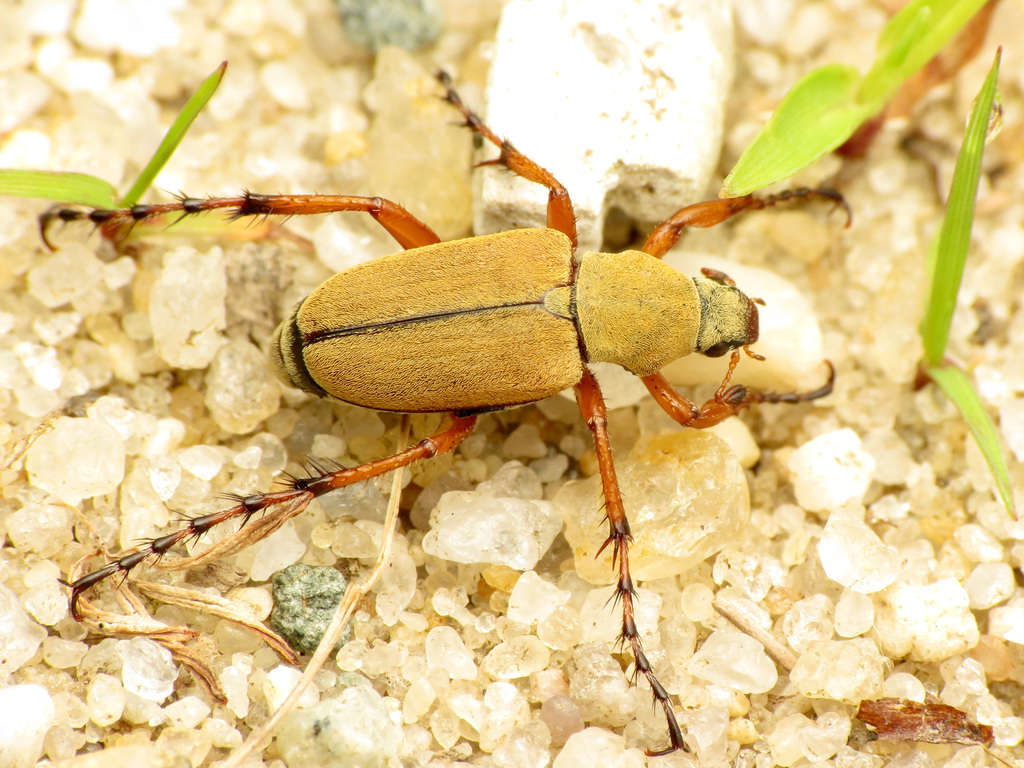
American Rose Chafer
Macrodactylus subspinosus
Macrodactylus subspinosus is a North American beetle of the family Scarabaeidae. It is one of at least two beetles in this family known as the "rose chafer", the other being the European Cetonia aurata. M. subspinosus occurs from Eastern Canada to Colorado and is considered a pest of many crops and flowers. It is given its common name of rose chafer because it eats the leaves of roses, although it also feeds on many other plants.
From the article Macrodactylus subspinosus on Wikipedia (CC BY-SA), quoted section by section
Description
The rose chafer has a yellowish-tan coloured body that is about 8–13 millimetres (0.3–0.5 in) in length, with wings that do not completely cover the abdomen. The beetle has six long, spiny, reddish-brown legs that gradually become darker towards the end of the appendage. It has two short lamellate antennae that end in a club of flat plates and it has chewing mouthparts. Rose chafers are covered in dull yellow hairs which give the body its characteristic colour, however with age and with normal activity the hairs are worn off the head and thorax revealing a black colour. It is thus possible to distinguish between older and younger beetles, as older beetles will have fewer hairs and thus be darker in colour. Females tend to lose more hairs, especially on the thorax due to the mating process, and can also appear darker in colour. Females also tend to be more robust than the male. The eggs of the rose chafer are about 1 mm in length and are oval, white and shiny. The larvae are white C-shaped grubs that when mature develop a brown head capsule and three distinct pairs of legs. The pupae are yellowish-brown in colour and are about 15 mm in length.
What it does
As a member of the order Coleoptera, the rose chafer undergoes complete metamorphosis during its development. In late May, white-bodied larvae, about 18 millimetres (0.7 in) long, pupate after having overwintered deep in the soil. Once they have emerged from their pupal case, adults live for 3–6 weeks, during which time they will feed on plant material and mate. Their eggs are laid in sandy soils, 15 centimetres (6 in) deep, and hatch in 1–3 weeks. This new generation of larvae will feed on the roots of grasses, weeds, and some ornamental garden plants during the rest of the summer, before they burrow deep in the soil to overwinter; these larvae will emerge as adults in the following year.
Wikipedia: “Life cycle”
Listen
Looking for field recordings…
Where it lives
Recorded sightings
—
geo-referenced records in GBIF, from museums, herbaria and field observers.
Drag the globe to turn it. Dots are where records exist, not a range map; darker means more records.
In the stacks
Searching the stacks…
Every page naming Macrodactylus subspinosus in the Biodiversity Heritage Library →
This page is assembled live from iNaturalist, GBIF, Wikipedia, the Source Library and the Internet Archive. It is not yet part of the hand-edited codex. iNaturalist taxon 130504.