- Animals
- ›Arthropods
- ›Hexapods
- ›Insects
- ›Winged and Once-winged Insects
- ›Grasshoppers, Crickets, and Katydids
- ›Katydids, Crickets, and Allies
- ›Katydids, wētā, and allies
- ›Tettigonioidea
- ›Katydids
- ›Leaf Katydids
- ›Barbitistini
- ›Leptophyes
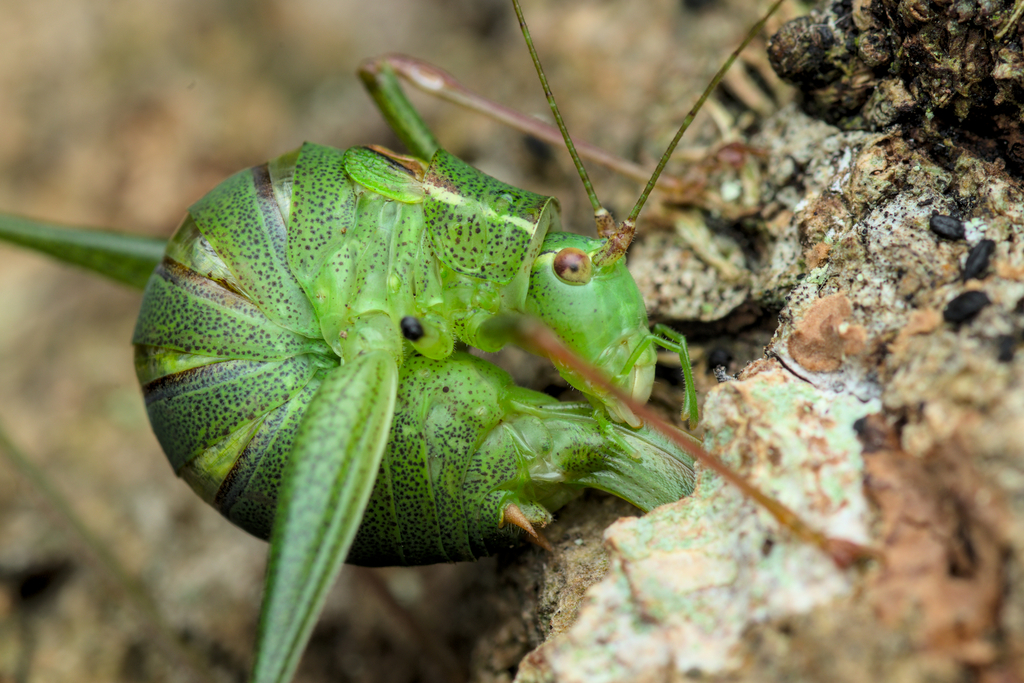
Speckled Bush-cricket
Leptophyes punctatissima
The speckled bush-cricket (Leptophyes punctatissima) is a flightless species of bush-cricket belonging to the family Tettigoniidae. The species was originally described as Locusta punctatissima in 1792.
From the article Speckled bush-cricket on Wikipedia (CC BY-SA), quoted section by section
Description
The speckled bush-cricket can reach a body length of about 10–15 mm (0.39–0.59 in). It is green with minute black speckles all over its body (more evident in the nymphs), as reflected in the common and Latin name of the species. Its colouring and secretive lifestyle, hidden away in the undergrowth, means that it often passed unnoticed. The dorsal surface of the abdomen features an orange-brown stripe; this is more pronounced in the male than the female. A yellow-white stripe extends backwards from the eyes. The lower legs and feet are brownish. The antennae are twice as long as the body. The species is brachypterous meaning the male's forewings are reduced to small flaps, and those of the female are even more reduced. The hindwings are completely absent, and both males and females are flightless. The female's ovipositor is laterally compressed and curves sharply upwards.
Range & habitat
The speckled bush-cricket is common across much of Europe. It ranges from the British Isles, France, Poland and Belgium in the west to the European parts of Russia in the east, and from southern Scandinavia in the north to southern Italy, Bulgaria and Greece. It has been recorded as far south as Israel. It is also present in the Nearctic realm.
Wikipedia: “Distribution”
What it does
After reaching sexual maturity around early August, males and females will call out to locate each other. Once found, the female remains stationary while the male pushes himself beneath her. If she rejects him, she will simply move away. During copulation, the male produces a spermatophore which is surrounded in a edible substance called spermatophylax. Unlike other cricket species, this substance provides no nutritional value and is, instead, thought to protect the sperm from being removed prematurely as well as distract the female from other males. It can take the female between 12 minutes and 2 hours to completely eat the spermatophore. Males will not mate again for at least 24 hours. The female may start laying eggs as soon as the night after mating. She lays her eggs in tree bark or plant stems. The amount of eggs and how often they are laid over her lifespan varies considerably. For example, some bush-crickets have been observed laying one egg per week, while others were observed laying three eggs per day. Females have been recorded laying between 10 and 185 eggs in their lifetime.
Wikipedia: “Reproduction”
Listen
Looking for field recordings…
Where it lives
Recorded sightings
—
geo-referenced records in GBIF, from museums, herbaria and field observers.
Drag the globe to turn it. Dots are where records exist, not a range map; darker means more records.
In the stacks
Searching the stacks…
Every page naming Leptophyes punctatissima in the Biodiversity Heritage Library →
This page is assembled live from iNaturalist, GBIF, Wikipedia, the Source Library and the Internet Archive. It is not yet part of the hand-edited codex. iNaturalist taxon 131035.